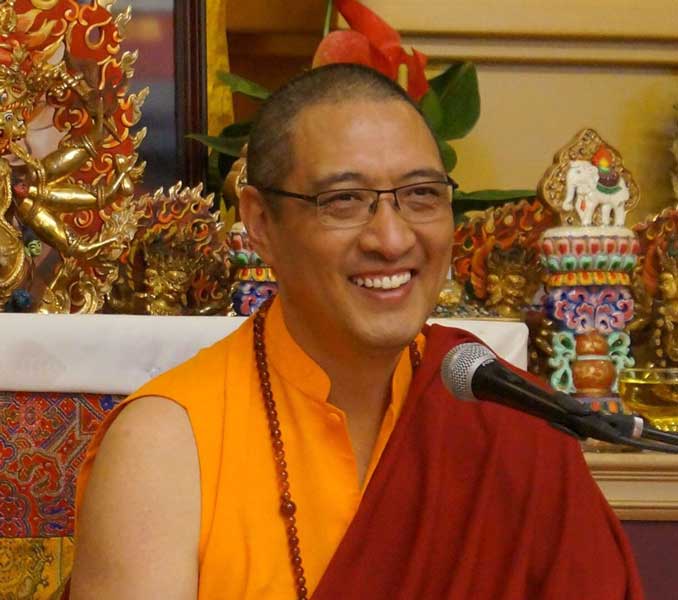
Professor Douglas Duckworth has received a distinguished research grant for his achievements in the field. Join with other scholars and translators in the field who will celebrate and discuss Shantideva’s classic text The Way of the Bodhisattva (Bodhicaryāvatāra) and its Tibetan Commentaries.
Join us for a roundtable discussion on one of the most important works of Buddhist literature that has now become one of the most popular western Buddhist books in translation, The Way of the Bodhisattva.
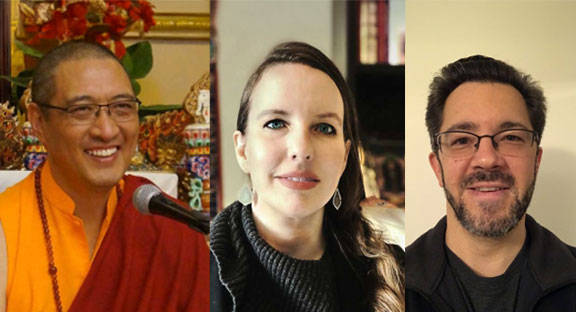
With Doulgas Duckworth, José Cabezón, Jonathan Gold, and Wulstan Fletcher.
3 PM Eastern Time, 12 Pacific, Tuesday, March 23rd.
Douglas Duckworth will present his ongoing work on Künzang Sönam’s commentary on The Way of the Bodhisattva and then we will have a roundtable discussion and responses from José Cabezón, Jonathan Gold, and Wulstan Fletcher.
Awarding the Tsadra Foundation Distinguished Research Grant in Tibetan Buddhist Studies
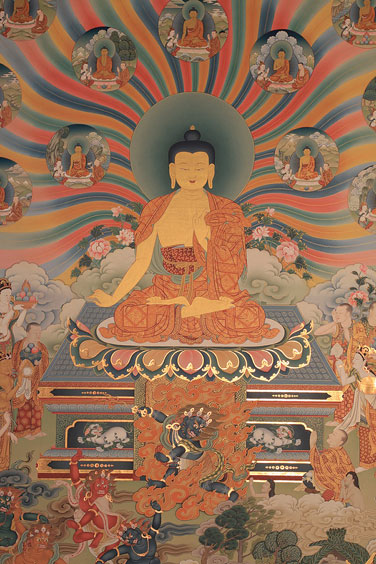
Śāntideva’s eighth-century work, the Guide to Bodhisattva Practice (Bodhicaryāvatāra), is known for its eminently practical instructions and its psychologically vivid articulations of the Mahāyāna path. It is a powerful, succinct poem into which are woven diverse Buddhist traditions of moral transformation, meditative cultivation, and philosophical insight. Since its composition, it has seen continuous use as a ritual, contemplative, and philosophical manual, making it one of the crucial texts of the Buddhist ethical and philosophical tradition.
This book serves as a companion to this Indian Buddhist classic. The fifteen essays contained here illuminate the Guide’s many philosophical, literary, ritual, and ethical dimensions. Distinguished scholars discuss the historical significance of the text as an innovative piece of Indian literature, illuminate the important roles it played in shaping Buddhism in Tibet, and bring to light its contemporary significance for philosophy and psychology. Whether experienced or first-time students of Buddhist literature, readers will find compelling new approaches to this resonant masterpiece. (Source)
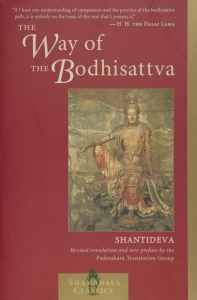
The Way of the Bodhisattva. Translated by Wulstan Fletcher and Helena Blankleder of the Padmakara Translation Group. Boulder: Shambhala Publications, 2006.
Often recommended as the best and most readable version of the text in English, Padmakara’s Way of the Bodhisattva is a joy to read and can also be listened to and studied with materials online from Shambhala Publications.
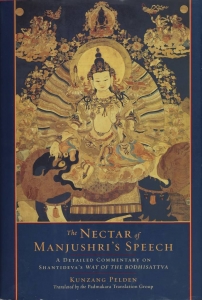
The Nectar of Manjushri’s Speech: A Detailed Commentary on Shantideva’s Way of the Bodhisattva by Kunzang Peldan. In this commentary, Kunzang Pelden has compiled the pith instructions of his teacher Patrul Rinpoche, the celebrated author of The Words of My Perfect Teacher.
Tsadra Foundation Dissertation Fellowship for Tibetan Buddhist Studies
Announcement!
We are happy to announce the recipients of our new grant for graduate students engaged in Tibetan Buddhist Studies at North American universities.
The recipients of the 2021 fellowship are:
Annie Heckman (University of Toronto)
Khenpo Yeshi (University of California, Berkeley)
Miguel Sawaya (University of Virginia)
This fellowship program provides one-year grants of $35,000 to graduate students at North American universities in order to support them in their pursuit of dissertation research focused specifically on Tibetan Buddhism. Dissertation research must include significant textual work on Tibetan Buddhist primary sources and include translation into English.
The purpose of the grant is not only to encourage more research in the area of Tibetan Buddhism but also to encourage the sharing of academic research with the larger world. Within one year of finishing the grant term, recipients will be required to submit an essay aimed at sharing their dissertation research with a nonacademic audience, with the purpose of advancing Buddhist literacy in North America and connecting educated readers with the research of academics on topics in Tibetan Buddhist studies.
The academic committee, composed of professors at major universities across North America who are leaders in the field, reviewed many detailed applications, deliberated and debated, and finally voted on these candidates from a shortlist of truly amazing scholars.
We wish to congratulate all of the applicants on their wonderful projects and look forward to seeing the fruits of their labors.
Learn More About the 2021 Dissertation Fellowship Recipients
Annie Heckman (University of Toronto)
Annie Heckman is a doctoral candidate in the University of Toronto’s Department for the Study of Religion and Book History and Print Culture collaborative program. Born in Chicago, Heckman studied in the arts (BFA University of Illinois at Chicago, 2002; MFA New York University, 2006), teaching at DePaul University before turning to Tibetan language and literature (University of Chicago Graham School, 2013–14; MA University of Toronto 2016). She contributes to Bird of Paradise Press in Virginia and reviews Dunhuang manuscripts at McMaster University, where she was an Ontario Visiting Graduate Student (2017– 2019). Her dissertation focuses on a Tibetan digest of narratives for nuns’ rules in the Mūlasarvāstivāda-vinaya.
Dissertation Topic: “Reassembling Discipline: A Study of Butön’s Compendium of Narratives for Nuns”
Khenpo Yeshi (University of California, Berkeley)
Khenpo Yeshi was born in 1969 in Nakchu, Tibet, and walked across the Himalayas to India as a refugee at the age of 20. There, he pursued studies at several monasteries of the Geluk, Kagyu, and Nyingma schools. After completing a three-year retreat, he taught both monks and westerners at Rangjung Yeshe Institute in Kathmandu, Nepal. In 2001, he moved to the United States and received a B.A. (2012) and an M.A. (2017) from UC Berkeley and is now a doctoral candidate. His research focuses on Tibetan Buddhism and the early development of the Great Perfection (rdzogs chen) Heart Essence (snying thig) tradition.
Dissertation Topic: “Seeing without Looking: The Eleven Topics and the Formation of Tibet’s Heart Essence”
Miguel Fares Sawaya (University of Virginia)
Miguel Sawaya holds a BA in Jazz Performance from UCLA and an MA in Indo-Tibetan Buddhism with Tibetan Language from Naropa University. After completing the year-long Translator Training Program at Rangjung Yeshe Institute, Kathmandu University’s Centre for Buddhist Studies, he worked there for six years as a Tibetan language instructor and interpreter for Buddhist philosophy courses taught by monastic instructors. He translates for the 84000 project under the auspices of the Dharmachakra Translation Committee, interprets for several Tibetan Buddhist teachers in a variety of contexts, and is currently pursuing doctoral studies in Buddhism at the University of Virginia.
Dissertation Topic: Tsele Natsok Rangrol’s contemplative practice material
Tsadra Foundation Dissertation Fellowship for Tibetan Buddhist Studies
Description and Purpose
We are happy to announce a new grant for graduate students engaged in Tibetan Buddhist Studies at North American universities. Apply by September 1st for the 2021 fellowship.
This fellowship program provides two, one-year grants to graduate students at North American universities in order to support them in their pursuit of dissertation research focused specifically on Tibetan Buddhism. Dissertation research must include significant textual work on Tibetan Buddhist primary sources and include translation into English. Two non-renewable grants of $35,000 are available each year beginning in 2021.
The purpose of the grant is not only to encourage more research in the area of Tibetan Buddhism but also to encourage the sharing of academic research with the larger world. Within one year of finishing the grant term, recipients will be required to submit an essay to the Foundation aimed at sharing their dissertation research with a nonacademic audience, with the purpose of advancing Buddhist literacy in North America and connecting educated readers with the research of academics on topics in Tibetan Buddhist studies. This essay may be published in a magazine or online publication by the recipient, or if no suitable venue is available, it will be published online on the Tsadra Foundation website. Recipients with exceptional research that is ready to be presented at academic venues may also apply for an additional small stipend to travel and present at conferences, meetings, or workshops.
Eligibility
Graduate students in doctoral programs in North America who are engaged in the study of Tibetan Buddhist texts, practices, and related topics.
A student is eligible to receive a fellowship if he or she:
Is a graduate student in good standing at an institution of higher education in North America who, when the fellowship begins, is admitted to candidacy in a doctoral program at that institution–applicants need not be currently ABD, but must have achieved candidacy by the time the grant period begins;
Possesses adequate skills in the language(s) necessary to carry out the dissertation project (i.e., Tibetan and possibly also Sanskrit, Chinese, Pali, or Mongolian.)
Duration of the Grant:
12 Months. The fellowship may not be renewed.
Terms and ConditionsA fellow shall:
Send a written report after six months and a final report to Tsadra Foundation detailing their progress;
Devote full time to research or writing on the approved dissertation topic;
Remain a student in good standing at his or her institution; and
Maintain satisfactory progress in the conduct of his or her research.
Grant recipients will also be expected to present their dissertation research in public at least once, as part of a workshop, conference, or event organized or supported by Tsadra Foundation. Additional funds will be made available for this, as needed.
Finally, as described above, recipients will be required to submit an essay aimed at sharing their dissertation work with a nonacademic audience. This essay may be published in a magazine or online publication by the recipient, or if no suitable venue is available, it will be published on the Tsadra Foundation website.
Applicant Information
Current Grant Applications for summer/fall 2021:
Application deadline: September 1st, 2020 – Notices will be sent by February 1st, 2021.
To receive this grant, applicants must complete requirements for candidacy in their PhD program by August 31st, 2021, or the start of their grant period, whichever is earlier.
The application review committee is composed of scholars in the field of Tibetan Buddhist studies with positions at major universities in North America.
A cover letter of no more than 1000 words explaining their dissertation research and the state of their dissertation work
Academic writing sample
Curriculum vitae
One letter of reference
No funding may be used for overhead at university institutions and programs. This grant may be held concurrently with other fellowships and grants and any academic appointments. There is no additional financial support for dependents.
Tsadra Foundation is in no way obligated to award any of the candidates who apply for this grant and a decision will be made by the members of the search committee after a thorough review of the submitted documents.
Selection Criteria
Significance of the topic and its potential contribution to Tibetan Buddhist studies
Potential for advancing the objective of public Buddhist literacy
Feasibility and clarity of work plan and likelihood of completing dissertation
This email will be viewable by the entire academic committee that will choose the grant recipients. If you have a simple question, please direct it to:
Tsadra Foundation Hosts Tibetan Language Intensive at CU, Boulder
UPDATE! The 2019 summer program was the last of these events.
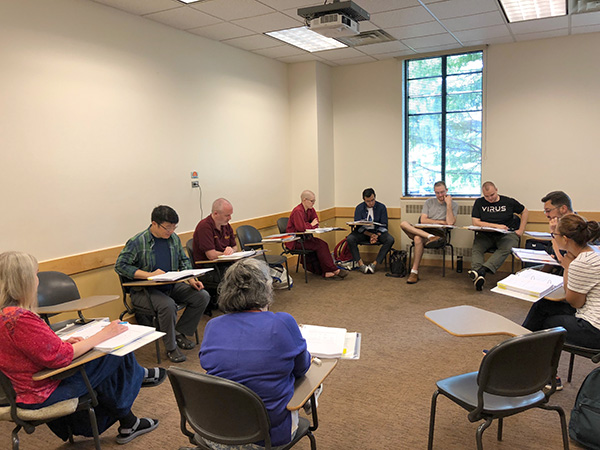
Tsadra Foundation’s first Summer Tibetan Language Intensive concluded on August 25, 2018 at the University of Colorado, Boulder. The course created an opportunity for twenty-four students who otherwise could not have afforded long breaks from work, family, or school–or travel to Asia–to experience a condensed and rigorous training with excellent language instructors and master translators.
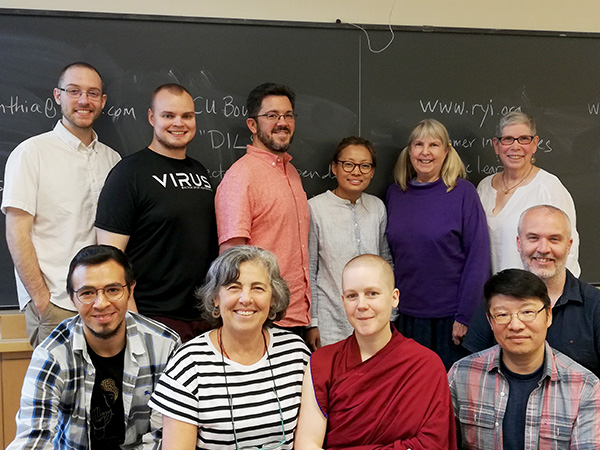
Students from as close as Boulder and as far from Colorado as Australia and Brazil traveled to attend the two-week-long intensive course. Three tracks–beginning, intermediate, and advanced–were taught by Lama Sarah Harding, Dr. Jules Levinson, Cinthia Font, Miguel Sawaya, and Tashi Choezom. Students were placed according to a self-assessment of their skill level with classical and colloquial Tibetan and each track was designed specifically to support the development of skills in both classical/literary and spoken Tibetan.
“The content was perfectly suited to me and our class. It was useful, inspiring!” -Advanced student
Advanced students spent their mornings with Sarah Harding working their way through Mendong Tsampa Rinpoche’s commentary on the famous Aspiration Prayer of Definitive Mahamudra (Chakchen Monlam) by the third Karmapa Rangjung Dorje, while the beginning and intermediate students focused on classical and colloquial Tibetan respectively.
Afternoons of the eleven-day course featured Jules Levinson working with the advanced students to develop skills in oral translation while the intermediate students worked through classical works like the Praise to Manjushri (གང་གི་བློ་གྲོས་) and Tsongkhapa’s Three Principle Aspects of the Path (ལམ་ཙོ་རྣམ་གསུམ་,). Beginning students continued their work on colloquial skills by learning songs and practicing sentence construction utilizing various interactive methods.
Short workshops were offered during the course based on students’ interests, including lunch sessions on digital resources for Tibetan translators, Sanskrit for Tibetan translators, methodologies for oral interpretation, and a presentation on the Amdo dialect and the Ume script.
“I loved my teachers! Simply fantastic!” – Beginning student
Tsadra Foundation wishes to offer sincere thanks to Holly Gayley, the Center for Asian Studies, and the University of Colorado for helping us host the event!
Naropa Students Enjoy Lunch with Master Translators
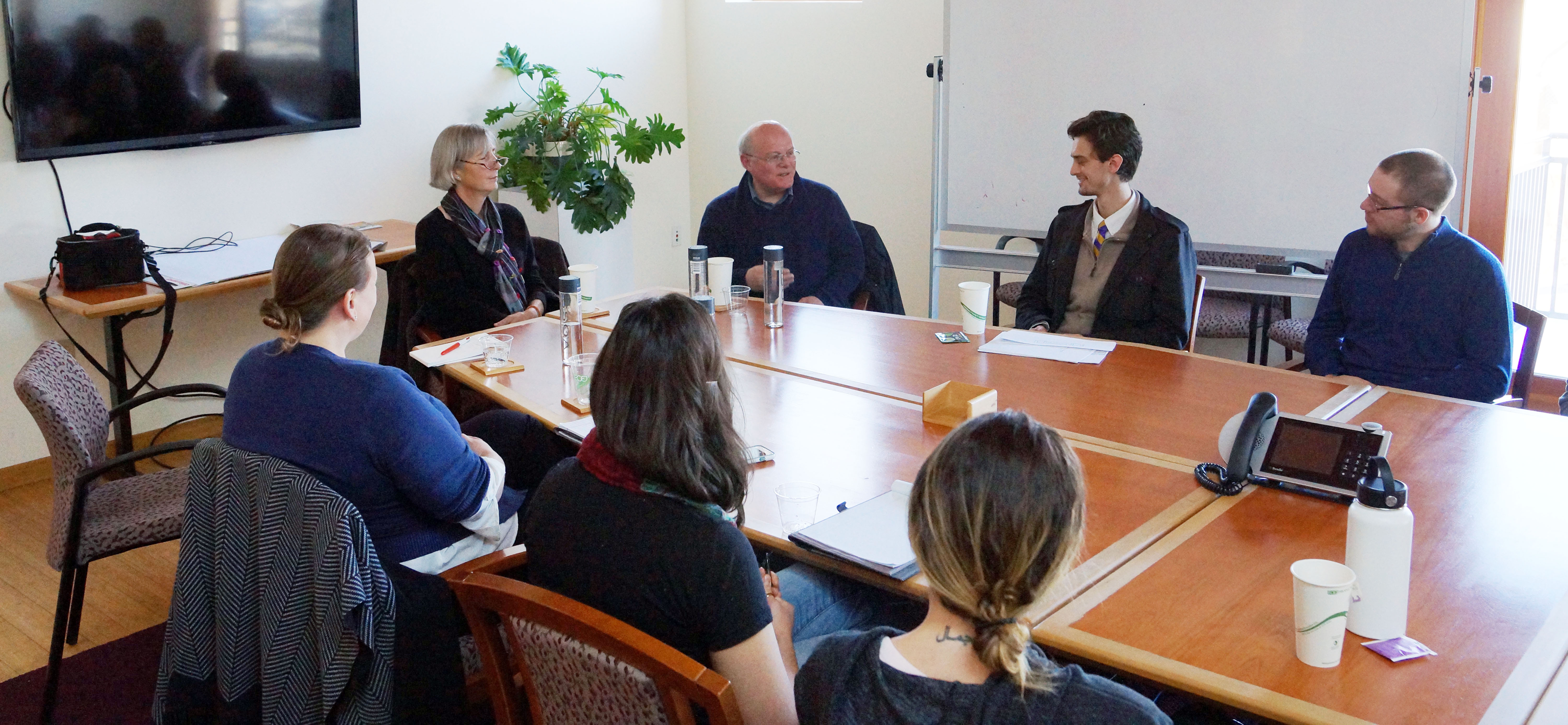
Master translators Wulstan Fletcher and Elizabeth Callahan visited Naropa University to speak with students about the process of translation from Tibetan to English, and the motivations that led them to pursue such work.
The conversation occurred as part of Naropa University’s Indo-Tibetan Lunch Seminar Series, organized and hosted by Dr. Amelia Hall, Assistant Professor of Religious Studies, which fosters discussion among students across disciplines—art, Indo-Tibetan studies with Tibetan and/or Sanskrit language—and encourages them to explore different ways to study language in general, and Tibetan and Sanskrit in particular.
Elizabeth began by describing her motivation to learn Tibetan: she was interested in practicing Tibetan Buddhism and understanding what she was practicing. Over the course of her six years of retreat, she gradually learned to serve as an interpreter for Tibetan teachers and became a translator of practice texts. After completing retreat, she fell into being a translator because she wanted to develop a better understanding of emptiness, the rituals associated with Buddhist practice, and the “point” of meditation and saw a way to do that through the practice of translation.
“Translation can be a skillful way to approach in-depth study.”
-Elizabeth Callahan
Following Khenpo Tsultrim Gyamtso Rinpoche’s encouragement to understand the text from the practitioner’s perspective, Elizabeth took translation as the path early on. She explained the importance of working closely with masters of the lineage and students of the same teacher to produce translations. She described a model to approach the translation of Tibetan materials to English to benefit oneself and others equally: absorb yourself in the text–practice, study, and research, then the product of the translation contributes to others being able to practice.
Elizabeth closed her comments with an encouragement to students to, “Bring <your knowledge of Tibetan> to a point where it is useful for you if you are interested to practice. Train until, when you pick up a text, you have 90% comprehension, and that you’re fluent enough in colloquial Tibetan that you can ask questions to get to 100%.”
Wulstan began by introducing himself to the group as “The Reluctant Translator”. Completely self-taught, Wulstan completed three-year retreat and worked on technical translations until Tsadra offered support for him to work full time. From his perspective, translation is part of one’s bodhisattva commitment to help people who will never be in a position to learn the language, giving them access to a wonderful tradition that is still alive. “Translation is breaking the shell so people can eat the kernel, or taking the stone off the well so people can get to the water.”
Wulstan then shifted to sharing his love of language. He explained that the classical Tibetan of the texts, which is quite different from the modern spoken language, is a learned language, like Latin was in the middle ages. It has remained fairly stable and unchanged over the centuries. The written Tibetan of a modern author like Dudjom Rinpoche is in many respects the same as that of Longchenpa, who lived in the fourteenth century. As writers, they are virtual contemporaries even though they are separated by six centuries. This means that, once you have learned to read Tibetan, you have access to vast literature spanning over a thousand years.
“If you think Buddhadharma is valuable, translate. You can’t know what the benefit will be—maybe you’re giving a tool to someone who can use it much better than you could!”
-Wulstan Fletcher
Exploring the Craft of Translation
Elizabeth and Wulstan answered thoughtful questions from the students about what to do when experiencing a block or facing something you don’t understand. Wulstan urged students to read slowly and not to lose heart. He explained that while Tibetan grammar is not complicated, its syntax is strange and confusing to speakers of an Indo-European language like our own. Tibetan is not written in sentences in the way that English is—centerd on a main verb with principal and relative clauses all clearly connected. Thanks to its use of particles and its unrestricted capacity for subordination, Tibetan is often written in extended, river-like periods which can be very long indeed—alarmingly so for the beginner. Nevertheless, it is important to get used to the way Tibetan writers arrange their ideas and to read their sentences in the way Tibetans do rather than jumping around trying to piece together bits of sense, more or less guessing how they should be put together. It’s only when you have grasped the meaning of the Tibetan that you can then put it into English, dividing up the Tibetan into shorter manageable statements. This isn’t easy and takes a lot of practice, so it’s important to be patient and not get discouraged. Then, because the syntactical structure of the two languages is so different, it is important to “step away” from the original Tibetan and recast the meaning into a natural English form. When the translation process is complete, the text should read as clearly and easily as a text composed in English. This is part of being kind to the reader which, above all, Elizabeth and Wulstan reminded the students to do by thinking of their audience when translating.
Both translators spoke of the importance of mastering of one’s own language—cultivating a knowledge of English literature to know stylistically what is good. They encouraged the students to read literature, to love English, to read the poets, and cherish the language. By translating, one is contributing to the corpus of literature in our own language.
They offered a step-by-step approach to working with a translation:
Work with context and play with how to say things in different ways;
Continue the research process: “Read around” the text by engaging with relevant texts and scholarly materials to help build context; and
Ask questions: understanding the author’s life could inform your translation.
The conversation ended with an encouraging comment from Elizabeth to the young translators: “If you feel drawn to learn Tibetan and become a translator, do it. You’ll find a way.”
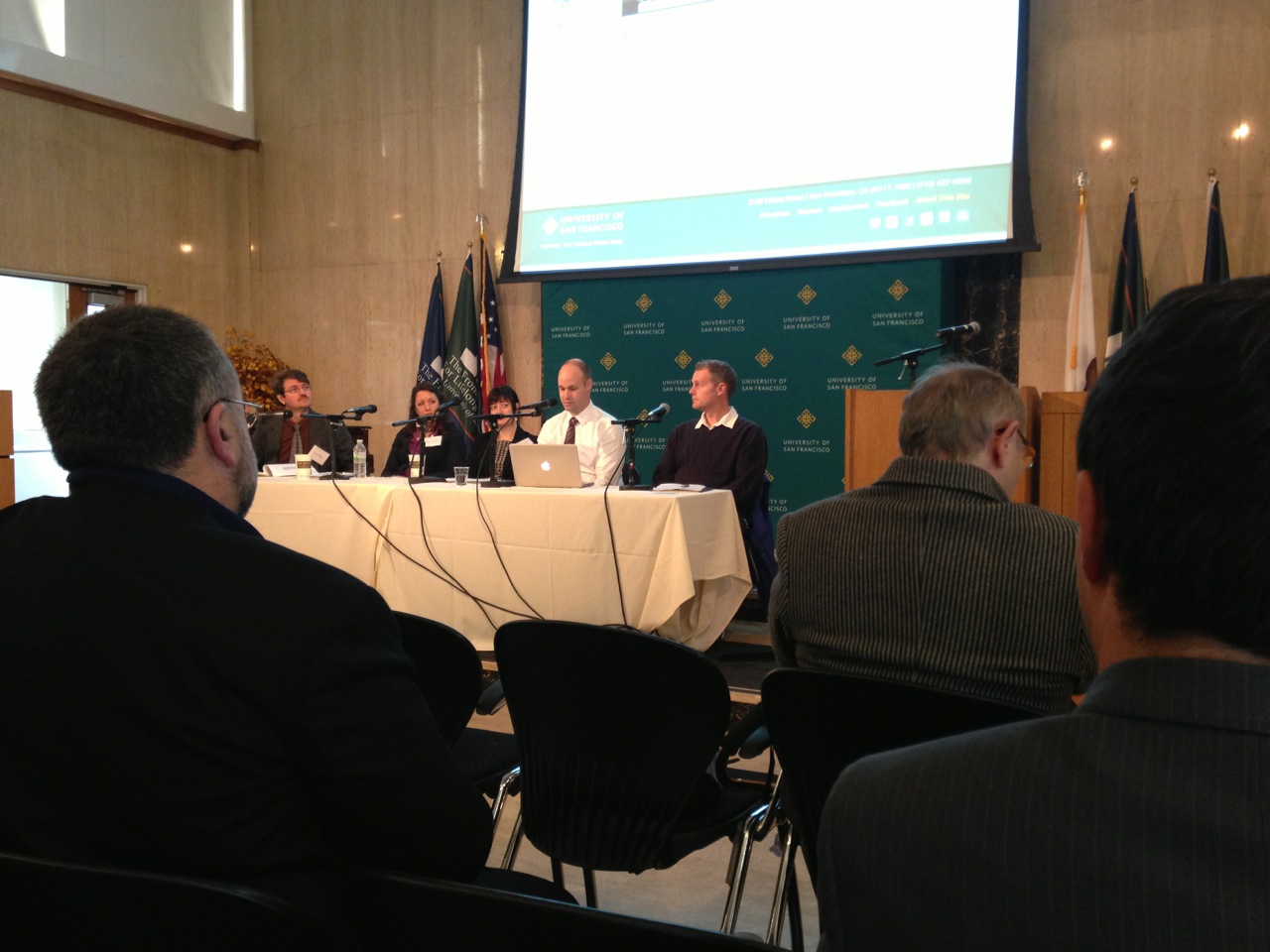
The symposium held this past weekend at the University of San Francisco was a gathering of scholars from around the world who presented papers focused on the “Tulku” (སྤྲུལ་སྐུ་ , sprul sku) institution of Tibetan Buddhism. Organized by professor Tsering Wangchuk and Jake Nagasawa, the conference was the second recent meeting focused on the reincarnation system of Tibetan Buddhism. There were four main panels at the conference, allowing for thirteen seasoned scholars to present their research:
Tulkus in Transnational Buddhism: Authentication and Contestation of Hybridity in the Cross-Cultural Reincarnation System
Tulkus in Historical Context: Power, Knowledge, and Politics in the Innovation of the Reincarnation Institution
Tulkus as a Model of Ideal Beings: Embodying the Enlightened Characteristics
Envisioning and Retelling Birth-Stories: Tulku Lineage Narratives and the Quest for Legitimation.
Representatives speaking at the conference ran the gamut of scholars and although some papers seemed farther from the theme than others, the threads tying them together were questions about the history, place and function of the unique system of dynasties of reincarnated Buddhist masters solidified in Tibetan culture as the “Tulku System.” I’m not sure what general readers imagine Tibetan history may have been like, but perhaps imagining a Tibetan version of Game of Thrones with the houses as monastic institutions continuing not through a lord’s blood relations but via recognition and enthronement of child prodigies destined to take the place of previous throne holders is a useful “imaginary.” The reasons for a gathering focused on discussing the Tulku Institution are many: it is an essential and unique part of Tibetan culture and history, it is a useful entry point for discussions about the transmission of Buddhism or about the philosophical and religious beliefs of historical Tibetan peoples and of modern Buddhist practitioners, and it is a controversial topic, both inside and outside of the tradition. In recent years we have seen young tulkus rebelling against their traditions and revealing improprieties, movie stars becoming tulkus, and reports of general distrust of the tulku system in modern Tibetan peoples. Despite any of this, tulkus are often some of the most powerful and popular Tibetan Buddhist teachers. But these controversies were less the focus of the conference as it was about presenting research on various historical figures and creating a more nuanced and detailed thick description of the phenomenon of Tulkus in Tibetan society.
Dr. Donald Lopez gives the first Keynote speech
Fascinating, but utterly different keynote speeches were delivered at the symposium by professors Donald Lopez and Jeffrey Hopkins. The difference in their presentations is of course partly due to personal style, but the tension between the two approaches is illustrative of some of the tensions observable throughout the symposium. Some presenters discussed the idealized tulku as a prodigy motivated by the will to help all sentient beings, while others focused on children forced into servitude of an institution motivated by greed and power. Some discussed the history of the tulku institution or the particulars of the development of tulku lineages in particular monastic institutions, and others focused on various responses to the question of its continuation in the modern world. Dr. Lopez’s presentation was expertly delivered and fascinating in that it revealed that a 20th century gathering of the most powerful exiled Tibetan leaders ended with a moratorium on the recognition of tulkus, which lasted a decade before some unnamed group broke it, ushering in open season on tulku recognition. This is interesting because it appears that the Tibetan leaders, many of whom are recognized tulkus, found reason to suspend their own system. However, it appears no one has studied the meeting in depth and we don’t know whether this was motivated by an attempt to end the tulku system for good because of corruption, or if it was an issue of expediency brought on by exile, or some other reason. Lopez weaved together reports from the earliest Western accounts of encounters with young tulkus (they must be demons!), Central Asian and European history, and modern accounts. His talk was called, “Four Possibilities,” referring to a logical relationship between the term “lama” and “tulku,” argued by the Dalai Lama in a talk attended by Dr. Lopez to be “mushi“. Namely, there are people who are neither lamas nor tulkus, people who are both lamas and tulkus, people who are lamas but are not tulkus, and people who are tulkus who are not lamas. It is this last one that gives people pause, as it is generally assumed that tulkus are not merely lamas, but are the representatives of the highest level of realized masters.
While Lopez’s approach was historical and text-based, on day two Dr. Hopkins gave his usual hilarious, rambling, and intensely personal account of study with Tibetan masters such as the Dalai Lama. He mixed his narrative with great jokes as well as with translations from specific philosophical texts providing traditional definitions of Tibetan Buddhist concepts such as the various kayas and the meaning of “tulku.” This is perhaps not the place to mention the significance of some of his other comments about reincarnation, and as Hopkins himself said during his speech, perhaps there are things that should remain private. Hopkins first emphasized the technical definitions, taken from the Gomang Curriculum material he is currently translating, that require tulkus to be dharmakayas and not merely bodhisattvas of some high level. However, he also placed emphasis on his own doubt about most tulkus’ knowledge and he insisted that what a teacher says, and the knowledge he or she thereby displays, is more important than any official stamp of recognition as a tulku. That he felt it necessary to admonish the audience, as though they were making the mistake of believing all tulkus to be genuinely capable teachers, is interesting in and of itself.
The Beginning of the Tulku Institution?
Sometimes people like to spice things up a bit by debating when some historical institution, philosophical school, or religious practice started or ended. In the case of the Tulku institution, the topic of this short symposium, some speakers talked about the earliest texts describing concatenated reincarnates (an unbroken line of dharma teachers) or the earliest reported recognition of Tibetan people as emanations of deities. But the statement found in a text that so and so is the emanation of so and so is not the same as the cultural phenomenon of the recognition of a person as an emanation who then comes to take the power and wealth of the deceased leader, subsequently taking on the wealth and followers of that leader. Perhaps an interesting question would be, who was the first Tibetan student who, upon the death of his teacher, having spent a lifetime studying with him as the executive of a monastery, found himself bowing down to a child believed to be the reincarnation of his teacher? That is, when and how did the social event of the installment of a Tulku first occur? How meaningful was it for that society? After the conference I am still wondering about the answers to these questions.
Some students of Tibetan Buddhism may believe that the earliest members of a lineage of reincarnated teachers held the same kind of status as the later members of the lineage. In fact, many lineages would be applied or recognized later in history, once the institution of the lineage holder became relevant. For instance, while surely the first Karmapa’s students revered him in his time, they may not have thought of him as a special reincarnation while he was alive. It was not until later Karmapas that the lineage was written down and traced backwards. So one of the questions is, when did this way of thinking about teachers come about?
Daniel Hirshberg’s paper at the conference, “A Post-Incarnate Usurper? Guru Chöwang’s Claim to the Patrilineal Inheritance of Nyang” indicates that a 13th century figure may have worked rather hard to become recognized as a reincarnation. Guru Chowang appears to have inserted himself in Nyangral’s lineage line and Nyangral himself used various strategies to claim a lineage stretching back to the great Tibetan King Tri Song Detsen. These are stories of people convincing themselves and others of holding the connection of an unbroken lineage and claiming to be “tulku” – emanations, not merely of a Buddha or deity in general, but of specific historical people. Although the basic logic is much older, it doesn’t seem to be until the 12th century that we are seeing the tulku logic instantiated in texts listing specific historical names, as indicated in José Cabezón’s paper at the conference.
Although it is often said that the life of the second Karmapa, squarely in the 13th century (1204/06-1283), marks the start of the Tulku institution, José Cabezón mused that the textual evidence is in fact representative of reports of what the second Karmapa said about his previous lives and could have been the work of a later writer, such as the third Karmapa, Rangjung Dorjé. Leonard van der Kuijp has shown evidence that there were people recognized as reincarnations of earlier figures in the 1100s. But here we are not talking about a fully formed Tulku institution. There were, of course, earlier written accounts of people being recognized as emanations of deities and Buddhas and so forth, but what of the earliest accounts of the Tulku institution being present and functioning in a Tibetan society? Would this be the third Karmapa? The Fourth? Another lineage? Who was first called “tulku” by Tibetan peoples?
While most scholars at the conference presented information about historical figures, a few scholars focused on current living tulkus, both Western and Asian. Elijah Ary, a recognized tulku, a Canadian, and a scholar trained at Harvard, spoke of the small group of “Western Tulkus,” many recognized by traditional Tibetan leaders but rarely teaching to ethnic Tibetan peoples. Dr. Ary questioned the use of the term “Western Tulku” and talked about the unique challenges of young people recognized and expected to fulfill their duty in a traditional religious culture. The clash of cultures represented by the term seems to me to be a fascinating starting place for discussions about the transmission of Tibetan Buddhism to the modern Western world. Will any Western teacher ever create a lineage of tulkus? Would any want to? I’m sure we can look forward to seeing more discussion of this kind in the future as Tibetan Buddhism gains more and more adherents in the West.
The Mangalam Research Center for Buddhist Languages will be offering 7-week language programs in both Sanskrit and Tibetan this summer with Dr. Ligeia Lugli (SOAS) and Dr. Alberto Todeschini (UVa) respectively.
Applications for both these programs are due by May 1, and applicants will be notified by May 15. For further information, see www.mangalamresearch.org
The second International Conference on Tibetan Buddhism began today, October 19th, at Emory University. Several hundred scholars and writers, venerable nuns and monks, lamas and tulkus, and representatives from sangha’s around the world converged on the Emory Conference Center in Atlanta, Georgia for a meeting of influential minds. The attendance list reads like a who’s who of Tibetan Buddhism in the West. Although a certain bias can be noted, it appears that the organizers made an effort to include representatives from many traditions. There are certainly a few key figures missing and it’s too bad because one of the key points that His Holiness the Fourteenth Dalai Lama stressed in his opening speech was the importance of nonsectarian collaboration among Tibetan Buddhist groups.
To formally open the conference, HHDL gave a moving speech about the importance of remembering the shared root of all types of Tibetan Buddhism and he implored the conference attendees to discuss the problems of degeneration and corruption of Tibetan Buddhism. He did not leave the sense of the “root” of Tibetan Buddhism abstract, but instead specifically pointed to the traditions of Nalanda and particularly to the writings of the masters of Nalanda. He said that it was necessary to study their writings directly and that too many Tibetan Buddhists focus on their individual lineage master’s writings or their college’s yig cha, to the detriment of the tradition. His Holiness seemed to really want to emphasize that it was important that the different schools needed to work together more and that it was essential that we deal with ‘corruption’ in Tibetan Buddhism. He did not elaborate on specifics, but it seemed to me that he was saying more than just the usual “we’re in a degenerate age, be careful with the quality of dharma you teach…” kind of talk. He said that Tibetan Buddhism has become empty ritual in some instances and that deep and proper understanding needs to be cultivated.
The opening session included introductions and remarks from Geshe Lobsang Negi, Dr. Gary Hauk, Lobsang Nyandak, Greg Kruglak and a performance by the Drepung Loseling Monks of the Mystical Arts of Tibet Tour. After the address by His Holiness, Khamba Lama gave a report on the First International Conference on Mongolian Buddhism, which concluded in September in Ulan Batar. Following the departure of His Holiness, the first panel sessions began. Session 1A was on Tibetan Buddhism’s Encounter with Modern Science and Session 1B was on Tibetan Buddhism and Social Engagement.
Panel Session 1B: Tibetan Buddhism and Social Engagement.
As you can see, many distinguished guests were present.
The “Engaged Buddhism” Panel was chaired by Dr. JohnMakransky and the keynote speakers were Dr. Jan Willis and Lama Pema Wangdak. Responding panelists Acharya Fleet Maul, Ven. Karma Lekshe Tsomo, Diana Rose, and Tsoknyi Rinpoche were each given a very short time to present a few thoughts on engaged Buddhism. This format was somewhat interesting but led to each person giving a short spiel that was very informative but didn’t seem to lead to real dialog. “Questions” from the audience were similar in that they were not in fact questions at all, but statements made by very interesting people doing very interesting things, which sometimes included general questions for all present to take home and consider. David Germano seemed to have prepared a particular three-point speech (a condensed version of a speech he gave at IATS this year), which he provided to the whole room and seemed, by the observed reaction of the crowd, to be the most interesting and thought provoking of all. He charged academic institutions with not being truly ethical in their actions regarding Tibet and called on everyone to consider how their actions and chosen focus in regard to Tibetan Buddhism effects Tibet and Tibetans. Unfortunately time was up at the end of his speech and no one was prepared to respond. The panel really was very interesting, and some of the most important statements probably came from Ven. Lekshe Tsomo, who rightly mentioned the inequality in Tibetan Buddhist institutions and the plight of Buddhist women the world over; however, there was no time for real dialog about anything. It appears that there will be a “business meeting” tomorrow that will allow for “resolutions” to be drawn up―which sounds delightful and absurd―but perhaps at that time actual dialog among the panelists and attendees can occur.
Before moving on to the next panel I wanted to summarize here a few of the points made at the panel on engaged Buddhism:
Dr. Jan Willis noted that while “engaged Buddhism” might be a new term, Buddhism has been engaged since it’s inception. From the very moment that Buddha stood up from his Kusha grass seat and began to teach, Buddhism has been “engaged” in the world. The rest of her comments then were about the foundation of Buddhism as an engaged religion and about an ethics in which she linked compassion and interdependence with love in the Bible and Dr. Martin Luther King’s ideas. She said that we should feel our responsibility for others when we feel love and that we should then act in the world for others benefit.
Lama Pema Wangdak of the Sakya tradition, creator of Tibetan Braille, spoke a little about his personal experience with social engagement and stressed that education and the founding of schools for children who would otherwise not receive quality schooling was essential for the preservation of Tibetan culture. He spoke about the importance of investing in the brain trust of Tibetan people.
Acharya Fleet Maul, creator of the Prison Dharma Network and author of Dharma in Hell, spoke about some of the challenges Tibetan Buddhism faces in terms of “engaged Buddhism.” He said that “Tibetan Buddhism is not the leader in engaged Buddhism” and that compared with the developed modern Buddhisms from China and Japan we are lagging behind and there is a lot of work to do. However, he stressed that he feels that the Vajrayana path gives us a particular strength in the area of service. He said that it provides the fortitude for going into the modern charnel grounds and working with injustice directly.
The Very Venerable Karma Lekshe Tsomo gave a talk about her experience on sabbatical from the University of San Diego when she traveled to 14 Buddhist countries around the world. Her report focused on the tragedies that beset Buddhist women around the world and I must commend her again for being the only person on the panel to really mention how little support and how little power women have in Tibetan Buddhist institutions the world over. One of the key points she brought up was about the power of other religious groups who are working to convert traditionally Buddhist peoples. This was also touched on by several other people at the conference and from the various reports I have heard it sounds like certain areas are getting to a point of crises in which Buddhism may be overtaken by Christian and Muslim proselytizers who provide basic needs to Buddhist peoples, who then convert because they need food and clothing (more on this later).
Diana Rose, President of Garrison Institute and the Lostand Foundation, spoke about the Garrison Institute and her work creating a training program for care-givers and people who work in shelters.
Tsoknyi Rinpoche, teacher and author of Carefree Dignity and Fearless Simplicity, was very well spoken and succinct. He said that there were two principles that are key for the Buddhist tradition that connect with the sense of “engaged Buddhism”: 1) Nonviolence and 2) Contentment. He said a few things about nonviolence, but chose to spend more time describing the importance of the middle way of being content with what one has and what one’s body needs, not with what one’s mind wants to have. Basically he said, with many examples, that overconsumption is really NOT OK and that right livelihood includes paying attention to how we live in relation to Mother Earth.