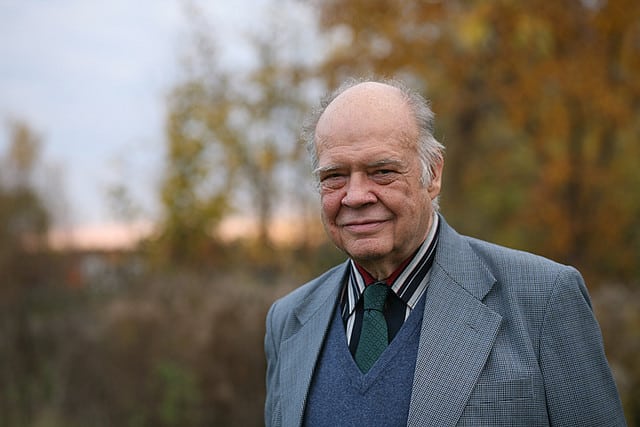
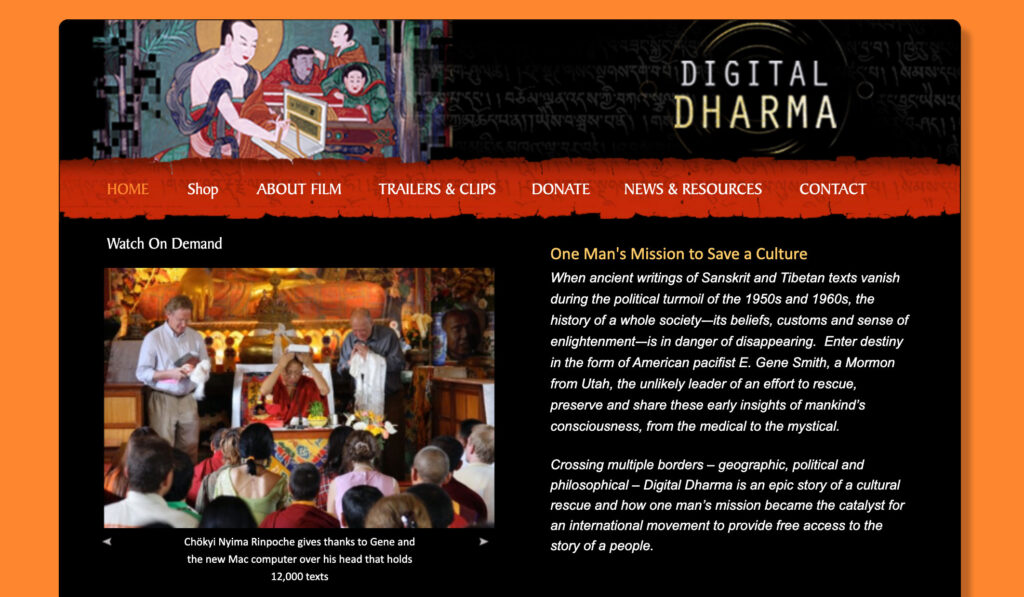
A private screening of a new movie about the great scholar and collector of Tibetan texts, E. Gene Smith, will be shown in Boulder on December 15th, 2011.
You are invited to a special preview of the upcoming documentary, Digital Dharma, the story of E. Gene Smith, founder of the Tibetan Buddhist Resource Center (TBRC) and a pioneer in Tibetan Studies who dedicated his life to finding, preserving and disseminating the rich literary heritage of Tibet. Next week will mark one year since the death of E. Gene Smith. An evening of remembrance on December 15th will include a preview screening of Digital Dharma, the feature-length HD documentary about Gene’s life’s work. www.digitaldharma.com.
This sneak peek of the film will be hosted for hundreds of worldwide fans of the film’s central character via the virtual environment platform of vcopious™, a Philadelphia-based global virtual environment technology provider. The live event will be streamed from The 8th Floor, a gallery and screening room in New York City.
The local Rocky Mountain showing will be at: University of Colorado, Boulder Campus ATLS 1B31 (on 18th Ave if you’re coming from Broadway) Thursday December 15, 2011 4-6 pm
I am pleased to announce that under the sponsorship of Do Ngag Kunphen Ling of Redding, CT and the Mahayana Sutra and Tantra Center of Howell, NJ an extraordinary teaching event will be held in New York City this summer, from August 13 to August 21. Gyume Khensur Lobsang Jampa Rinpoche, an esteemed Lama trained in the Gelukpa tradition, has accepted a request to present a teaching on Nāgārjuna’s Five Stages (S: pañcakrama, T: Rim pa lnga pa). This verse text, consisting of five chapters, is universally recognized as a vital resource on the completion stage instructions associated with the Guhyasamāja tradition of Anuttarayoga Tantra. Two teaching sessions will be held each day. There will be no charge for any of the classes.
A major goal of this teaching is to provide Western Buddhists with an opportunity to pursue the study of Mahayana Tantric Buddhism at the most advanced levels here in the United States. In addition, the organizers wish to extend this invitation to practitioners affiliated with all the traditions of Tibetan Buddhism as well as to academic scholars who specialize in this area of study. The sole requirement for attending is that you have received a complete Anuttarayoga Tantra initiation from a qualified Buddhist master.
Gyume Khensur Lobsang Jampa Rinpoche was born in Lhasa, Tibet in 1937. He entered the Mey College of Sera Monastery at the age of ten and studied there until 1959. After fleeing to India following the March 10 Lhasa uprising, he resumed his religious training there, first at Buxar in West Bengal and then in South India in 1970 when the exile seat of Sera Monastery was established at the Bylakuppe Settlement Camp. In 1986 he was awarded the Geshe Lharampa degree. After this, he entered Gyume Tantric College, near the town of Hunsur in the Mysore District of Karnataka State. Upon completion of his tantric studies, he held the positions of Gekö (T: dGe bskos)—or Proctor—and Lama Umdze (T: Bla ma dbu mdzad), the leader that presides over the daily Tantric rituals. In November 1996, His Holiness the Dalai Lama appointed him as Khenpo, or Abbot, a position which he held for three years. During this time, he taught the curriculum of Tantric studies to successive classes of Geshe monk scholars. Khensur Rinpoche first visited the United States in 1996. After returning to the U.S. again several times, he accepted a five-year position as resident teacher at the Guhyasamaja Center in Washington, D.C. He currently resides at Do Ngak Kunphen Ling in Redding, CT.
Within the Gelukpa tradition, the instructions and practice associated with the Guhyasamāja Tantra are considered to represent the pinnacle of Mahayana Tantric Buddhism. They form one of the many bodies of instruction that the founder of this tradition, Je Tsongkapa Losang Drakpa (T: rJe Tsong kha pa bLo bzang grags pa), studied and mastered. As the Tibetan scholar and historian Gö Lotsawa Shönu Pel (T: ’Gos Lo tsā ba gZhon nu dpal) wrote in the Blue Annals:
In the lineage of disciples descending from ’Gos [Lo tsā ba Khug pa lhas brtsas], Bu ston [Rin chen grub] is recognized as having been the most knowledgeable. He taught the Guhyasamāja instructions to Khung po lhas pa gZhon nu bzod nams. They were heard from the latter by the great rJe Tsong kha pa. That individual—that is, the great rJe Tsong kha pa—benefited the overall [Buddhist] Teaching extensively and, in particular, filled [the realm that lies on] the surface of the earth with the Guhyasamāja teachings.
Later in the same work, Gö Lotsawa also wrote:
The great rJe Tsong kha pa used Bu ston’s treatise on the Five Stages and the oral instructions of gSer sDings bagZhon nu ’od upon which [Bu ston’s work] is based as the foundation for identifying a range of important topics. Then, after having thoroughly examined and analyzed both the Sūtrayāna and Tantrayāna canon in general, and, in particular, the Guhyasamāja Root and Explanatory Tantras, as well as the major Indian commentaries [on these canonical works] and various Tibetan traditions [on the Guhyasamāja practice], he composed [a series of] instruction manuals on the Five Stages, as well as his Lamp that Illuminates the Five Stages (T: Rim lnga gsal sgron), which is a detailed commentary on the meanings contained in [Nāgārjuna’s] work. By doing so, he restored the Guhyasāmaja system [of teaching and practice] that had fallen into decline.
In his Lamp that Illuminates the Five Stages, Je Tsongkapa points out that the principal aim of all Mahayanists, Tantric and non-Tantric alike, is to fulfill the needs of all sentient beings in the highest possible manner, and that this is accomplished by achieving a Buddha’s physical body. He further notes that the supreme method for achieving such a body is the completion stage practices of the Anuttarayoga Tantra path. Moreover, the Guhyasamāja Tantra works in general and the Five Stages in particular teach the unique methods for attaining the two stages of the māyādeha (T: sgyu ma’i sku), or “illusory body,” that lead ultimately to Buddhahood. Je Tsongkapa further states that while the Yoginī or Mother Tantras present detailed teachings on the unique form of knowledge that combines bliss and emptiness inseparably, they do not explain with the same fullness how to achieve the illusory body that is generated from a combination of subtle wind and mind. He then asserts that the instructions on this topic represent the unsurpassed characteristic of the Guhyasamāja Tantra system.
Gyume Khensur Rinpoche’s teachings will be based on the explanations of the Guhyasamāja instructions that are presented in Je Tsongkapa’s Lamp that Illuminates the Five Stages. He will also use two additional texts, both of which were written by the Panchen Lama Losang Chökyi Gyeltsen (T: bLo bzang chos kyi rgyal mtshan). One is an abbreviated presentation of Je Tsongkapa’s work, known as The Essence of the Lamp that Illuminates the Five Stages (T: Rim lnga gsal sgron gyi snying po). The other is a commentary that provides literal explanations of each of the verses in Nagarjuna’s root text. Its shortened title is The Treasury of the Jewel-like State of the United Pair (T: Zung ’jug nor bu’i bang mdzod).
To receive more information about this event, please respond to: [email protected].
Kathmandu University and the Centre for Buddhist Studies at Rangjung Yeshe Institute will host the 8th Annual Symposium on Buddhist Studies on Saturday, December 11th, 2010 from 1pm to 5pm at the Hyatt Regency Hotel, Boudhanath, Kathmandu, Nepal.
Theme: “Great Debates”
Speakers:
Dr. Tom Tillemans, University of Lausanne Dr. Pascale Hugon, Austrian Academy of Sciences Dr. Georges Dreyfus, Williams College Dr. Jonardon Ganeri, University of Sussex Chokyi Nyima Rinpoche, Ka-Nying Shedrub Ling Monastery Ven. Dr. Phramaha Dhammahaso, Mahachulalongkorn University
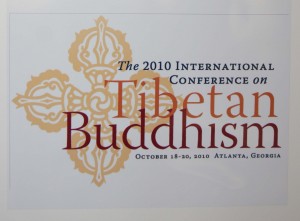
The second International Conference on Tibetan Buddhism began today, October 19th, at Emory University. Several hundred scholars and writers, venerable nuns and monks, lamas and tulkus, and representatives from sangha’s around the world converged on the Emory Conference Center in Atlanta, Georgia for a meeting of influential minds. The attendance list reads like a who’s who of Tibetan Buddhism in the West. Although a certain bias can be noted, it appears that the organizers made an effort to include representatives from many traditions. There are certainly a few key figures missing and it’s too bad because one of the key points that His Holiness the Fourteenth Dalai Lama stressed in his opening speech was the importance of nonsectarian collaboration among Tibetan Buddhist groups.
To formally open the conference, HHDL gave a moving speech about the importance of remembering the shared root of all types of Tibetan Buddhism and he implored the conference attendees to discuss the problems of degeneration and corruption of Tibetan Buddhism. He did not leave the sense of the “root” of Tibetan Buddhism abstract, but instead specifically pointed to the traditions of Nalanda and particularly to the writings of the masters of Nalanda. He said that it was necessary to study their writings directly and that too many Tibetan Buddhists focus on their individual lineage master’s writings or their college’s yig cha, to the detriment of the tradition. His Holiness seemed to really want to emphasize that it was important that the different schools needed to work together more and that it was essential that we deal with ‘corruption’ in Tibetan Buddhism. He did not elaborate on specifics, but it seemed to me that he was saying more than just the usual “we’re in a degenerate age, be careful with the quality of dharma you teach…” kind of talk. He said that Tibetan Buddhism has become empty ritual in some instances and that deep and proper understanding needs to be cultivated.
The opening session included introductions and remarks from Geshe Lobsang Negi, Dr. Gary Hauk, Lobsang Nyandak, Greg Kruglak and a performance by the Drepung Loseling Monks of the Mystical Arts of Tibet Tour. After the address by His Holiness, Khamba Lama gave a report on the First International Conference on Mongolian Buddhism, which concluded in September in Ulan Batar. Following the departure of His Holiness, the first panel sessions began. Session 1A was on Tibetan Buddhism’s Encounter with Modern Science and Session 1B was on Tibetan Buddhism and Social Engagement.
Panel Session 1B: Tibetan Buddhism and Social Engagement.
As you can see, many distinguished guests were present.
The “Engaged Buddhism” Panel was chaired by Dr. JohnMakransky and the keynote speakers were Dr. Jan Willis and Lama Pema Wangdak. Responding panelists Acharya Fleet Maul, Ven. Karma Lekshe Tsomo, Diana Rose, and Tsoknyi Rinpoche were each given a very short time to present a few thoughts on engaged Buddhism. This format was somewhat interesting but led to each person giving a short spiel that was very informative but didn’t seem to lead to real dialog. “Questions” from the audience were similar in that they were not in fact questions at all, but statements made by very interesting people doing very interesting things, which sometimes included general questions for all present to take home and consider. David Germano seemed to have prepared a particular three-point speech (a condensed version of a speech he gave at IATS this year), which he provided to the whole room and seemed, by the observed reaction of the crowd, to be the most interesting and thought provoking of all. He charged academic institutions with not being truly ethical in their actions regarding Tibet and called on everyone to consider how their actions and chosen focus in regard to Tibetan Buddhism effects Tibet and Tibetans. Unfortunately time was up at the end of his speech and no one was prepared to respond. The panel really was very interesting, and some of the most important statements probably came from Ven. Lekshe Tsomo, who rightly mentioned the inequality in Tibetan Buddhist institutions and the plight of Buddhist women the world over; however, there was no time for real dialog about anything. It appears that there will be a “business meeting” tomorrow that will allow for “resolutions” to be drawn up―which sounds delightful and absurd―but perhaps at that time actual dialog among the panelists and attendees can occur.
Before moving on to the next panel I wanted to summarize here a few of the points made at the panel on engaged Buddhism:
Dr. Jan Willis noted that while “engaged Buddhism” might be a new term, Buddhism has been engaged since it’s inception. From the very moment that Buddha stood up from his Kusha grass seat and began to teach, Buddhism has been “engaged” in the world. The rest of her comments then were about the foundation of Buddhism as an engaged religion and about an ethics in which she linked compassion and interdependence with love in the Bible and Dr. Martin Luther King’s ideas. She said that we should feel our responsibility for others when we feel love and that we should then act in the world for others benefit.
Lama Pema Wangdak of the Sakya tradition, creator of Tibetan Braille, spoke a little about his personal experience with social engagement and stressed that education and the founding of schools for children who would otherwise not receive quality schooling was essential for the preservation of Tibetan culture. He spoke about the importance of investing in the brain trust of Tibetan people.
Acharya Fleet Maul, creator of the Prison Dharma Network and author of Dharma in Hell, spoke about some of the challenges Tibetan Buddhism faces in terms of “engaged Buddhism.” He said that “Tibetan Buddhism is not the leader in engaged Buddhism” and that compared with the developed modern Buddhisms from China and Japan we are lagging behind and there is a lot of work to do. However, he stressed that he feels that the Vajrayana path gives us a particular strength in the area of service. He said that it provides the fortitude for going into the modern charnel grounds and working with injustice directly.
The Very Venerable Karma Lekshe Tsomo gave a talk about her experience on sabbatical from the University of San Diego when she traveled to 14 Buddhist countries around the world. Her report focused on the tragedies that beset Buddhist women around the world and I must commend her again for being the only person on the panel to really mention how little support and how little power women have in Tibetan Buddhist institutions the world over. One of the key points she brought up was about the power of other religious groups who are working to convert traditionally Buddhist peoples. This was also touched on by several other people at the conference and from the various reports I have heard it sounds like certain areas are getting to a point of crises in which Buddhism may be overtaken by Christian and Muslim proselytizers who provide basic needs to Buddhist peoples, who then convert because they need food and clothing (more on this later).
Diana Rose, President of Garrison Institute and the Lostand Foundation, spoke about the Garrison Institute and her work creating a training program for care-givers and people who work in shelters.
Tsoknyi Rinpoche, teacher and author of Carefree Dignity and Fearless Simplicity, was very well spoken and succinct. He said that there were two principles that are key for the Buddhist tradition that connect with the sense of “engaged Buddhism”: 1) Nonviolence and 2) Contentment. He said a few things about nonviolence, but chose to spend more time describing the importance of the middle way of being content with what one has and what one’s body needs, not with what one’s mind wants to have. Basically he said, with many examples, that overconsumption is really NOT OK and that right livelihood includes paying attention to how we live in relation to Mother Earth.
The 2010 International Association of Tibetan Studies Conference will open tomorrow morning in Frederic Wood Theatre at UBC in Vancouver. The UBC campus has already been filled with a veritable who’s who of Tibetan Studies and I am looking forward to listening to as many of these eminent scholars as possible. Tomorrow will include a welcoming ceremony including addresses by professor Tsering Shakya and Dr. Charles Ramble. I will then spend most of the day at the Contributions to Tibetan Literature: Texts, Genres and Generic Terms panel, which will include papers titled:
” “Collected Writings” (gsung ‘bum) in Tibetan Literature: Towards a Systematic Study of Their Compilation, Redaction and Composition and its Use for Genre Classifications,” “Tools of the Trade of the Tibetan Translators,” and “Classifying Literature or Organizing Knowledge? Some General Remarks on Genre Classifications in Tibetan Literature.”
Do leave me a note if there is some discussion you simply must hear about, otherwise I will be attending things I am interested in, such as the Madhyamaka panel, the Tibetological Library and Archive Resources panel, and Buddhist Texts and Philosophy, and The History of the Rang-stong/Gzhan-stong, and the list goes on. It is impossible to attend all of the truly fascinating panels at this years IATS, but I hope to be able to discuss a few of the most interesting here on this blog over the course of the next week.
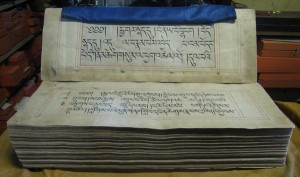
For the stunning price of $4,700 you can order 7 DVDs of the high quality digitized them spang ma edition held in the National Library of Mongolia. The Peking edition is 5 DVDs for $3,700.
The first issue is scheduled to appear in Summer 2012. The journal invites submissions of articles on any topic in the field of Buddhist philosophy. Anyone interested is encouraged to send submissions or inquiries for more information to [email protected]