Naropa Students Enjoy Lunch with Master Translators
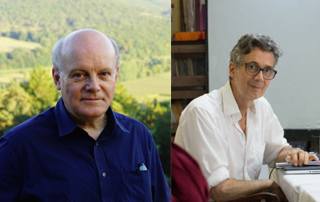
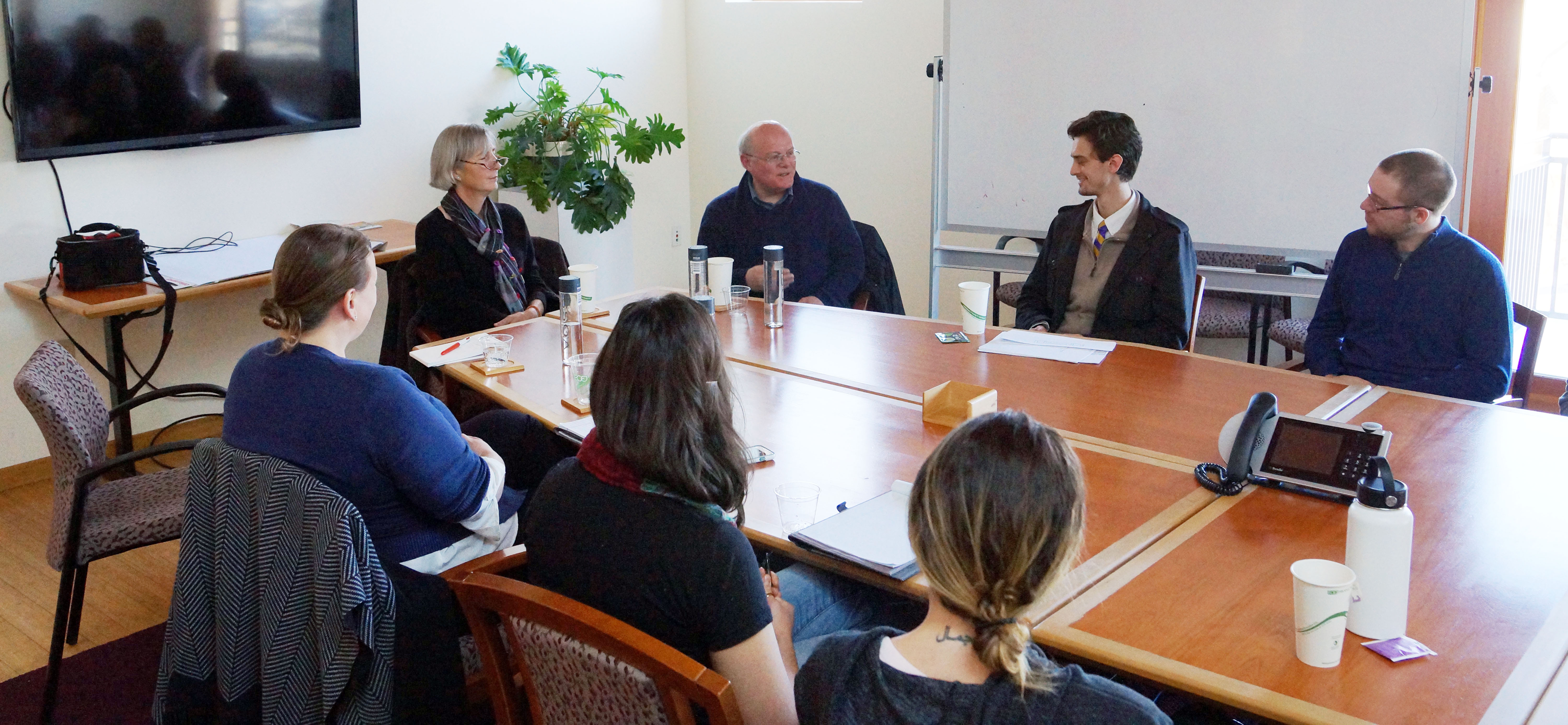
Master translators Wulstan Fletcher and Elizabeth Callahan visited Naropa University to speak with students about the process of translation from Tibetan to English, and the motivations that led them to pursue such work.
The conversation occurred as part of Naropa University’s Indo-Tibetan Lunch Seminar Series, organized and hosted by Dr. Amelia Hall, Assistant Professor of Religious Studies, which fosters discussion among students across disciplines—art, Indo-Tibetan studies with Tibetan and/or Sanskrit language—and encourages them to explore different ways to study language in general, and Tibetan and Sanskrit in particular.
Elizabeth began by describing her motivation to learn Tibetan: she was interested in practicing Tibetan Buddhism and understanding what she was practicing. Over the course of her six years of retreat, she gradually learned to serve as an interpreter for Tibetan teachers and became a translator of practice texts. After completing retreat, she fell into being a translator because she wanted to develop a better understanding of emptiness, the rituals associated with Buddhist practice, and the “point” of meditation and saw a way to do that through the practice of translation.

“Translation can be a skillful way to approach in-depth study.”
-Elizabeth Callahan
Following Khenpo Tsultrim Gyamtso Rinpoche’s encouragement to understand the text from the practitioner’s perspective, Elizabeth took translation as the path early on. She explained the importance of working closely with masters of the lineage and students of the same teacher to produce translations. She described a model to approach the translation of Tibetan materials to English to benefit oneself and others equally: absorb yourself in the text–practice, study, and research, then the product of the translation contributes to others being able to practice.
Elizabeth closed her comments with an encouragement to students to, “Bring <your knowledge of Tibetan> to a point where it is useful for you if you are interested to practice. Train until, when you pick up a text, you have 90% comprehension, and that you’re fluent enough in colloquial Tibetan that you can ask questions to get to 100%.”
Wulstan began by introducing himself to the group as “The Reluctant Translator”. Completely self-taught, Wulstan completed three-year retreat and worked on technical translations until Tsadra offered support for him to work full time. From his perspective, translation is part of one’s bodhisattva commitment to help people who will never be in a position to learn the language, giving them access to a wonderful tradition that is still alive. “Translation is breaking the shell so people can eat the kernel, or taking the stone off the well so people can get to the water.”
Wulstan then shifted to sharing his love of language. He explained that the classical Tibetan of the texts, which is quite different from the modern spoken language, is a learned language, like Latin was in the middle ages. It has remained fairly stable and unchanged over the centuries. The written Tibetan of a modern author like Dudjom Rinpoche is in many respects the same as that of Longchenpa, who lived in the fourteenth century. As writers, they are virtual contemporaries even though they are separated by six centuries. This means that, once you have learned to read Tibetan, you have access to vast literature spanning over a thousand years.
“If you think Buddhadharma is valuable, translate. You can’t know what the benefit will be—maybe you’re giving a tool to someone who can use it much better than you could!”
-Wulstan Fletcher
Exploring the Craft of Translation
Elizabeth and Wulstan answered thoughtful questions from the students about what to do when experiencing a block or facing something you don’t understand. Wulstan urged students to read slowly and not to lose heart. He explained that while Tibetan grammar is not complicated, its syntax is strange and confusing to speakers of an Indo-European language like our own. Tibetan is not written in sentences in the way that English is—centerd on a main verb with principal and relative clauses all clearly connected. Thanks to its use of particles and its unrestricted capacity for subordination, Tibetan is often written in extended, river-like periods which can be very long indeed—alarmingly so for the beginner. Nevertheless, it is important to get used to the way Tibetan writers arrange their ideas and to read their sentences in the way Tibetans do rather than jumping around trying to piece together bits of sense, more or less guessing how they should be put together. It’s only when you have grasped the meaning of the Tibetan that you can then put it into English, dividing up the Tibetan into shorter manageable statements. This isn’t easy and takes a lot of practice, so it’s important to be patient and not get discouraged. Then, because the syntactical structure of the two languages is so different, it is important to “step away” from the original Tibetan and recast the meaning into a natural English form. When the translation process is complete, the text should read as clearly and easily as a text composed in English. This is part of being kind to the reader which, above all, Elizabeth and Wulstan reminded the students to do by thinking of their audience when translating.
Both translators spoke of the importance of mastering of one’s own language—cultivating a knowledge of English literature to know stylistically what is good. They encouraged the students to read literature, to love English, to read the poets, and cherish the language. By translating, one is contributing to the corpus of literature in our own language.
They offered a step-by-step approach to working with a translation:
- Use dictionaries and online resources like Columbia University’s Buddhist Canon Research Database with searchable unicode text, the BDRC database, and the Tibetan Himalayan Translation Tool online;
- Work with context and play with how to say things in different ways;
- Continue the research process: “Read around” the text by engaging with relevant texts and scholarly materials to help build context; and
- Ask questions: understanding the author’s life could inform your translation.
The conversation ended with an encouraging comment from Elizabeth to the young translators: “If you feel drawn to learn Tibetan and become a translator, do it. You’ll find a way.”