Tag: Tibetan Translators

[rev_slider alias=”tsadra-blog”]

Tibetan Translators

  • Naropa Students Enjoy Lunch with Master Translators

    Naropa Students Enjoy Lunch with Master Translators

    Naropa Students Enjoy Lunch with Master Translators

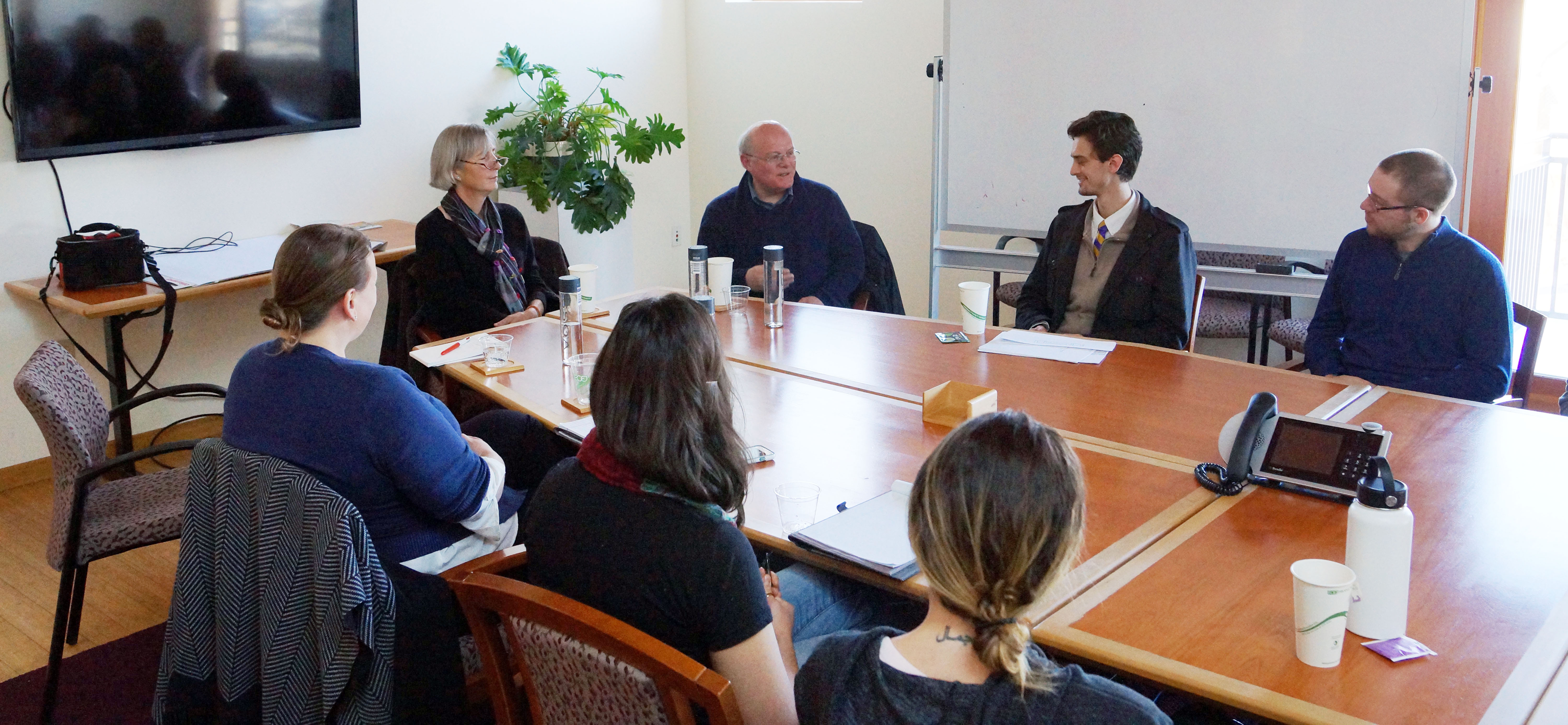
    Master translators Wulstan Fletcher and Elizabeth Callahan visited Naropa University to speak with students about the process of translation from Tibetan to English, and the motivations that led them to pursue such work.

    The conversation occurred as part of Naropa University’s Indo-Tibetan Lunch Seminar Series, organized and hosted by Dr. Amelia Hall, Assistant Professor of Religious Studies, which fosters discussion among students across disciplines—art, Indo-Tibetan studies with Tibetan and/or Sanskrit language—and encourages them to explore different ways to study language in general, and Tibetan and Sanskrit in particular.

    Elizabeth began by describing her motivation to learn Tibetan: she was interested in practicing Tibetan Buddhism and understanding what she was practicing. Over the course of her six years of retreat, she gradually learned to serve as an interpreter for Tibetan teachers and became a translator of practice texts. After completing retreat, she fell into being a translator because she wanted to develop a better understanding of emptiness, the rituals associated with Buddhist practice, and the “point” of meditation and saw a way to do that through the practice of translation.

    “Translation can be a skillful way to approach in-depth study.”
    -Elizabeth Callahan

    Following Khenpo Tsultrim Gyamtso Rinpoche’s encouragement to understand the text from the practitioner’s perspective, Elizabeth took translation as the path early on. She explained the importance of working closely with masters of the lineage and students of the same teacher to produce translations. She described a model to approach the translation of Tibetan materials to English to benefit oneself and others equally: absorb yourself in the text–practice, study, and research, then the product of the translation contributes to others being able to practice.

    Elizabeth closed her comments with an encouragement to students to, “Bring <your knowledge of Tibetan> to a point where it is useful for you if you are interested to practice. Train until, when you pick up a text, you have 90% comprehension, and that you’re fluent enough in colloquial Tibetan that you can ask questions to get to 100%.”

    Wulstan began by introducing himself to the group as “The Reluctant Translator”. Completely self-taught, Wulstan completed three-year retreat and worked on technical translations until Tsadra offered support for him to work full time. From his perspective, translation is part of one’s bodhisattva commitment to help people who will never be in a position to learn the language, giving them access to a wonderful tradition that is still alive. “Translation is breaking the shell so people can eat the kernel, or taking the stone off the well so people can get to the water.”

    Wulstan then shifted to sharing his love of language. He explained that the classical Tibetan of the texts, which is quite different from the modern spoken language, is a learned language, like Latin was in the middle ages. It has remained fairly stable and unchanged over the centuries. The written Tibetan of a modern author like Dudjom Rinpoche is in many respects the same as that of Longchenpa, who lived in the fourteenth century. As writers, they are virtual contemporaries even though they are separated by six centuries. This means that, once you have learned to read Tibetan, you have access to vast literature spanning over a thousand years.

    “If you think Buddhadharma is valuable, translate. You can’t know what the benefit will be—maybe you’re giving a tool to someone who can use it much better than you could!”
    -Wulstan Fletcher

    Exploring the Craft of Translation

    Elizabeth and Wulstan answered thoughtful questions from the students about what to do when experiencing a block or facing something you don’t understand. Wulstan urged students to read slowly and not to lose heart. He explained that while Tibetan grammar is not complicated, its syntax is strange and confusing to speakers of an Indo-European language like our own. Tibetan is not written in sentences in the way that English is—centerd on a main verb with principal and relative clauses all clearly connected. Thanks to its use of particles and its unrestricted capacity for subordination, Tibetan is often written in extended, river-like periods which can be very long indeed—alarmingly so for the beginner. Nevertheless, it is important to get used to the way Tibetan writers arrange their ideas and to read their sentences in the way Tibetans do rather than jumping around trying to piece together bits of sense, more or less guessing how they should be put together. It’s only when you have grasped the meaning of the Tibetan that you can then put it into English, dividing up the Tibetan into shorter manageable statements. This isn’t easy and takes a lot of practice, so it’s important to be patient and not get discouraged. Then, because the syntactical structure of the two languages is so different, it is important to “step away” from the original Tibetan and recast the meaning into a natural English form. When the translation process is complete, the text should read as clearly and easily as a text composed in English. This is part of being kind to the reader which, above all, Elizabeth and Wulstan reminded the students to do by thinking of their audience when translating.

    Both translators spoke of the importance of mastering of one’s own language—cultivating a knowledge of English literature to know stylistically what is good. They encouraged the students to read literature, to love English, to read the poets, and cherish the language. By translating, one is contributing to the corpus of literature in our own language.

    They offered a step-by-step approach to working with a translation:

    1. Use dictionaries and online resources like Columbia University’s Buddhist Canon Research Database with searchable unicode text, the BDRC database, and the Tibetan Himalayan Translation Tool online;
    2. Work with context and play with how to say things in different ways;
    3. Continue the research process: “Read around” the text by engaging with relevant texts and scholarly materials to help build context; and
    4. Ask questions: understanding the author’s life could inform your translation.

    The conversation ended with an encouraging comment from Elizabeth to the young translators: “If you feel drawn to learn Tibetan and become a translator, do it. You’ll find a way.”
  • Tengyur Translation Conference 2011

    Tengyur Translation Conference 2011

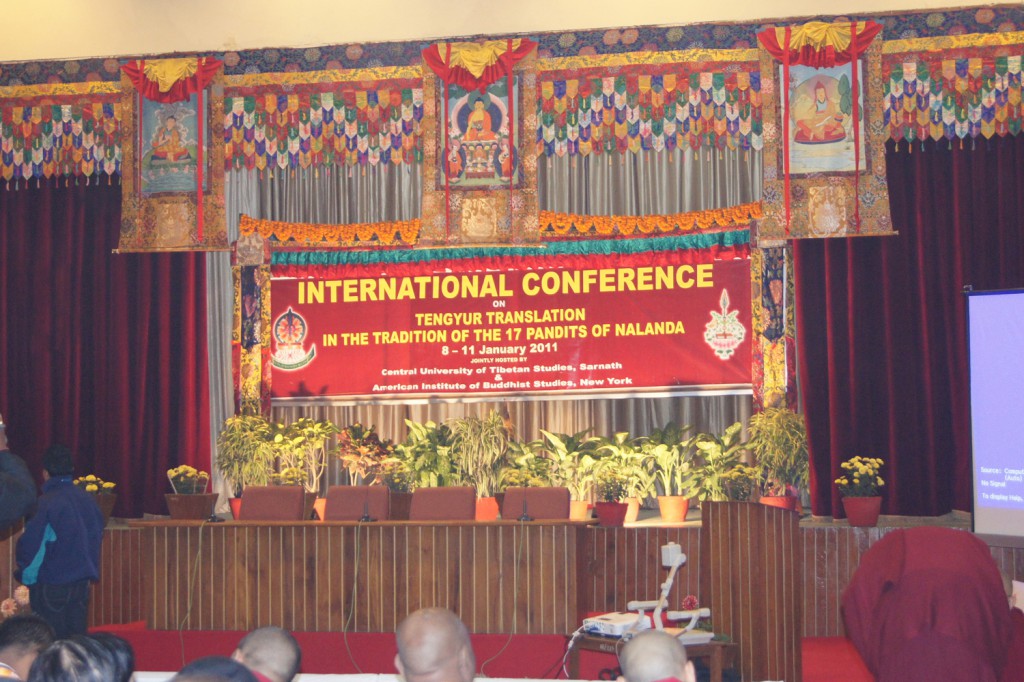
    See the follow up to this blog post here. Tengyur Translation Conference Banner

    The crowd on the opening day of the conference in Atisha Hall

    The “Tengyur Translation Conference: In the Tradition of the 17 Pandits of Nalanda,” was held at the Central University of Tibetan Studies (CUTS, formerly CIHTS) in Sarnath, India, with the support and attendance of His Holiness the Dalai Lama. Scholars, teachers, translators and Tibetan Lamas from many traditions attended the four day affair in the unusually cold January weather, which made Atisha Hall a large refrigerator throughout the proceedings. Despite the need to speak at the podium wearing North Face jackets and scarves, participants gave some excellent presentations and many lively discussions marked this important scholarly venture. Jointly held by CUTS and AIBS (American Institute of Buddhist Studies, Columbia, New York), the conference was to be a meeting of some of the best minds in Buddhist studies on the project of translating the entire Tengyur section of the Tibetan Canon. Such a project presents many organizational, theoretical, philological and economic problems, some of which were touched upon by various presenters. In fact, a key purpose for the conference was the assessment and discussion of such issues amongst a learned body of scholars.

    Dr. Robert Thurman

    The conference came together in large part due to the efforts of Robert Thurman’s “crew” at AIBS and the University of Columbia, Annie Bien and Tom Yarnall, and on the CUTS side, Shrikant Bahulkar and Ven. Ngawang Samten. Hats off to all those seen and unseen who provided for all the participants and laid the ground for the conference.

    Dr. Thurman made a point to note that this conference was really the third in a set of conferences he felt built on one another, the first being the translator conference in Boulder and the second the Khyentse Foundation conference in Bir. This and other comments may have led some participants to wonder about the relationship between the organizations involved in each of these conferences, organizations which are in fact quite distinct. Although the stated projects and goals of each conference were somewhat different, probably the most important thing that links each of these conferences is the opportunity they provide for an ongoing dialog among translators and scholars who work with Tibetan texts. This, I think, is the most important outcome of these conferences and I hope it can continue. Regardless of the various organizations, politics and attempts at institution building, the translators, scholars and scholar-practitioners who attend these conferences benefit greatly from the time they share together. Every person I asked about the conference responded as most do at the conferences I have attended over the past few years: The most important aspect of the conference is the time outside of the scheduled events where they meet with colleagues and discuss finer points or are introduced to new people and ideas. However ephemeral and unquantifiable, it appears that the unchaperoned times are the real reason to attend such a conference.

    One of the more concrete outcomes of the conference was the reports that were made on the state of translating Buddhist texts into a whole host of languages. Participants arrived from many countries to discuss translations of primarily Tibetan texts into English, Sanskrit, Hindi, Chinese, Korean, Japanese, Nepali, German, French, Spanish, Italian, Russian, Hebrew, and other European languages. It was an impressive list really and particularly interesting to hear about the efforts of Nepali and Hindi translators. There were a number of calls from the audience to place more focus on the importance of translating Buddhist texts into the modern languages of India, as this was where the Buddha’s teaching originated. Ngawang Samten noted that at the Central University of Tibetan Studies about 60 texts have been translated into Hindi so that key commentaries are available to Indian peoples. Although it was a little difficult to piece together a clear picture of the state of Tengyur text translation around the world, the picture painted seemed to indicate that quite a lot of work is currently underway. While some presenters described the long history of translation efforts into their mother tongues (German, French, English), others decried a sad state of affairs (Spanish, Hindi). Although there appears to be work happening around the world, compared to the mountain of texts that exist as a part of the several known Tengyur catalogs, the world’s Tibetan translators still have a long way to go. One important point that was made by quite a number of delegates at the conference was that the key factor in translating texts into their language was not seen to be money or support, but expertise and training. There simply are not enough well-trained translators capable of working on what are some of the most difficult texts in Buddhist literature. Translating Tengyur texts is not just a matter of gathering together a group of people who are excited about the project and who know a little Tibetan. Time and again scholars at the conference noted the importance of establishing schools or finding other ways to support the development of truly qualified translators. The lack of qualified translators is felt not only in Spanish or Hindi or Russian, but in every language. What to do about it is certainly a problem that needs to be addressed by any organizational body wanting to tackle such an ambitious project.

    Betsy Napper, who gave some of the most practical advice, suggested that a training program could be developed in which the younger generation of translators worked on draft translations of texts and then handed off their work to elder translators. Before any actual translation work should be done, however, she suggested the project be taken on in a modular way, first developing online and bibliographic tools, then creating groups to develop critical editions of texts, and so forth.

    Alexander Berzin also presented practical advice for tackling the immense project by discussing lessons learned developing his “Berzin Archives” website. Truly an amazing accomplishment, the large network of translators, transcribers, editors, proofreaders, and other specialists that Dr. Berzin has developed provides a constantly evolving archive of translations and teachings on Buddhism in many languages worldwide. Dr. Berzin was therefore able to give specific advice about the development of tools for managing work-flow, tools for managing translation in many disparate languages – such as a wiki that all translators could log into – interlinked glossaries that allow standardization of terminology, separate online glossaries for readers, and so on.

    The Dalai Lama himself also offered some interesting advice: Collect all the texts from the Asian canons (Chinese, Korean, Pali, Sanskrit, Tibetan) and make sure that the texts missing from one are included in another. Once a “complete” canon is available, then translate that into modern western languages.

    It remains to be seen what advice will be taken to heart as various projects to translate the Kangyur and Tengyur develop around the world. Robert Thurman’s American Institute of Buddhist Studies was the driving force behind this conference and they have been working on the project of translating texts from the Tengyur for some time. Their mission statement, as reported by Dr. Thurman at the opening of the conference, is “To create and support the necessary institutional framework within which to produce critical, readable, contemporary translations of the 3,600+ classical source texts of the “liberating arts and sciences” of the Indo-Tibetan civilization.” This is truly a massive undertaking and one that will need the support of many scholars and translators world-wide if it is to even begin to make headway. It will be very interesting to see what comes out of this exciting project in the coming years.

    A seat waits for His Holiness the Dalai Lama

    See the next post about the Tengyur Translation Conference here.

  • Tools of the Trade’ of the Tibetan Translators

    Tools of the Trade’ of the Tibetan Translators

    Pieter Verhagen, Leiden University, The Netherlands

    (12th Seminar of the IATS, Vancouver, BC, August 16th, 2010)

    Pieter Verhagen presented a list of textual sources that he believes the early Tibetan translators of Indian Buddhist texts relied upon as “tools of the trade”. I beg his pardon, and hope he doesn’t mind that I share this list here, as it was made publicly available by him at the conference and I think others will be interested. These are the texts he discussed and the citations he provided in a hand out:

    1) Mahāvyutpatti = bye brag tu rtogs byed chen po sde dge bstan ‘gyur vol. co, f. 1r1-131r8

    2) sgra byor bam po gnyis pam sde dge bstan ‘gyur vol co, f. 131v1-160r7

    3) khri lde srong btsan sad na legs (799-815) > ‘translation’ edict 814 CE

    4) khri srong lde btsan (755-797) >’translation’ edict 795 (or 783) CE

    5) *Sv-alpa-vyutpatti = bye brag tu rtogs byed chung ngu

    9) Dhātupāṭha

    – CG 21: Dhātu-kāya, Tib. byings kyi tshogs sde dge bstan ‘gyur vol. no, f. 112v6-122v2 (Tohoku no. 4429)
    – CG 22: Dhātu-kāya, Tib. (lung ston pa ka lā pa’i) byings kyi tshogs sde dge bstan ‘gyur vol. le, f. 63r3-75r7 (Tohoku no. 4285)
    – CG 25: Dhātu-kāya, Tib. (tsandra pa’i) byings kyi tshogs sde dge bstan ‘gyur vol. re, f. 71r5-78r7 (Tohoku no. 4277)
    – CG 30: Kalāpa-dhātu-sūtra, Tib. ka lā pa’i byings kyi mdo sde dge bstan ‘gyur vol. no, f. 1v1-10r7 (Tohoku no. 4422)
    – CG 32: *Dhātu-sūtra, Tib. byings kyi mdo (brda sprod pa tsandra pa’i byings kyi tshogs kyi gleg bam gyi mdo) sde dge bstan ‘gyur vol. no, f. 21v2-31v4 (Tohoku no. 4424)
    – CG 45: Pāṇini-dhātu-sūtra, Tib. Pā ṇi ni’i byings kyi mdo Peking bstan ‘gyur vol. pho, f. 342v2-358r5 (Otani no. 5913) [sde dge: deest]

    10) Gaṇapāṭha

    – CG 2: Viṃśaty-upasarga-vṛtti, Tib. nye bar (b)sgyur ba nyi shu pa’i ‘grel pa (a) Peking bstan ‘gyur vol. le, f. 36v4-41v1 (Otani no. 5768); snar thang vol. le, f. 35v1-39v7; dga’ ldan vol. le, f. 43r1-49r2 (b) sde dge bstan ‘gyur vol re. f. 30r1-34r2 (Tohoku no. 4270); Co ne vol. re, f. 32r1-36v3

    – CG 18: Prayoga-mukha-vṛtti, Tib. rab tu sbyor ba’i sgo’i ‘grel pa

    • sde dge bstan ‘gyur vol. she, f. 244r1-250v6 (Tohoku no. 4292)
    • co ne bstan ‘gyur vol. she, f. 246r1-252v6
    • Peking bstan ‘gyur vol. le, f. 238v1-245v6 (Otani no. 5781)
    • snar thang bstan ‘gyur vol. le, f. 222v1-230r6

    – CG 26: Saṃbandha-siddhy-abhidhāna-prakriyā, Tib. ‘brel ba grub pa zhes bya ba’i rab tu byed pa

    • sde dge bstan ‘gyur vol. re, f. 78v1-106r5 (Tohoku no. 4278)
    • co ne bstan ‘gyur vol. re, f. 85v4-114v4
    • Peking & snar thang bstan ‘gyur: deest