Tsadra Foundation Hosts Tibetan Language Intensive at CU, Boulder
UPDATE! The 2019 summer program was the last of these events.
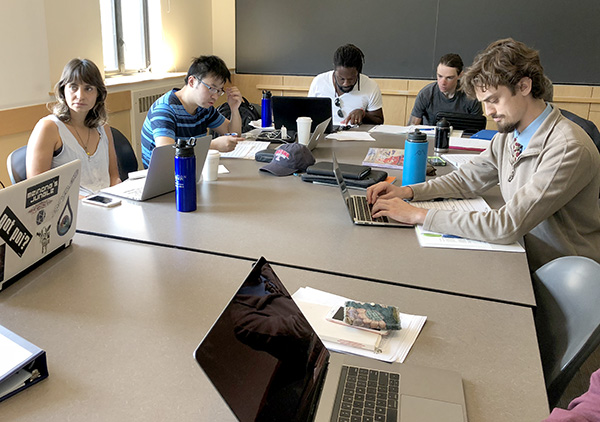
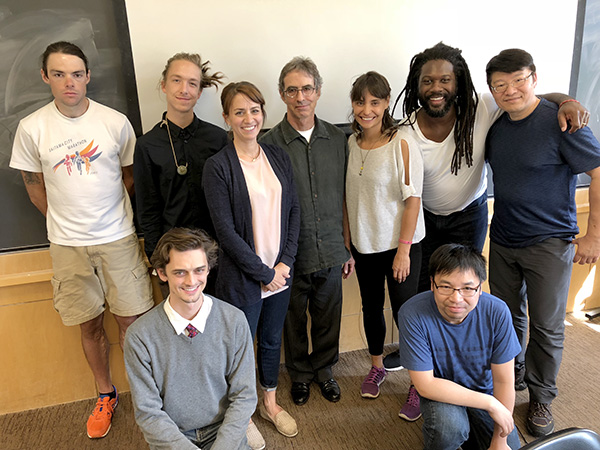
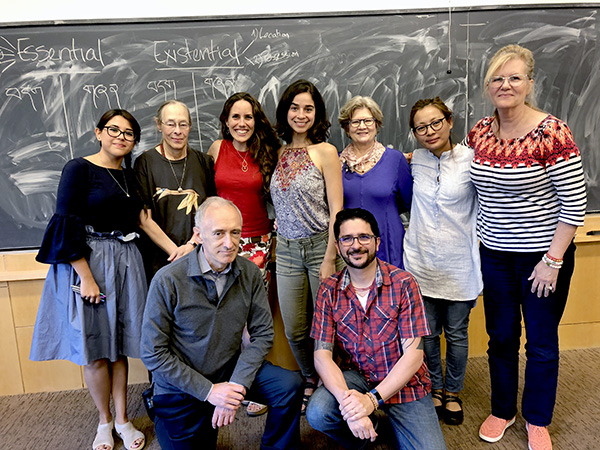
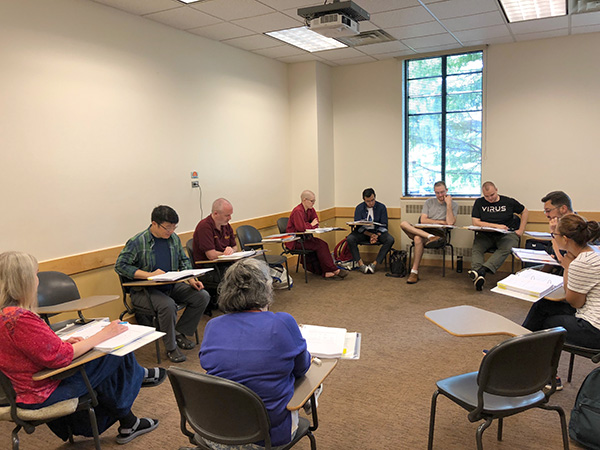
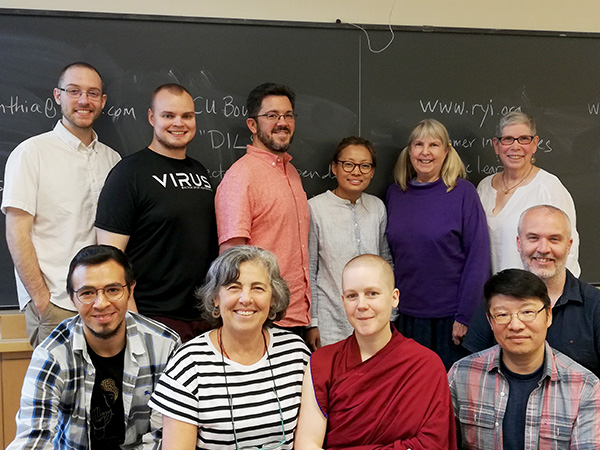
Tsadra Foundation’s first Summer Tibetan Language Intensive concluded on August 25, 2018 at the University of Colorado, Boulder. The course created an opportunity for twenty-four students who otherwise could not have afforded long breaks from work, family, or school–or travel to Asia–to experience a condensed and rigorous training with excellent language instructors and master translators.
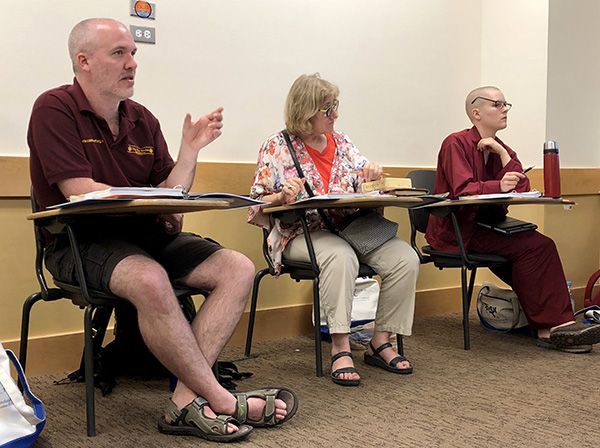
Students from as close as Boulder and as far from Colorado as Australia and Brazil traveled to attend the two-week-long intensive course. Three tracks–beginning, intermediate, and advanced–were taught by Lama Sarah Harding, Dr. Jules Levinson, Cinthia Font, Miguel Sawaya, and Tashi Choezom. Students were placed according to a self-assessment of their skill level with classical and colloquial Tibetan and each track was designed specifically to support the development of skills in both classical/literary and spoken Tibetan.
“The content was perfectly suited to me and our class. It was useful, inspiring!” -Advanced student
Advanced students spent their mornings with Sarah Harding working their way through Mendong Tsampa Rinpoche’s commentary on the famous Aspiration Prayer of Definitive Mahamudra (Chakchen Monlam) by the third Karmapa Rangjung Dorje, while the beginning and intermediate students focused on classical and colloquial Tibetan respectively.
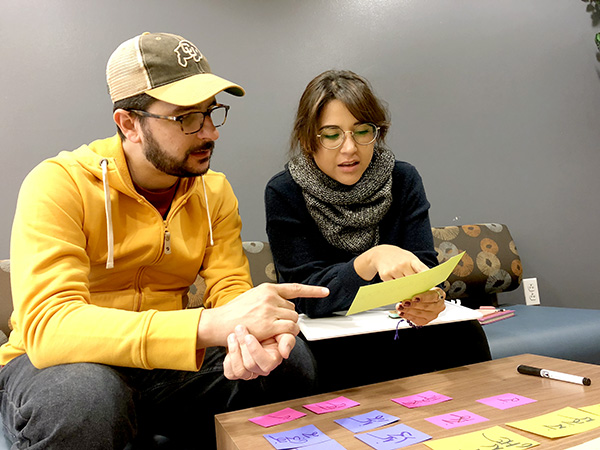
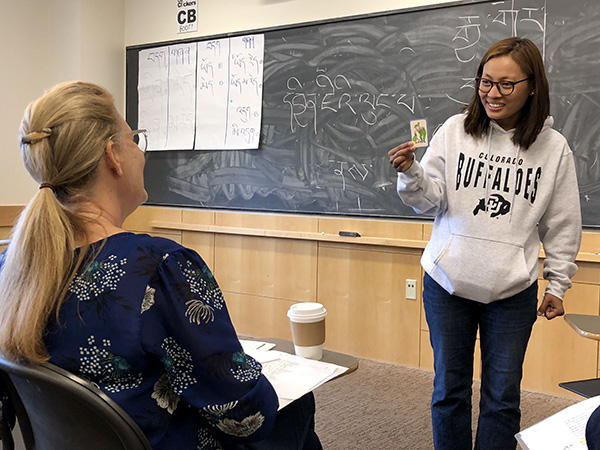
Afternoons of the eleven-day course featured Jules Levinson working with the advanced students to develop skills in oral translation while the intermediate students worked through classical works like the Praise to Manjushri (གང་གི་བློ་གྲོས་) and Tsongkhapa’s Three Principle Aspects of the Path (ལམ་ཙོ་རྣམ་གསུམ་,). Beginning students continued their work on colloquial skills by learning songs and practicing sentence construction utilizing various interactive methods.
Short workshops were offered during the course based on students’ interests, including lunch sessions on digital resources for Tibetan translators, Sanskrit for Tibetan translators, methodologies for oral interpretation, and a presentation on the Amdo dialect and the Ume script.
“I loved my teachers! Simply fantastic!” – Beginning student
Tsadra Foundation wishes to offer sincere thanks to Holly Gayley, the Center for Asian Studies, and the University of Colorado for helping us host the event!
Naropa Students Enjoy Lunch with Master Translators
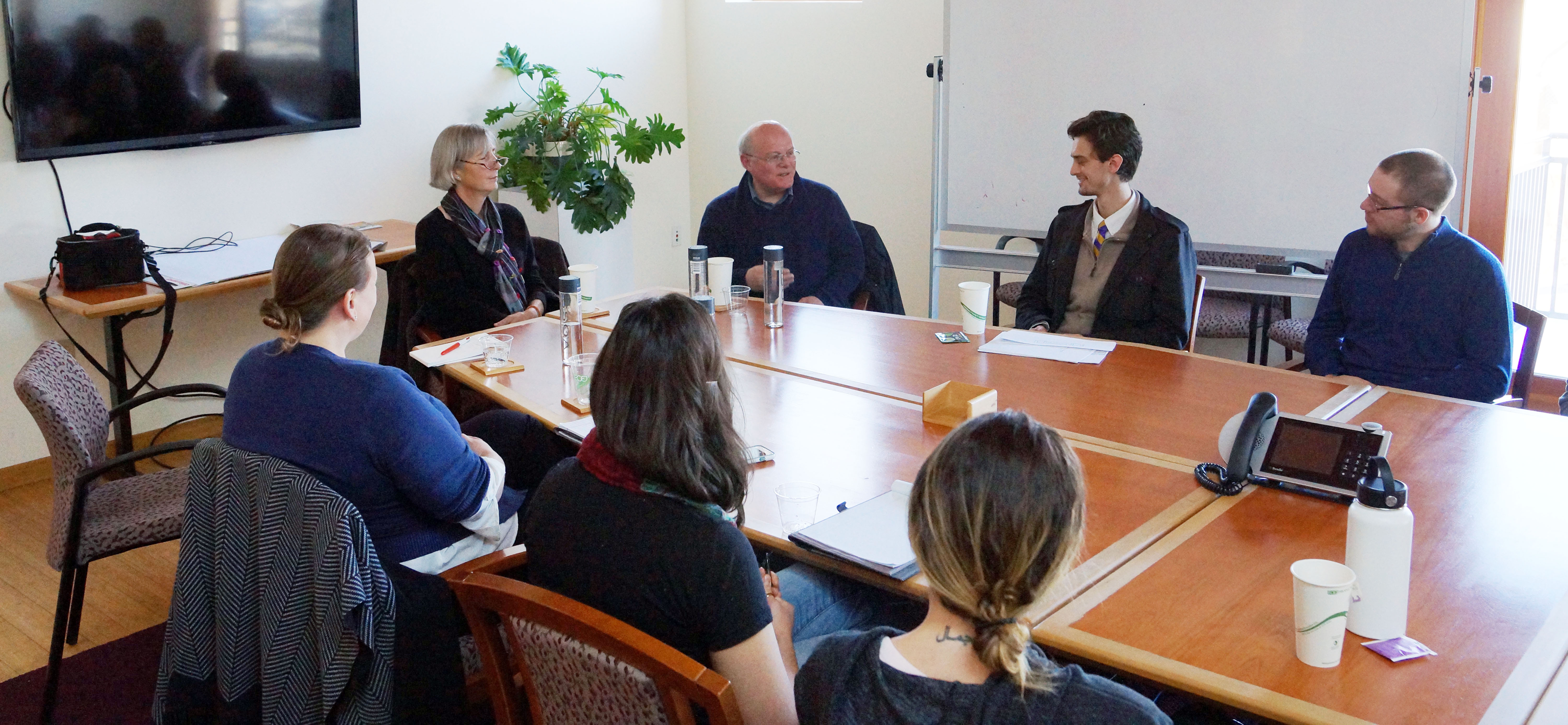
Master translators Wulstan Fletcher and Elizabeth Callahan visited Naropa University to speak with students about the process of translation from Tibetan to English, and the motivations that led them to pursue such work.
The conversation occurred as part of Naropa University’s Indo-Tibetan Lunch Seminar Series, organized and hosted by Dr. Amelia Hall, Assistant Professor of Religious Studies, which fosters discussion among students across disciplines—art, Indo-Tibetan studies with Tibetan and/or Sanskrit language—and encourages them to explore different ways to study language in general, and Tibetan and Sanskrit in particular.
Elizabeth began by describing her motivation to learn Tibetan: she was interested in practicing Tibetan Buddhism and understanding what she was practicing. Over the course of her six years of retreat, she gradually learned to serve as an interpreter for Tibetan teachers and became a translator of practice texts. After completing retreat, she fell into being a translator because she wanted to develop a better understanding of emptiness, the rituals associated with Buddhist practice, and the “point” of meditation and saw a way to do that through the practice of translation.
“Translation can be a skillful way to approach in-depth study.”
-Elizabeth Callahan
Following Khenpo Tsultrim Gyamtso Rinpoche’s encouragement to understand the text from the practitioner’s perspective, Elizabeth took translation as the path early on. She explained the importance of working closely with masters of the lineage and students of the same teacher to produce translations. She described a model to approach the translation of Tibetan materials to English to benefit oneself and others equally: absorb yourself in the text–practice, study, and research, then the product of the translation contributes to others being able to practice.
Elizabeth closed her comments with an encouragement to students to, “Bring <your knowledge of Tibetan> to a point where it is useful for you if you are interested to practice. Train until, when you pick up a text, you have 90% comprehension, and that you’re fluent enough in colloquial Tibetan that you can ask questions to get to 100%.”
Wulstan began by introducing himself to the group as “The Reluctant Translator”. Completely self-taught, Wulstan completed three-year retreat and worked on technical translations until Tsadra offered support for him to work full time. From his perspective, translation is part of one’s bodhisattva commitment to help people who will never be in a position to learn the language, giving them access to a wonderful tradition that is still alive. “Translation is breaking the shell so people can eat the kernel, or taking the stone off the well so people can get to the water.”
Wulstan then shifted to sharing his love of language. He explained that the classical Tibetan of the texts, which is quite different from the modern spoken language, is a learned language, like Latin was in the middle ages. It has remained fairly stable and unchanged over the centuries. The written Tibetan of a modern author like Dudjom Rinpoche is in many respects the same as that of Longchenpa, who lived in the fourteenth century. As writers, they are virtual contemporaries even though they are separated by six centuries. This means that, once you have learned to read Tibetan, you have access to vast literature spanning over a thousand years.
“If you think Buddhadharma is valuable, translate. You can’t know what the benefit will be—maybe you’re giving a tool to someone who can use it much better than you could!”
-Wulstan Fletcher
Exploring the Craft of Translation
Elizabeth and Wulstan answered thoughtful questions from the students about what to do when experiencing a block or facing something you don’t understand. Wulstan urged students to read slowly and not to lose heart. He explained that while Tibetan grammar is not complicated, its syntax is strange and confusing to speakers of an Indo-European language like our own. Tibetan is not written in sentences in the way that English is—centerd on a main verb with principal and relative clauses all clearly connected. Thanks to its use of particles and its unrestricted capacity for subordination, Tibetan is often written in extended, river-like periods which can be very long indeed—alarmingly so for the beginner. Nevertheless, it is important to get used to the way Tibetan writers arrange their ideas and to read their sentences in the way Tibetans do rather than jumping around trying to piece together bits of sense, more or less guessing how they should be put together. It’s only when you have grasped the meaning of the Tibetan that you can then put it into English, dividing up the Tibetan into shorter manageable statements. This isn’t easy and takes a lot of practice, so it’s important to be patient and not get discouraged. Then, because the syntactical structure of the two languages is so different, it is important to “step away” from the original Tibetan and recast the meaning into a natural English form. When the translation process is complete, the text should read as clearly and easily as a text composed in English. This is part of being kind to the reader which, above all, Elizabeth and Wulstan reminded the students to do by thinking of their audience when translating.
Both translators spoke of the importance of mastering of one’s own language—cultivating a knowledge of English literature to know stylistically what is good. They encouraged the students to read literature, to love English, to read the poets, and cherish the language. By translating, one is contributing to the corpus of literature in our own language.
They offered a step-by-step approach to working with a translation:
Work with context and play with how to say things in different ways;
Continue the research process: “Read around” the text by engaging with relevant texts and scholarly materials to help build context; and
Ask questions: understanding the author’s life could inform your translation.
The conversation ended with an encouraging comment from Elizabeth to the young translators: “If you feel drawn to learn Tibetan and become a translator, do it. You’ll find a way.”
The Foundation, in consultation with all the partners, sponsors, conference steering committee members, and speakers from the 2014 Translation & Transmission Conference is proud to announce the second conference in the Translation & Transmission Series, which will take place June 1-4, 2017 in Boulder, Colorado. In light of the universal support and positive feedback we received for the previous conference, we feel that it is important to continue the conversation and community building that the 2014 conference facilitated.
The purpose of this conference series is to provide an international forum for sustained dialogue and the sharing of ideas and experiences, as well as for collective reflection on the larger cultural and societal dimensions of the transmission of Tibetan Buddhism to the contemporary sphere. This conference is not a showcase for any single project or institution but an opportunity for all to gather in an open and collegial spirit.
In the spring of 2017 the conference will convene in the heart of Boulder, Colorado, at the Glenn Miller Ballroom, University Memorial Center, June 1st through 4th, 2017.
Karl Brunnholzl (Nitartha Institute, Nalandabodhi)
Translating – Day 2
Kurtis Schaeffer (University of Virginia)
Thupten Jinpa (Institute of Tibetan Classics)
Elizabeth Napper (Tibetan Nuns Project)
Translations – Day 3
John Canti (84000, Padmakara)
Tom Yarnall (AIBS, Columbia, Tibet House US)
David Kittelstrom (Wisdom Publications)
Sarah Harding (Tsadra, Naropa University)
Workshop presenters are still to be invited but will include more than 32 other translators and specialists in Tibetan language.
The program schedule is still being planned and announcements will be made as soon as possible. Please sign up to receive the conference newsletter if you plan to attend or would like more information about the conference.
Registration will open online in Summer 2016.
If you or your organization wishes to donate to the conference effort or become a sponsor of the conference, please contact Marcus@tsadra.org
The Conference Steering Committee
John Canti (Padmakara Translation Group & 84000)
Wulstan Fletcher (Padmakara Translation Group & Tsadra Foundation)
Holly Gayley (University of Colorado, Boulder)
Sarah Harding (Naropa University & Tsadra Foundation)
The Challenge of translation – Faithful yes, but not a slave
BY CHRISTIAN CHARRIER
While no one disputes that a translation must be truthful, the definition of truthfulness and the ways in which translators have striven to achieve it have varied over the centuries. Word-for-word translation has given way to translation of meaning with the translated text reading as naturally in the TL as the original did in the SL. Reconciling truthfulness and beauty is one of the most important challenges faced by translators.
*****
Much has been said and written about the notion of faithfulness (or fidelity) in translation, even the sexist comment that a translation is like a woman : if is faithful it is not beautiful and if it is beautiful it is not faithful, as if being both faithful and beautiful were mutually exclusive
Obviously, like everything else, “faithfulness” depends on how you define it – a principle of loyalty or honesty or a matter of exactness and accuracy ; or both ; or much more that that ) – and also it depends on what you relate it to – word or meaning ; the source language or the target language ; the source text or the target text ; the author or the reader.
Faithfulness will also depend on the different choices you make and the strategies you use in different translating situations (oral or written), with different texts (literary or technical ; philosophy, poetry, logics, etc…). And accordingly, it raises different types of difficulties. Usually technical translators are envious of literary translators because they do not have technical problems to solve, and literary translators are envious of technical translators because they only have technical questions to deal with. We Dharma translators, are not envious of anybody else, because we have both : the technical problems and all the rest…
Without getting into theoretical issues about linguistic theories in translation, I would like to relate this notion of faithfulness to my personal experience as a Dharma translator and specially to one model of translation strategy developed by Lederer (2001) at the ESIT school of translators in Paris that I find interesting and useful. So, as this exploration of the extent of faithfulness, has mainly given me the opportunity to reconsider my ideas about translation and my involvement in translating Dharma I am afraid that apart from being a very self-centered talk, the rest might be very familiar to you and overrun.
*****
In the early eighties, when the director of a FPMT center in France asked me to translate orally, from English to French, the teachings of the resident gueshé on Shiné and Lhaktong, I thought he was pulling my leg. First, I did not know who Shiné and Lhaktong were and did not think that just knowing a foreign language suddenly qualified someone to be a translator or worse an interpreter. On top of that How can you translate something you do not understand ? The reason that apparently made me a translator was that I understood English and had a degree in linguistics from a Canadian university. But speaking a language and translating a Buddhist senior monk talk about meditation and philosophy are for me two different things : in one case, you think you know what you are talking about, while in the other you know you don’t.
But curiosity and temptation were stronger than I thought, so I finally went up to meet Gueshé la in his room and find out more about the subject.
After hearing all my excuses about my incompetence, Gueshé La just smiled at me and said : ” Oh don’t be so shy just say the same thing in your own language ! “
Saying the same thing in my own language ! That was exactly what I thought I could not do, as my knowledge of the thing itself was rather a non-thing and definitely not functional.
But as you cannot resist a wise and compassionate person, a few days later, after some more encouragement by Gueshé la, convincing me that there was not any body else around who could do it, I was sitting on the hot cushion, scared as a newborn lamb, trying to convey as faithfully as I could, that is almost word by word, whatever Gueshé la was saying. Sorry, whatever the English translator was saying, as I did not know Tibetan then. This was my first experience of translating Dharma : translating a Tibetan translator translating the words of a Tibetan scholar speaking about a subject I knew nothing about. This is how Dharma teachings were introduced in France when at this time when there were no direct Tibetan-French translators available. Taking any one who came close to accomplishing the function of a merely labeled translator. In that case ME.
Everybody knows the famous expression (traduttore, traditore): that interpreters are traitors. And in that case we were two traitors. Although some might argue that two traitors are probably better than just one, as betraying the traitor could be one step closer to truth !?! Anyway, we both joined our efforts as best we could, trying to translate every word like a dictionary would. Isn’t a dictionary the best tool for translating ? This is when I proudly started to consider myself as being just a tool at the service of Dharma and others. A Dharma translating machine so to speak.
The 2011 Tsadra Foundation Fellows & Grantees Conference began today at the Emory Conference Center in Atlanta, Georgia. Participants flew in from around the world to share their research and their passion for translation, and to celebrate more than ten years of Tsadra Foundation projects.
Tsadra Fellows, grantees, and guests gathered for the opening dinner at Houston Mills House, just across the iron bridge from ECC.
The next three days will be filled with presentations from some of the best translators in the world on such diverse topics as translation theory, the Indian and Tibetan sources of gzhan stong, and the autobiographical writings of Kun dga’ grol mchog.