

Tag: Sakyadhita

[rev_slider alias=”tsadra-blog”]

Sakyadhita

  • What’s in a Name? Sakyadhita Conference Presentation from Sarah Harding

    What’s in a Name? Sakyadhita Conference Presentation from Sarah Harding

    16th Sakyadhita Conference: Buddhist Women Rising to Challenges

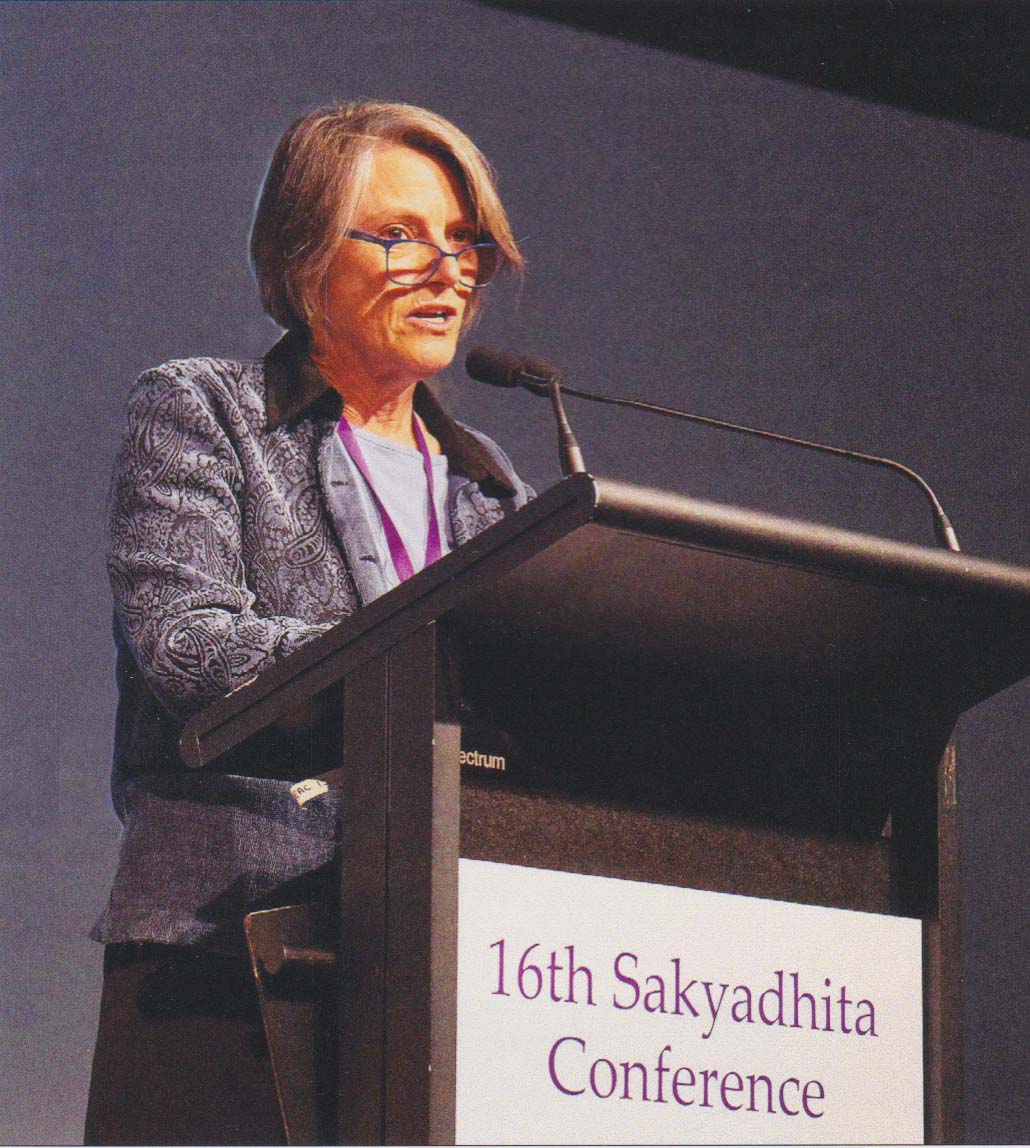
    Presentation by Sarah Harding

    What’s in a Name?

    “Buddhist Women Rising to Challenges” struck a chord with me since I have definitely felt the challenge of being a woman in the Buddhist world. But as that experience was certainly not unique, it never occurred to me to write about it. Then way down at the bottom of Sakyadhita’s call for papers it said “More personalized perspectives based on one’s own experiences will be welcome.” 

So for the first time ever I will try that.

    I met my teacher Kalu Rinpoche at his monastery near Darjeeling, India around 1972. I immediately launched into his program of practice through daily teachings in his room with a small group of westerners, in the midst of the usual life of an all-male monastery. One event that struck me was the sudden “liberation,” as it is called, of a three-year retreat that had been going on there unbeknownst to me. I was extremely impressed by the monks that emerged. Later, when Rinpoche announced the first such retreat for westerners, I immediately applied and was not-so-immediately accepted. I learned Tibetan, did the preliminary practices, accumulated the money, helped to build the retreat facilities at a center in France, and entered retreat in 1976 with seven other women. There was only one nun among us. The men were similarly ensconced a short distance away. Rinpoche had not been deterred by criticism from other lamas for assigning women the same practice program as the men, but he did truly wish that everyone would ordain as monastic, and never gave up trying. On his visits in the retreat, he liked to regale us with true, if somewhat exaggerated, stories from his travels of marriages gone terribly wrong. Still, no one new took permanent ordination, and most gave back the temporary vows that we took for the retreat immediately afterwards. As of now, not a single woman or man from that retreat actually retains their monastic vows. In the highly monastic Kagyu and Shangpa traditions, lay people participating at this level of vajrayāna practice in extended, cloistered group retreat was virtually unknown. That left quite a dilemma for an elderly Tibetan master from a different era, culture, and experience to sort out, enlightened or not.

    When the retreat ended in 1980, the first thing that happened was that Rinpoche had each of us give a Dharma talk there at the center in France. So the message was clear: we would be teaching, even though no one had that in mind when they entered retreat (At least not the women. I can’t speak for the men.) The next thing was that we were all to accompany him on a tour of centers around France, sitting on stage with him in our maroon robes, advertised as “the first thirteen occidental lamas.” Rinpoche was clearly very proud of his achievement, and we basked in the glory.

    After the glory tour, (and mine was cut short by being sent to rescue a Sikkimese lama who had run away in Los Angeles), we were all assigned to various posts. I was already in Los Angeles, translating for the runaway lama. I noticed that all the other women were also sent to translate or attend Tibetan lamas, while all the men were sent to be lamas in various centers.  So that was interesting. When I had a chance to inquire, there was some talk about how that was more skillful, since in western culture men were dominant and would be listened to. Right—well, as a translator I can say that people might think they were listening to a man, but in fact they were listening to the invisible female voice beside the throne occupied by a monk. Doesn’t that just resemble the history of the modern world? After my first child was born and I wouldn’t wear Rinpoche’s new fashion for lay teachers of maroon with white stripes, Rinpoche seemed to give up on me. I had totally failed.

    Around 1982, Kalu Rinpoche was preparing for another retreat in Canada, and I decided to attend the empowerments. Somewhat surprisingly, I was the only one of the earlier retreat graduates who was required to pay the attendance fees, which I could not afford. Perhaps inspired by that injustice, I confronted Rinpoche about the whole issue. Were women doing the retreat the same as men? Yes, but the word “lama” is for men. (Funny, since it is a feminine gendered word in Tibetan.) What about Jetsun Lama Kushola? She’s called lama because she’s the sister of Sakya Trinzin. What about Lama Yeshe? Well, if someone calls themselves “lama” it’s polite to address them as they like. And so on. Later, in a public talk, Rinpoche actually said “You can’t call a cow a bull” and “If someone has qualities, they will automatically shine forth like a rainbow appearing when gold is under the ground.” And so forth. I was so devastated that Rinpoche thought I was trying to stake a claim for myself, I slunk away that very day, definitely not rising to the challenge.

    An important Kagyu lama tried to prescribe the word “naljorma” (yogini) for lay female retreat graduates, but this didn’t really stick. However, Kalu Rinpoche’s successor, Bokar Rinpoche, had no trouble at all addressing and respecting lay women who have completed the retreat as “lamas.” So perhaps it is no longer an issue. But my experience with my own guru, in whom I have never had a moment’s doubt, spawned a series of questions for about thirty years that I will try to describe in two minutes:

    I’ve always disdained titles. So why bother? But, at the same time, is it fair if men get it and women don’t? Is this even my fight? I don’t even like the job description of “lama” since I don’t want followers. But if I don’t stand up to it, am I abandoning women? If I do, will it seem arrogant and assertive? Aren’t claims and titles a male thing anyway? Why should a woman have to act like a man? Do I even want to buy into titles bestowed or withheld by men? So, “thanks but no thanks.” (Or something a little more rude.) Do I want a title in a foreign language that no one really understands? Would I rather be called “professor,” since that’s clear? If the power of women is communal and not hierarchical, why set ourselves up for reverence based on a name? Is all this my neurosis or my wisdom?

    This last is the burning question. We are taught, in the Tibetan Buddhist teachings, that the kleśas or toxic emotions are actually a kind of wisdom when they are not distorted by ego-clinging. Thus, desire is the wisdom of discernment, anger is mirror-like wisdom, and so forth. This is a fundamental teaching of the vajrayāna. Usually it is described as the wisdom present after those poisons are purified. But what if they co-exist? If desire exists alongside the wisdom of discerning that those specific desired phenomena are intrinsically empty; that anger is permeated by the mirror-like wisdom that reflects equally the merely superficial images of infuriating situations; that pride actually is the wisdom of equality that recognizes our interconnectedness, and so on?

    And what if the wisdom of the noncompetitive nonassertive female power coexists in me along with the scourge of female low self-esteem? That not rising to the challenge of female equity in the Buddhist ranks or stepping up to the role of lama is both a kind of humility and resistance to egomania and at the same time a shrinking acquiescence to male dominance? I don’t know.

    There’s no time now to report on my research regarding female titles, other than a few observations. While many Asian lineages have mostly kept the traditional titles in the west, occasionally sharing them with women, the Tibetan lineages use all kinds of titles, mostly deriving from Tibetan or Sanskrit terms taken out of context. So there are mitras, shastris, loppons, acharyas, naljormas, ngakmas, yoginis, jetsunmas, khandromas, etc. In a nod to the English, one group uses “vicar” and the hilarious “brevet lama,” borrowed from British military.

    The important pattern to notice is that aside from the word “lama” when it is used for graduates of the three-year retreat, almost all the titles do not indicate any specific achievement. Titles are bestowed solely at the discretion of a teacher at best, or at worst claimed by the person themselves in what is a very literal “sense of entitlement.” The former requires us to have confidence in the clairvoyance of the preceptor that granted the title, and the one that granted that one, and so on back into the past. But this makes it quite difficult to research the background of any prospective teacher, the way the Dalai Lama has recommended. And I found that the majority of title grants were more about promoting the teacher’s sphere of influence than the spiritual realization of the disciple, which in any case is difficult to assess. Needless to say, the self-entitled teachers greatly add to the befuddlement of us mortals.

    Ideally, titles should indicate something specific that anyone could understand. For instance, a PhD doesn’t guarantee wisdom, but at least we know the person did their homework. Usually. That’s why “Venerable” and “Venerable Bhiksuni” for fully ordained nuns works so well. Someone who takes and keeps vows is worthy of veneration for that alone. It’s clear and universally understood. But for there to be an equivalent term for lay female teachers would require agreement on teacher training, programs, levels, names, and so forth across Buddhist schools and lineages, or even within one lineage. I don’t think that is going to happen. It would be nice to do away with titles altogether, but that’s not going to happen either. I guess each person has to figure it out alone.

    Anyway, it’s too late for me now: my five-year-old grandson already calls me “grammalama.” I’m going to have a lot of explaining to do.


    Learn more about Sakhyadhita on their website: Working at the grassroots level, Sakyadhita provides a communications network among Buddhist women internationally. We promote research and publications on Buddhist women’s history and other topics of interest. Our members strive to create equal opportunities for women in all Buddhist traditions. Read More
  • Sakyadhita Conference

    Sakyadhita Conference

    What I did over Christmas Vacation

    With the support of Tsadra Foundation, I ventured forth to the 11th Sakyadhita International Conference on Buddhist Women, held from December 28th through January 3rd, in Ho Chi Minh City, or Saigon, in Vietnam. There, I presented a paper entitled “Seeking Niguma, Lady of Illusion” extracted from my forthcoming book of translations of the works of this 11th century Indian saint.

    Sakyadhita—”Daughters of the Buddha”—is a global coalition of Buddhist Women established in 1987. It has 2000 members and friends in 45 countries, and has an international conference every two years in a different country, and national conferences in individual countries. There is a strong emphasis on women’s scholarship and on supporting the bikkhuni sangha (fully ordained nuns) in the various Buddhist countries. In their own words:

     Working at the grassroots level, Sakyadhita provides a communications network among Buddhist women internationally. The organization promotes research and publications on Buddhist women’s history and other topics of interest. It supports Buddhist women’s initiatives to create education projects, retreat facilities, training centers, women’s shelters, and local conferences and discussion groups. Members strive to create equal opportunities for women in all Buddhist traditions. The goal is to empower the world’s 300 million Buddhist women to work for peace and social justice.

    Venerable Karma Lekshe Tsomo

    Since the first small gathering in Bodhgaya with the Dalai Lama as keynote speaker, the movement has gained momentum under the able leadership of Venerable Karma Lekshe Tsomo, an American nun and author who divides her time between the University at San Diego and Asia. The conference this year in Vietnam boasted the overwhelming attendance of over 2000 people from 34 different countries, the majority of them nuns.

    many good nuns

    I really didn’t know there were so many! There were nuns of every stripe and color. The majority were, of course, from Vietnam itself, where nuns in grey and saffron robes mix beautifully. Others were also there in force: There were the brilliant dayglo-orange nuns from Sri Lanka, whose membership of fully ordained nuns has gone from 0 to over 1000 in just ten years since Sakyadhita has been there to support them.

    nuns in panchos

    There were the grey armies from Korea, who burst into smiles and antics at the merest glance, including one favorite singing nun who serenaded our taxi ride with “Santa Rucia.” There were several grades and colors from Thailand, the white-robed novice meji and the controversial fully ordained nuns, most bravely represented by Dhammananda Bhikkhuni (Chatsumarn Kabilsingh—more on her later). There were pink and white nuns, maybe from Nepal or Burma, and many greys and browns from the Chinese tradition, mostly from Taiwan, Singapore and Hong Kong.

    multimedia nuns

    There was a tight team of Ladhaki nuns who came with minimal sponsorship, seeking more. The six or so Ladakhis, along with one Bhutanese, one Singaporean, and several Indian-based nuns from Kinnaur and Dharamsala, were the only Asians representing the Tibetan tradition.

    Ladakhis

    The main maroonies were Westerners, including the most venerable Jetsunma Tenzin Palmo, who is absolutely the rock star of the bikkhuni world.

    Jetsunma Tenzin Palmo holding court

    The same goes for the Japanese traditions, which were represented by a decent turnout of ordained priests from San Francisco Zen Center, but little else. A good many lay people also attended from countries like Malaysia, Mongolia, Australia, Serbia, Germany, Britain, PRC, Canada, and the States.

    the view from the podium

    The crowds of participants jammed into the biggest temple in Ho Chi Minh City  reflect the state of that city altogether. Seriously—and I’ve been to a lot of Asian cities—I have never before dealt with traffic like that! Crossing the road was utterly harrowing. Generously, the conference paid for all taxis to and from the temple. So walking the short distance to the hotel was only necessary on the many occasions when I had to rush back at midday to a cold shower and air-conditioning. The conflict was in deciding which was more unbearable: the hot sticky smog-induced sweat or crossing the road? Each day was a different conclusion. Meals were also generously supplied by the temple, so the question too was between battling the army of nuns for the delicious vegetarian meals or just settling for the banana stolen from the breakfast-included hotel. These were the daily dilemmas for seven full days.

    But I guess I should talk about content!  Every day for the whole morning, papers were read by various scholars and quasi’s (like me). Each person had only ten minutes, so this basically consisted of reading as fast as possible. Foreign papers had been previously translated into Vietnamese and Chinese, and then “edited” by the government. The Vietnamese version was broadcast loudly over the speakers (and Vietnamese is not a gentle language), while English and Chinese could be heard with difficulty in the headphones connected to a little steamy booth on the upper level where nuns were diligently reading and trying to keep up. The papers ranged from excellent to a good opportunity to visit the porto-potties. The subject of the conference this time was “eminent Buddhist women”, so many of the papers were straightforward histories of women and nuns whose stories might easily have been overlooked were it not for this conference. This in itself is one great gift of the Sakyadhita organization. Many of these stories were of Vietnamese women, and I felt the sense of wonderment from the readers that there seemed to be people who actually wanted to hear their stories. The end of exclusively andocentric story-telling is surely in sight. There were other topics as well, including about the environment, Buddhist pedagogy, animal rights, women’s leadership, social work, and engaged Buddhism. Individual paper topics and abstracts can still be viewed on the Sakyadhita website.

    A fgood paper?

    For my own paper, cut and pasted from the introduction to the Niguma book, I explored the rather unpopular notion that our great dakinis and precious female role models in the Tibetan tradition might be male symbols of enlightenment—basically yogi pin-up girls. For the exciting conclusion to this query, you can see the paper attached, or read the book.

    workshop on loving animals

    In the afternoons there were various workshops to choose from. The ones I attended suffered greatly from communication and translation issues, but were wonderful opportunities to get to know some of the people. Two personal consequences of the workshops were an interview in The Guardian (Asian version), and a vow of vegetarianism (OMG!). One afternoon late in the conference there was a significant workshop in the main hall that requires a little background information:

    Two distressing events happened in the Buddhist world immediately before this conference that you may or many not know of. One is that, according to Thich Naht Hanh, the inhabitants of two of his monasteries in Vietnam, Bat Nha and Phuoc Hu, were violently evicted by government forces. This is of course denied by the government, and from what I’ve read, the situation is not so clear. The other event concerning Thailand and Australia is even more complicated. Very briefly, one of the senior western monks of the Thai Forest Tradition, Achan Brahm, bestowed the full bikkhuni ordination on some women before receiving the approval of the conservative monk leadership in Thailand (which he apparently knew he would not get and therefore “rushed” the ordination). Achan Brahm was then excommunicated from the order. The distressing part to western Theravadin practitioners has been that two of their senior male teachers, the highly respected Achans Amaro and Sumeda, came out in support of the leadership and against the ordination.

    These two events were the elephants in the temple, and I wondered if they would ever be noticed. Of the first one, there was ne’er a whisper (which was probably wise, if we wanted to even have a conference in Vietnam). But the issue of bikkhuni ordination, it was finally announced, was going to be the subject of an afternoon workshop late in the conference. It was well attended, and there was a senior representative of the Thai Forest Tradition from Australia on the panel. I had spoken with her and another senior nun of that tradition earlier, and had only noticed great resistance to the subject. Her speech at this workshop was underwhelming at best, and a study in describing the stitching in the emperor’s new clothes at worst. Nothing of the controversy was even mentioned. So it was left to Dhammananda Bikkuni, or Dr. Chatsumarn Kabilsingh of Thailand, to finally air it. I had met Dr. Kamilsingh before, at the conference of Women Religious Leaders in Geneva, soon after her ordination as a bikkhuni. And I had watched as the Thai monks in attendance walked out of the room as soon as she took the podium.

    Dhammananda Bikkhuni Chatsumarn Kabilsingh

    There is great resistance to fully ordained nuns in Thailand, and it’s hard not to think that it relates to the fact that the more vows one has, the more worthy one is of the offerings of laypeople who make merit in this way. The absence of nuns with the full set of vows ensures that the monastic women have no economic support and must continue to serve monks in the monasteries to survive. Well, that’s the cynical view. The official reasons are nit-picky lineage stuff, concisely laid out at the workshop by a German professor and fully ordained nun at the University of Hamburg, Jampa Tsedroen:

     “Three different Indian Vinaya schools survived down to the present day. First, the Theravāda which you find in Sri Lanka, Thailand, Cambodia, Laos, Indonesia and Vietnam. Second, the Dharmaguptaka which you find in China, Korea and Vietnam, and third, the Mūlasarvāstivāda which you find in Tibet, the Himalayan border area, Nepal, Bhutan, and Mongolia. The bhikkunī ordination only survived in the Dharmaguptaka tradition to date. The three different Vinaya schools only emerged after the Buddha’s parinirvāna, but for a long time all believed that their own school was the first. And still many believe that only their lineage is pure and unbroken. At the end of the last century there were no more bhikkunīs in the Theravada and Tibetan tradition. Some women who already kept ten precepts in accord with their tradition asked for full ordination in the Dharmaguptaka tradition. Thus the question arose whether you can mingle two Vinaya schools, or whether bhikkus could start a new order of bhikkunīs within their own Vinaya school.”

    Dhammananda began her discussion by pointing out that the time limit imposed on her, and even the translation into Vietnamese, were signs of oppression. She described the situation clearly, if briefly. She mentioned that the concerned actions from the west, such as petitions and so forth (which I too had signed), were just making the situation worse. There was no conclusion to her talk, since this situation is on-going. One wonders how long these monks will hold out.

    Although not as oppressive, the same kind of situation is true for nuns in the Tibetan tradition. The khenpos and lamas tell them that it’s too difficult to have full ordination and that they are better off as novices, while at the same time being gelongs themselves. I discovered that this is actually the view of most of the Tibetan tradition Asian nuns at the conference. That has to change.

    I digress into all of this because it is happening right now in the Buddhist world and hopefully has been informative for you. But also because it highlights one of the main functions of Sakyadhita conferences: to inspire and uphold the Buddhist tradition of bikkhunis, and to foster equality of education and scholarship among them. Personally I think that a monastic life-style is an awesomely radical alternative lifestyle choice for a woman and a truly viable feminist stand to take, and that we should support it wherever we can.

    off to work

    After the formal conference was over, there were two days of visits to nunneries and orphanages run by nuns, and of course official headquarters of various government offices connected with Buddhism, in and around Ho Chi Minh City. Then there was a five-day tour to the North, which I can only describe as the tour from hell. I’d really rather not revisit it. What’s that? You insist? OK, so here it is:

    divine bus

    Up at 4 a.m. to “avoid traffic” (not actually possible in any case), then waiting in the street until 9:00 for a fourth bus to carry the “uncounted” people (oops). With Buddhist flags flying (designed by the American Colonel Henry Alcott, little did they know), we are escorted by police out of the city. Driving driving driving until lunch at a country nunnery, driving driving driving until dusk to visit a flower theme park somewhere, and then on to a zen monastery in the dark, where a male zen master gave a talk about how it really is ok to be a woman. Really it is. Sleeping on zen mats with snoring women and heruka mosquitoes for a thankfully short night. Then up at four, before dawn, to make sure we didn’t see anything of the beautiful zen gardens there. Then driving driving driving—our city bus driver crawling over the mountains, then speeding up as the beautiful coast near Danang whizzed by. Half the passengers jumping ship into the night of Hoi An (which was on the schedule to visit—ha ha) and then arriving finally in Hue after midnight. Yes, over 20 hours of driving. I can brag that I have seen half of Vietnam—at night! One day of touring around in Hue, and actually seeing some cool stuff like the royal palace and the temple of a famous 14th century princess nun. Then the next day, flying into Hanoi and only finding out en route that our hotel would actually be several hours outside the city.  OK—that’s where I lost it and took off on my own. Well actually not on my own, since several others joined me including a certain venerable. So I had a few days of wandering around in the old quarter of Hanoi, enjoying, to some extent, the masses of humanity. Hanoi, now that’s a city. Capital for over a thousand years, full of life and hope still. Almost cool, both in temperature and in attitude. (And by the way, the great legacy of the French? Coffee. Including even the weasel vomit kind.)

    Angkor Wat

    Then I took off on a little side adventure in Cambodia with my friend Sandy, who came over from the Burmese refugee camps in Thailand. She and I spent four glorious days wandering around the temple ruins like Angkor Wat and other Tomb Raider spots. (I tried telling one guide that I was Angelina’s mother, but he was no fool.) Angkor Wat—really impossible to describe, so I won’t. But pondering those ancient stones, the eyes of Buddha and Vishnu watching untold thousands of sunrises and sunsets, and the miles and miles of intricate carvings in multidimensional relief, I wondered if I could have been just a tad more patient with group activities.

    awesome nuns