

ཐོ་ལིང་
Although a complete list of the books we have in our new Research Center in Boulder might be useful, I think readers will find it much more interesting if I regularly make note of a useful, strange, beautiful, or rare book found in our library. This week I would like to bring to your attention Roberto Vitali’s book, Records of Tho.Ling. By no means a rare book (you can find it on Amazon), it is expensive and perhaps for good reason.
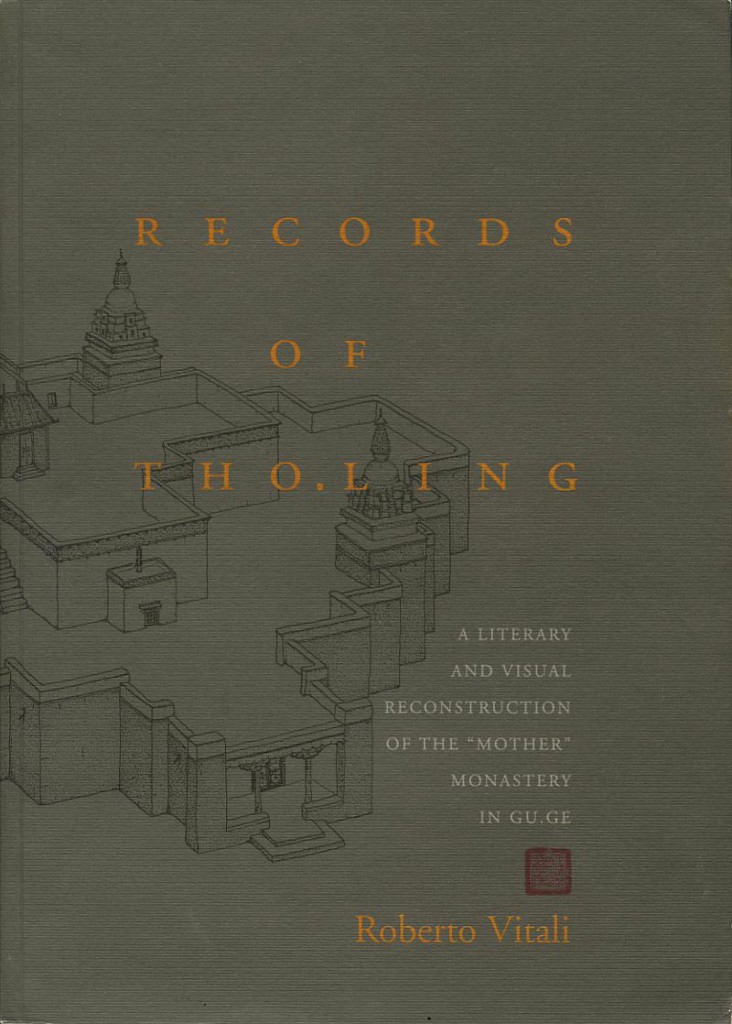
Records of Tho.Ling was published in 1999 and is A Literary and Visual Reconstruction of the “Mother” Monastery in Gu.ge with monumental reconstruction and mapping of Tho.ling and branch monasteries by Bianca Visconti and Christophe Besuchet. It includes stunning visual work, line drawings, designs and paintings by Laura Boutwell, Robert Powell, Mukti Singh Thapa, and Bianca Visconti. Robert Powell’s excellent painting of the view of Tho.ling from the entrance is most notable, along with the Viscontis’ line drawings, designs and sketches. The book was published by High Asia, an imprint of Amnye Machen, an institute devoted to the systematic and scientific study of Tibetan history, culture, society and politics.
There are several things to love about this book, but what I must mention above all is the design. I love footnotes, in all shapes and sizes, but having a wide margin with smaller type footnotes on the left and right sides? Brilliant! It lets the text flow as normal through full pages, but allows for relevant scholarly information and references to be found on the page while reading instead of having to stop and check the back of the book. Of course, it is rarely practical to print a book 21.27cm X 29.85cm in size. The fonts used and the weight of the paper together with the beautiful drawings and diagrams reminds me of the wonder and fascination I experienced in libraries when I was young and first discovering the beauty of books.
Although I mention the art and design first, the book is not another “art of Tibet” volume. It includes a detailed literary reconstruction of Toling monastery with translations of relevant historical texts, notes, bibliography, an index, and appendixes. In the first part of the book, the monastery of Toling and the process of it’s creation is discussed along with a presentation of phases of Toling’s history from the 10th century on up to the 19th century. In the second part there is a kind of reconstruction of the temple complex at Toling along with studies of its organization and the historical implications of it’s monuments. The appendixes contain a number of interesting things, including a printing of the relevant documents used in the book in Tibetan script.
Toling, (ཐོ་ལིང་), which is apparently also pronounced Toding (མཐོ་ལྡིང་), was an important religious institution in western Tibet for a thousand years. It is sometimes claimed to have been founded by the great Tibetan translator Rinchen Zangpo (རིན་ཆེན་བཟང་པོ་), but the sources Vitali quotes indicate that it was King Yeshe Ö or the both of them together. Rinchen Zangpo “frequented” one of the temples in Toling and according to the stories had a residence there. Atīśa ( ཇོ་བོ་རྗེ་) also graced the spot with his presence, which sources say is the site where the two, Pandita and Lotsawa, had their first meeting (The Blue Annals, etc.). According to Vitali, the only known early text to clearly date the founding of Toling is the Ngari Gyalrab (མངའ་རིས་རྒྱལ་རབས་), in which it says that Toling was founded by the king Yeshe Ö ( ཡེ་ཤེས་འོད་) in 996 (“མེ་ཕོ་སྤྲེའུའི་ལོ་ལ་གུ་གེར་ཐོ་ལིང་གི་གཙུག་ལག་ཁང་གི་རྨངས་བྲིས་”; p.53, lines 7-8, Vitali page 20 and 193). This, together with evidence of the inscription at Tapo (ཏ་པོ་) that says it was founded at the same time as two other monasteries known to be founded in 996 allows for the dating to be more certain. The original temple complex seems to have consisted of four major temples around one central building with eight smaller structures near them, creating the mandalic structure of the complex. King Yeshe Ö was famous for his governance strategies and was a major patron of Buddhism in western Tibet. He ordered the local farmers to provide for the 80 monks that made up the first sangha at Toling, which was one of the key acts of patronage that allowed it to grow into the most important religious seat in the kingdom of Gugé (page 21).
Because of the choice of transliteration scheme used throughout the main body of Vitali’s text, it really can’t be read meaningfully by a nonspecialist, but it is quite obviously not written for muggles. The text is filled with details about the theocratic organization of the kingdom and citations of government documents from old Tibet, which is wonderful. However, many of the sentences that are “translations” are in fact so full of transliterated terms with periods between the syllables that one might as well just read the Tibetan. In fact, some sentences are utterly illegible for someone who does not know Wylie and Tibetan. But I’d rather not dwell on the negatives: Sometimes it is not within the author’s power to make sure the Tibetan is included in a translation or academic work, so I applaud the use of Tibetan script in the appendices and I’m glad the publisher and printer were able to handle it. The book was printed in Italy by MARIOGROS of Torino, now part of AGIT, worth noting merely because the paper and style are excellent. The table of contents is recreated below so you can see some of the detail of the work presented there.
For more on Gugé and Toling, you can find a number of blogs and personal websites with pictures and descriptions, but take a look at some of these photos of the Gu ge Kingdom here and here you will find an interesting travel journal.
Our library also holds two other of Vitali’s excellent books: The Kingdoms of Gu.ge Pu.hrang: According to mNga’.ris rgyal.rabs by Gu.ge mkhan.chen Ngag.dbang grags pa, 1996; and The Earth Ox Papers: Proceedings of the International Seminar on Tibetan and Himalayan Studies, Held at the Library of Tibetan Works and Archives, September 2009.
The List of Contents from Records of Tho.ling:
Preface 1
Part One
The temples of Tho.ling. An annotated reminder of historical events concerning them 7
A description of Gu.ge, the land of Tho.ling 9
Valleys of Gu.ge 11
Synopsis 13
The Genealogy of the kings of Gu.ge 13
Building phases at Tho.ling 14
Building phases at each of the main Tho.ling temples 14
Documented images and structures put up at Tho.ling
from its foundation to the end of bstan.pa phyi.dar 15
Building phases of the Gu.ge temples 16
Section One
Historical phases at Tho.ling. A summary of the literary material
(10th-11th centuries) 19
The foundation 19
Antecedents: Tho.ling before the foundation of its temple 21
An episode occuring at Tho.ling during bstan.pa phyi.dar 21
The completion of Tho.ling gtsug.lag.khang in 1028 22
The protrectress of Tho.ling 24
The 1037 sack of Tho.ling 24
Byang.chub.’od’s contributions to Tho.ling 25
Tho.ling and Jo.bo.rje 27
Tho.ling gSer.khang 28
The Shing.sgra hill and its monuments 31
Zhi.ba.’ods endowments to Tho.ling gtsug.lag.khang 31
The Tho.ling chos.’khor 32
The period of obscurantism in Gu.ge and particularly at Tho.ling 32
Tho.ling from the late 12th to the late 13th century, the period in sTod
dominated by the bKa’.brgyud.pa-s 34
The restoration ofTho.ling by the Gu.ge king Grags.pa.lde 35
The second great phase ofTho.ling (15th century) 37
Section Two
Further annotated reminders of events in the history of Tho.ling
(16th-19th centuries) 43
Tho.ling during the time of Shanti.pa Blo.gros rgyal.mtshan (16th century) 43
Tho.ling in the 17th century: the La.dwags-Gu.ge war and the advent
of dGa’.ldan pho.brang 46
The La.dwags.pa period ofTho.ling 47
Tho.ling as the secular seat of Gu.ge.pa power: a summary 49
The dGa’.ldan pho.brang period 50
The lineage of the early dGe.lugs.pa abbots of Tho.ling 50
Tho.ling during the regency of sde.srid Sangs.rgyas rgya.mtsho 51
Tho.ling under the dGa .ldan pho.brang after
sde.srid Sangs.rgyas rgya.mtsho 54
The end of the royal lineage of Gu.ge 54
Tho.ling in the period after the end of the Gu.ge dynasty 55
Tho.ling during the 19th century 56
Part Two
A study of the buildings composing the Tho.ling complex
Introduction: the inventories of the Tho.ling receptacles of body,
speech and mind 59
Section One
English translation of the significant parts of the rten.deb 65
List of contents 65
‘du.khang ‘Dzam.gling.brgyan 66
brGya.rtsa lho.brgyud 68
Statues in medicinal clay in brGya.rtsa lho.brgyud 70
brGya.rtsa byang.ma 71
Statues in medicinal clay in brGya.rtsa byang.ma 73
Mani lha.khang 74
rGyal.khang 74
Bla.brang mgon.khang 75
mKhan.po rin.po.che’i gzims.chung 75
lha.khang ‘Jig-rten.brgyan 76
‘Bri.zur dge.slong bZang.po’i mchod.khang 76
Byams.khang 76
gSer.khang 76
Section Two
Critical considerations concerning textual evidence 77
Section Three
A classification of the Tho.ling temples based on both textual
and oral evidence 83
dPal.dpe.med lhun.gyis grub.pa’i gtsug.lag.khang 84
brGya.rtsa lho.brgyud 84
brGya.rtsa byang.ma 87
Temples outside the gtsug.lag.khang 88
Section Four
Final reconstruction of the temple complex (being a plan in words) 95
Religious and lay edifices of Tho.ling 95
The religious buildings 95
mChod.rten-s 98
The lay edifices 102
In the surroundings of Tho.ling 103
Section Five
A study of the organization of Tho.ling 109
The branch monasteries ofTho.ling 109
The hierarchy ofTho.ling 114
The annual ceremonies held at Tho.ling 115
Section Six
Historical implications arising from the monuments of Tho.ling 119
Tho.ling gtsug.lag.khang (i.e. the structure founded in 996) 119
dPal.dpe.med lhun.gyis grub.pa’i gtsug.lag.khang
(i.e. the same structure completed in 1028) 122
gSung.chos ra.ba 128
gNas.bcu lha.khang 128
‘Du.khang ‘Dzam.gling.brgyan 129
gSer.khang 129
The plain of Tho.ling 132
Appendixes
Appendix One
Records of Mang.nang: a brief attempt at a literary and visual
recontruction of its temples 135
Mang.nang sprod.deb 138
Appendix Two
Records of mDa’.ba.rdzong: a brief attempt at a reconstruction
of its temples based on literary and oral evidence 141
Religious buildings 145
Lay buildings 146
Appendix Three
A document being a synopsis of the Tho.ling rten.deb 147
Appendix Four
Tho.ling gNas.bcu lha.khang sprod.deb 149
Appendix Five
Temples in Gu.ge, Pu.hrang, sGar.rdzong, Ru.thog, dGe.rgyas,
sGer.rtse and mTsho.chen 151
Appendix Six
Tibetan text of the documents relevant to the reconstruction of Tho.ling 155
Tho.ling rten.deb 155
Tho.ling gNas.bcu lha.khang sprod.deb 176
Mang.nang sprod.deb 178
Appendix Seven
A few edicts concerning Tho.ling issued during the late period
of the Gu.ge dynasty and afterwards 181
The 1653 edict of the La.dwags king Indra.bo.dhi
to the people of Gu.ge 181
The edict of fire dragon (1736)
issued by the 7th Dalai Lama bsKal.bzang rgya.mtsho 182
The edict of earth horse (1738) 186
The bka’.shog issued by gNod.sbyin phun.tshogs in fire sheep 1847 186
Appendix Eight
Tibetan text of the passages translated in the present work
(documents other than those published in Appendix Six and Seven) 191
Bibliography
Primary sources 211
Secondary sources 216
Index 219