Kathmandu University and the Centre for Buddhist Studies at Rangjung Yeshe Institute will host the 8th Annual Symposium on Buddhist Studies on Saturday, December 11th, 2010 from 1pm to 5pm at the Hyatt Regency Hotel, Boudhanath, Kathmandu, Nepal.
Theme: “Great Debates”
Speakers:
Dr. Tom Tillemans, University of Lausanne Dr. Pascale Hugon, Austrian Academy of Sciences Dr. Georges Dreyfus, Williams College Dr. Jonardon Ganeri, University of Sussex Chokyi Nyima Rinpoche, Ka-Nying Shedrub Ling Monastery Ven. Dr. Phramaha Dhammahaso, Mahachulalongkorn University
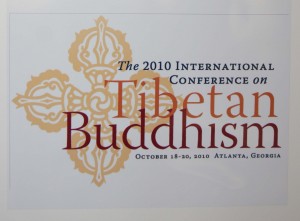
The second International Conference on Tibetan Buddhism began today, October 19th, at Emory University. Several hundred scholars and writers, venerable nuns and monks, lamas and tulkus, and representatives from sangha’s around the world converged on the Emory Conference Center in Atlanta, Georgia for a meeting of influential minds. The attendance list reads like a who’s who of Tibetan Buddhism in the West. Although a certain bias can be noted, it appears that the organizers made an effort to include representatives from many traditions. There are certainly a few key figures missing and it’s too bad because one of the key points that His Holiness the Fourteenth Dalai Lama stressed in his opening speech was the importance of nonsectarian collaboration among Tibetan Buddhist groups.
To formally open the conference, HHDL gave a moving speech about the importance of remembering the shared root of all types of Tibetan Buddhism and he implored the conference attendees to discuss the problems of degeneration and corruption of Tibetan Buddhism. He did not leave the sense of the “root” of Tibetan Buddhism abstract, but instead specifically pointed to the traditions of Nalanda and particularly to the writings of the masters of Nalanda. He said that it was necessary to study their writings directly and that too many Tibetan Buddhists focus on their individual lineage master’s writings or their college’s yig cha, to the detriment of the tradition. His Holiness seemed to really want to emphasize that it was important that the different schools needed to work together more and that it was essential that we deal with ‘corruption’ in Tibetan Buddhism. He did not elaborate on specifics, but it seemed to me that he was saying more than just the usual “we’re in a degenerate age, be careful with the quality of dharma you teach…” kind of talk. He said that Tibetan Buddhism has become empty ritual in some instances and that deep and proper understanding needs to be cultivated.
The opening session included introductions and remarks from Geshe Lobsang Negi, Dr. Gary Hauk, Lobsang Nyandak, Greg Kruglak and a performance by the Drepung Loseling Monks of the Mystical Arts of Tibet Tour. After the address by His Holiness, Khamba Lama gave a report on the First International Conference on Mongolian Buddhism, which concluded in September in Ulan Batar. Following the departure of His Holiness, the first panel sessions began. Session 1A was on Tibetan Buddhism’s Encounter with Modern Science and Session 1B was on Tibetan Buddhism and Social Engagement.
Panel Session 1B: Tibetan Buddhism and Social Engagement.
As you can see, many distinguished guests were present.
The “Engaged Buddhism” Panel was chaired by Dr. JohnMakransky and the keynote speakers were Dr. Jan Willis and Lama Pema Wangdak. Responding panelists Acharya Fleet Maul, Ven. Karma Lekshe Tsomo, Diana Rose, and Tsoknyi Rinpoche were each given a very short time to present a few thoughts on engaged Buddhism. This format was somewhat interesting but led to each person giving a short spiel that was very informative but didn’t seem to lead to real dialog. “Questions” from the audience were similar in that they were not in fact questions at all, but statements made by very interesting people doing very interesting things, which sometimes included general questions for all present to take home and consider. David Germano seemed to have prepared a particular three-point speech (a condensed version of a speech he gave at IATS this year), which he provided to the whole room and seemed, by the observed reaction of the crowd, to be the most interesting and thought provoking of all. He charged academic institutions with not being truly ethical in their actions regarding Tibet and called on everyone to consider how their actions and chosen focus in regard to Tibetan Buddhism effects Tibet and Tibetans. Unfortunately time was up at the end of his speech and no one was prepared to respond. The panel really was very interesting, and some of the most important statements probably came from Ven. Lekshe Tsomo, who rightly mentioned the inequality in Tibetan Buddhist institutions and the plight of Buddhist women the world over; however, there was no time for real dialog about anything. It appears that there will be a “business meeting” tomorrow that will allow for “resolutions” to be drawn up―which sounds delightful and absurd―but perhaps at that time actual dialog among the panelists and attendees can occur.
Before moving on to the next panel I wanted to summarize here a few of the points made at the panel on engaged Buddhism:
Dr. Jan Willis noted that while “engaged Buddhism” might be a new term, Buddhism has been engaged since it’s inception. From the very moment that Buddha stood up from his Kusha grass seat and began to teach, Buddhism has been “engaged” in the world. The rest of her comments then were about the foundation of Buddhism as an engaged religion and about an ethics in which she linked compassion and interdependence with love in the Bible and Dr. Martin Luther King’s ideas. She said that we should feel our responsibility for others when we feel love and that we should then act in the world for others benefit.
Lama Pema Wangdak of the Sakya tradition, creator of Tibetan Braille, spoke a little about his personal experience with social engagement and stressed that education and the founding of schools for children who would otherwise not receive quality schooling was essential for the preservation of Tibetan culture. He spoke about the importance of investing in the brain trust of Tibetan people.
Acharya Fleet Maul, creator of the Prison Dharma Network and author of Dharma in Hell, spoke about some of the challenges Tibetan Buddhism faces in terms of “engaged Buddhism.” He said that “Tibetan Buddhism is not the leader in engaged Buddhism” and that compared with the developed modern Buddhisms from China and Japan we are lagging behind and there is a lot of work to do. However, he stressed that he feels that the Vajrayana path gives us a particular strength in the area of service. He said that it provides the fortitude for going into the modern charnel grounds and working with injustice directly.
The Very Venerable Karma Lekshe Tsomo gave a talk about her experience on sabbatical from the University of San Diego when she traveled to 14 Buddhist countries around the world. Her report focused on the tragedies that beset Buddhist women around the world and I must commend her again for being the only person on the panel to really mention how little support and how little power women have in Tibetan Buddhist institutions the world over. One of the key points she brought up was about the power of other religious groups who are working to convert traditionally Buddhist peoples. This was also touched on by several other people at the conference and from the various reports I have heard it sounds like certain areas are getting to a point of crises in which Buddhism may be overtaken by Christian and Muslim proselytizers who provide basic needs to Buddhist peoples, who then convert because they need food and clothing (more on this later).
Diana Rose, President of Garrison Institute and the Lostand Foundation, spoke about the Garrison Institute and her work creating a training program for care-givers and people who work in shelters.
Tsoknyi Rinpoche, teacher and author of Carefree Dignity and Fearless Simplicity, was very well spoken and succinct. He said that there were two principles that are key for the Buddhist tradition that connect with the sense of “engaged Buddhism”: 1) Nonviolence and 2) Contentment. He said a few things about nonviolence, but chose to spend more time describing the importance of the middle way of being content with what one has and what one’s body needs, not with what one’s mind wants to have. Basically he said, with many examples, that overconsumption is really NOT OK and that right livelihood includes paying attention to how we live in relation to Mother Earth.
Before continuing to make notes about some of the interesting papers at the IATS conference this past August, I wanted to sneak in a little note about one of my teacher’s work. Dr. Phil Stanley has been working on analyzing the Tibetan canons for more than sixteen years. His work includes detailed statistical analysis of at least six Kangyur and four Tengyur, including analysis of the location of repeated texts, texts missing in some versions, as well as analysis of provenance figures given in colophons.
Phil Stanley’s recent dissertation analyzes the concept of canonicity and scripture in different traditions and presents the thesis that “Canonicity in Tibetan Buddhism and Buddhism in general differs from the Christian concept commonly presumed in religious studies in consisting of an inclusive canonical continuum not restricted to just the scriptures attributed to the Buddha.” The Christian concept of the ‘canon’ is rigidly associated with their concept of ‘scripture’ and has influenced the study of the Buddhist tradition in Academia such that the Buddhist understanding of ‘canonicity’ has been confused and the research has been one-sided in favor of Kangyur study, until recently. Phil proposes three types of canons: 1) “Formal Canons of doctrinally diverse scriptures and treatises, 2) Practical Canons of select texts inside and outside the Formal Canons that formed the basis of specific traditions, and 3) Inclusive Canons of all texts accepted by specific traditions.”
One of the few mentions of Tibetan sources at the Society for Tantric Studies Conference came from a young scholar at the University of Chicago who provided an interesting discussion of Kānha and the Grub thob brgyad bcu tsa bzhi’i lo rgyus. Samuel Hopkins noted that while most of the stories of the 84 Mahasiddhas follow a relatively strict format, Kānha’s story deviates significantly and he pursued this anomaly in his paper. If I understood correctly (I haven’t really read the story in Tibetan), unlike all the other stories, Kānha’s story begins later in his life-after initiation-and ends somewhat negatively with a warning about pride-Don’t be like Kānha. Aren’t we supposed to be impressed by the “greatness” of the Mahasiddhas? Not in Kānha’s case. It was interesting to hear that we have texts in which Kānha describes himself as grotesque, comedic, loathsome, detestable. Samuel Hopkins says that what he most certainly was was subversive. Kānha mixed comedy, criticism, and “serious” Buddhist teachings together in his own texts in such a way that his fame appears to come from his lack of decorum-his “crazy wisdom.” While we have many texts by various masters of the tradition, there are certainly few that are first person accounts of this kind. He may also have presented himself as a Hindu while secretly touting Buddhist teachings, or perhaps he was a member of a Hindu sect. The “anomalous Siddha” is actually claimed by more than one tradition, and while his texts may be by many different people writing under one name, what is so interesting is that despite his strange characteristics, sometimes seemingly at odds with Buddhist principles, his story remains a part of the grub thob and a part of Tibetan culture. The question is why, out of 84 stories of mahasiddhas, is this siddha the nail that didn’t get pounded in? Perhaps we shall hear more from this “other” Mr. Hopkins in the future.
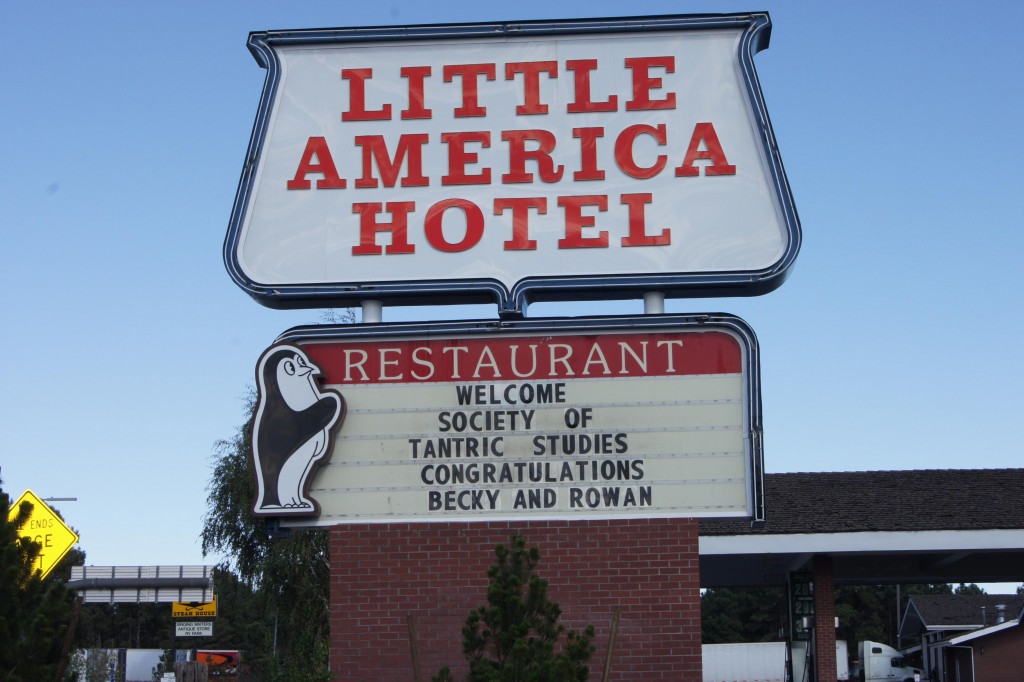
The Society for Tantric Studies met in September this year at the Little America Hotel in Flagstaff, Arizona.
Last week the Tsadra Scouts were sent to observe “academic Tantrikas” in their natural environment, The Society for Tantric Studies Conference. Composed of a relatively small group of scholars, the Society of Tantric Studies includes professors and independent scholars from several areas, mostly specialists in what we might calll “Hindu” Tantra and Buddhist Tantra. The attendees of the conference were quite diverse in terms of chosen topic, professional standing, and expertise. Although in previous years Tibetan studies was better represented, this year’s conference saw mostly Sanskrit specialists focused on Indology, Kaśmir Śaivism, Sāṃkhya, modern representations of Tantra, and comparative religions. The small numbers (perhaps 30 people) and the setting contributed to a comfortable and intimate feeling even though the topics people focused on were rather disparate. One presenter launched into a discussion of the concept of “core disgust” from a modern psychological perspective (very interesting in fact) while another discussed Satanism and modern Western esoteric traditions, and a third discussed early Śaivite divination manuals from a philological perspective. A master’s student gave a fascinating talk on the meaning and role of intellectuals using Seventeenth-century Sanskrit intellectuals as an example and established scholars David White and Gavin Flood both presented on the Netra-tantra. All of this variety contributed to a truly fascinating, if somewhat disjointed, academic conference. The variety also allowed us to observe the many behaviors and activities of academic Tantrikas in the wilds of Arizona.
One of the most fascinating presentations was on Abhinavagupta‘s ideas about aesthetics and it’s relationship to ethics. Professor Loriliai Biernacki proposed that through understanding Abhinavagupta we can see how ethics may be born out of the state of aesthetic wonder. She described the fascinating idea of rasa in Abhinavagupta’s aesthetics- an “undifferentiated dense mass of wonder.” The idea being, roughly, that through developing proper aesthetic sensibilities by connecting with this experience of wonder, ethical sensibility is also developed. Emphasizing the ethical element of aesthetic experience seemed a fascinating direction to me and the excellent discussion lit a fire of interest in Abhinavagupta’s ideas. I hope to read Dr. Biernacki’s paper as soon as it is available.
In “Erotic Forms of Ganeśa” professor Bühnemann showed surprising and fascinating images of the elephant-headed god in many different artistic contexts (Buddhist and Hindu sculpture and painting) in several countries (India, Nepal, Tibet, Korea, Japan). I had never seen nor heard that the Nyingma tradition had Thankas with Ganeśa in them, but the images themselves were even more interesting than that revelation. In one Thanka Ganeśa appears to be standing on the hands of a cat-woman who is either performing fellatio or drinking excretions from his linga while she menstruates into skull cups held by servants upon which she is standing. Apparently this tantric alchemical process allows for the practitioner to collect jewels from the skull cups, representing the attainment of the desired wealth, for which one would be propitiating Ganeśa in the first place.
“Netra-Tanra at the crossroads of the demonological cosmopolis.”
The keynote speaker, Professor David Gordon White, gave an engaging paper on the Netra-tantra spanning most of the evening on the opening day of the conference. The Netra-tantra is a text from Kashmir datable to the early 9th century CE. The Netra-tantra was referenced by Abhanavagupta several times and there is an extant detailed commentary on the text by his student Kshemaraja. The 19th and longest chapter is on demonology and this was the focus of Professor White’s talk. He stated that, “Like the Svacchanda Tantra and probably most tantras, the Netra is a composite work with at least two highly visible layers of redaction, the first of these is a demonological layer which comprises unadorned descriptions of demons, symptoms of demonological possession, and techniques for countering the same. This stratum of the text comprises a pragmatic technical guide to certain types of tantric ritual… the second layer of redaction which structures the text, for better or for worse, into a coherent and unified thesis is devoted to the deity Amritesha and more importantly to his all powerful conqueror of death mantra, which controls, routes, and slays demons with total accuracy…” Dr. White’s contention seems to be that the first layer is really the core of the text and that later layers, as well as commentarial traditions, manipulate the demonological data so as to further their own purposes. White’s analysis was of course considerably more complex than anything I’ll mention here but suffice it to say that demonology appears to have played an important role in the formation of tantric texts and tantra itself and that scholars will probably be spending more time on demonology in the future. To get a sense of how different Dr. White’s well-researched academic discussion of the Netra-tantra is, take a look at what is presented here: http://www.dhyansanjivani.org/tantra_mantra_yantra/the_netra_tantra.asp
The Academic Tantrikas’ Society for Tantric Studies
At a breakfast at an AAR in the late 1980s Glen Hayes, Charlie Orzeck and Jim Sanford decided to start a conference for Tantric studies. Alex Wayman was in attendance at the first conference held at the University of North Carolina retreat center. Since then the Society for Tantric Studies has steadily held conferences every three years or so, but due to the formation of a section at the AAR annual conference it appears they will meet less often. Hopefully, despite the small size of the conference, the next meeting will include more presentations from the Tibetan Buddhist perspective.
Before closing this little note on the conference and hopefully returning to blogging some of the very interesting papers at the IATS conference, I would like to note that the organizers of the conference, Glen Hayes and Paul Donnelly, were very friendly and open and I thank them heartily for their hospitality.
“Collected Writings: (gsung ‘bum) in Tibetan Literature: Towards a Systematic Study of Their Compilation, Redaction and Composition and Its Use for Genre Classifications” by Jim Rheingans – Universität Bonn
I was keen to hear what Dr. Rheingans had to say regarding Tibetan genre because of our recent attempts to catalog the gdams ngag mdzod and all of the difficulties that arose when attempting to classify texts by subject. In his talk, Dr. Rheingans discussed his work on the 8th Karmapa’s (mi bskyod rdo rje, 1507-1554) gsung ‘bum, collected by the 5th Shamarpa (dkon mchog yan lag, 1525-1583). The gsung ‘bum as a concept, and as a classification scheme itself, does seem like an interesting place to begin looking for ways of classifying Tibetan writing by topic and genre. In the dkar chags of all the extant gsung ‘bum‘s we will find many different ways of classifying texts and I suspect it is not always easy to find systematic dkar chags. However, a study of many dkar chags would certainly begin to provide an interesting picture of how Tibetan’s classified texts over time. In the gdams ngag mdzod we see perhaps far too many schemas, as many different lineages are represented, each with their own classificatory terms. However, the organization of these disparate texts shown in the dkar chag by ‘Jam mgon kong sprul are themselves a useful example of a Tibetan system (historically situated in this case as a part of the ris med period) that might be worthy of research.
Dr. Rheingans noted that the concept of gsung ‘bum itself seems to be mostly Tibetan in origin and not something inherited from Indian literature. He seemed to be continuing to research this issue, briefly mentioning a loose collection of texts from Advayavajra but no “real” gsung ‘bum in the formal sense.
He went on to say that the norm seems to be that students take on the responsibility of systematizing the master’s work, sometimes with direction from the master, and sometimes after his death. In the case of the 8th Karmapa, it seems that there was in fact a blessing given and a clear intention written down by the Karmapa allowing the Shamarpa to begin the work of systematizing his works. There seems to be an important point here: the context of collecting these works and the historical situation is an important part of the study of the gsung ‘bum, and thus also of classification itself. Some gsung ‘bum have clear systematized dkar chags and some do not. The question Rheingans posed was, what is actually systematized? How far can we take these indigenous classification schemes? These kinds of questions need to be asked when engaging in classifying texts.
In his talk he made the important point that paying attention to the context of literary production and genre can yield clues for historical research and interpreting doctrine in Tibetan studies. That is to say, other than abstract interest in classification schemes, there are utilitarian reasons why various types of scholars would be interested in systematic genre classification.
What I found useful was his call for more precision regarding understanding compilation, redaction, and composition when describing and discussing Tibetan writing. I wasn’t able to ask about his thoughts, but the thought that came to me was: since Tibetan writing often involves a large amount of “borrowing,” even the classification of a text as being “authored” by one person as opposed to another is complicated. Therefore, distinction between the redactor, compiler, or composer, is not always clear. That is to say, along with issues of genre, issues surrounding the classification of “provenance figures” or contributors to the text also have to be tackled.
In his short talk he did not try to present a list of genres or classificatory schemes everyone can take home and start using, but instead brought everyone’s attention to a set of questions that may lead us in the right direction. One of his guiding questions was: How can we employ academic classifications without neglecting traditional terminologies, both for generic terms we have and concrete genres? How much use can we get out of terms like narrative, explicative, argumentative, descriptive, and so forth? On this topic he noted that when classifying some text, one shouldn’t be distracted by the title, but take a closer look at how the topic develops in the text itself. He then gave some examples of situations where a text may be labeled as a rnam thar or placed in a volume of rnam thars, but in fact the content is found to be a set of specific instructions made in response to requests from a particular student. Apparently, one rnam thar he looked at can be used as a dkar chag for Mi bskyod rdo rje’s gsung ‘bum.
One text may also contain the qualities of several genres, in fact many Tibetan texts do, but this doesn’t have to make the project of discussing classification a non-issue. Rheingans called for more effort in this area, reminding us that if we only approach classifying a text from the traditional philological reading, then we “forget to write the book that may be influential beyond Tibetan studies.” That is to say, he wondered if it was possible to look more deeply at Tibetan literature and begin to form some useful schemas that would be transcultural, useful to academics at large, and not just to a small group of Tibetan studies scholars. Towards this end, he suggested systematic exploration with broader studies, which I presume would include cataloging larger numbers of gsung ‘bum and their classificatory schemas, as well as other types of collections and connecting that with the study of Tibetan literature as a whole. In doing this kind of work he suggested that some postmodern methodologies may be helpful, but we also have to use caution in their application. He suggested that perhaps it is still too early in the study of Tibetan literature to begin these kinds of classificatory projects, but Dr. Rheingans did seem hopeful that progress could be made.
On an interesting side note: There was also a discussion amongst those present at the Tibetological Library and Archive Resources panel focused on the idea of collecting genre types, subject headings and classification schemes for use in cataloging and archiving Tibetan works. For the librarian, the issue of how to classify a text is in fact quite practical and immediate, as the creation of a catalog for a library that is searchable by topic and genre is an obvious desideratum. I hope that practical work can be done to further this project as it will certainly benefit the whole field of Tibetan studies.
Pieter Verhagen, Leiden University, The Netherlands
(12th Seminar of the IATS, Vancouver, BC, August 16th, 2010)
Pieter Verhagen presented a list of textual sources that he believes the early Tibetan translators of Indian Buddhist texts relied upon as “tools of the trade”. I beg his pardon, and hope he doesn’t mind that I share this list here, as it was made publicly available by him at the conference and I think others will be interested. These are the texts he discussed and the citations he provided in a hand out:
1) Mahāvyutpatti = bye brag tu rtogs byed chen po sde dge bstan ‘gyur vol. co, f. 1r1-131r8
2) sgra byor bam po gnyis pam sde dge bstan ‘gyur vol co, f. 131v1-160r7
3) khri lde srong btsan sad na legs (799-815) > ‘translation’ edict 814 CE
5) *Sv-alpa-vyutpatti = bye brag tu rtogs byed chung ngu
9) Dhātupāṭha
– CG 21: Dhātu-kāya, Tib. byings kyi tshogs sde dge bstan ‘gyur vol. no, f. 112v6-122v2 (Tohoku no. 4429) – CG 22: Dhātu-kāya, Tib. (lung ston pa ka lā pa’i) byings kyi tshogs sde dge bstan ‘gyur vol. le, f. 63r3-75r7 (Tohoku no. 4285) – CG 25: Dhātu-kāya, Tib. (tsandra pa’i) byings kyi tshogs sde dge bstan ‘gyur vol. re, f. 71r5-78r7 (Tohoku no. 4277) – CG 30: Kalāpa-dhātu-sūtra, Tib. ka lā pa’i byings kyi mdo sde dge bstan ‘gyur vol. no, f. 1v1-10r7 (Tohoku no. 4422) – CG 32: *Dhātu-sūtra, Tib. byings kyi mdo (brda sprod pa tsandra pa’i byings kyi tshogs kyi gleg bam gyi mdo) sde dge bstan ‘gyur vol. no, f. 21v2-31v4 (Tohoku no. 4424) – CG 45: Pāṇini-dhātu-sūtra, Tib. Pā ṇi ni’i byings kyi mdo Peking bstan ‘gyur vol. pho, f. 342v2-358r5 (Otani no. 5913) [sde dge: deest]
10) Gaṇapāṭha
– CG 2: Viṃśaty-upasarga-vṛtti, Tib. nye bar (b)sgyur ba nyi shu pa’i ‘grel pa (a) Peking bstan ‘gyur vol. le, f. 36v4-41v1 (Otani no. 5768); snar thang vol. le, f. 35v1-39v7; dga’ ldan vol. le, f. 43r1-49r2 (b) sde dge bstan ‘gyur vol re. f. 30r1-34r2 (Tohoku no. 4270); Co ne vol. re, f. 32r1-36v3
– CG 18: Prayoga-mukha-vṛtti, Tib. rab tu sbyor ba’i sgo’i ‘grel pa
One hundred and ninety-five institutions from 25 nations attended 51 panels on Tibetan studies in five days spent on the UBC campus outside of Vancouver, Canada.
Almost every country with a university program devoted to Tibetan studies in some form or another was represented at this year’s conference in Vancouver: Australia, Austria, Belgium, Bhutan, Canada, China, Denmark, England, France, Germany, Greece, India, Israel, Italy, Japan, Korea, Nepal, The Netherlands, Norway, Poland, Russia, Spain, Sweden, Switzerland, and the USA were all represented. The bulk of participants seemed to be from the US, followed by England, France, and Germany. A significant contingent of independent scholars, NGOs, and major libraries were also present.