“As for the Blessing of Vajravārāhī, Marpa Lhodrakpa does not have it.” WTF?
by Sarah Harding
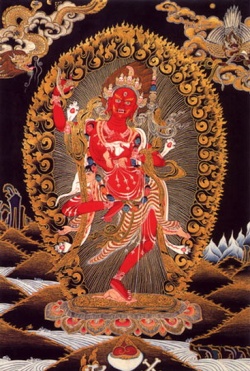
In the beginning, my work translating the Pakmo Namshe[1] by the 2nd Pawo Rinpoche Tsuklak Trengwa (dPa’ bo gtsug lag Phreng ba, 1504-1566) presented several surprises. I had always believed that this was a commentary about the secret practice of Vajravārāhı based on the sādhana by the Sixth Karmapa Tongwa Dönden (mThong ba don ldan, 1416-1453) that we had all practiced in three-year retreat. I had certainly used it as such. But as soon as I came across the actual words of the sādhana within the text, it was clearly not that. Tsuklak Trengwa gives the title of the sādhana as simply dPal rdo rje rnal ‘byor ma’i gsang ba’i grub thab, or Srı Vajrayoginı Guhya Sādhana, authored by Nāropa and translated by Marpa. Well that’s easy, I thought, because there’s a three-folia verse text in the Peking Tengyur by Nāropa, or rather Mahā Nāḍapāda, with just that Sanskrit name.[2] Great—only that was not it. Then I actually opened and looked at every single text attributed to Nāropa in the Tengyur, and could not find a match. Then for weeks there were random feverish searches on TBRC under every conceivable word, like “yoginī,” “secret,” “vajra,” “pig,” and so on. Finally one fine day brought up the Miscellaneous Works (gsung thor bu) of the First Karmapa, Dusum Khyenpa (Dus gsum mkhyen pa, 1110-1193), and there I found it among several other secret Vajrayoginī practices, 29 folios and with no author, under the title dPal rdo rje rnal ‘byor ma’i gsang bsgrub [rdo?] rje btsun mo lhan skyes.[3] That was what I call a researcher’s moment of glory. It’s been all down hill from there.
The second big surprise was the nature of the text. I was looking forward to translating Pakmo Namshe because I understood it to be a practice commentary. Pawo Tsuklak Trengwa even says, “It is this sādhana exactly as presented by the bhagavatī herself that will be expounded here.” But after the first fifty pages I realized that it’s really a rebuttal, a giant polemic in defense of Kagyu practices. I’ve since found that many if not most Kagyu commentaries on Vajrayoginī written during this period, the 15th-16th centuries, are similarly on the defensive. At first I thought that if I could make it through the history section, just fourteen folios, then finally there would be the Dharma. But that naiveté was again shattered when a few pages into the so-called “actual instructions,” even in the section on the location in which to practice, (Mountain peaks and charnel grounds/ Lone tree trunks and empty caves/ Hermitages and isolated places,… ) the narrative bends around to start sections with that red warning flag of “mkhas pa kha chig gis,” and somehow launches into another tirade. The one most shocking for me was the quote early on that is the title of this paper, “As for the blessing of Vajravārāhı, Marpa Lhodrakpa does not have it.” I mean, what? There’s been great controversy about mahāmudrā and maybe some suspicious creative innovations by lineage masters, such as evidenced by the accusations leveled at Gampopa. But Marpa? And he doesn’t even have the blessing? As I figure it, we’re screwed. So I decided to jump right in to the fray and try to figure out what’s going on here. Truly it is a can of worms, and I barely got the lid off. In order to make some use of the considerable time and energy that I already spent on Pakmo Namshe, although my work on it has now been set aside, I will present excerpts primarily from my translation of that, and some from other researches, especially Sakya Paṇḍita, Gorampa, Padma Karpo, Tashi Namgyal, and Lowo Khenchen. I’ll also make available a polished translation of the history section. What follows is basically a travelogue of my confusions, or my ‘khrul pa’i thob yig.
Prajñāpāramitā, Indian “gzhan stong pas,” and the beginning of Tibetan gzhan stong
In the Tibetan Buddhist tradition, there is an ongoing debate about whether the gzhan stong system was “invented” by Tibetans, in particular by Dol po pa, or whether there are Indian precursors of that view. I will discuss evidence for a number of typical gzhan stong positions in several Indian texts and early Tibetan works before Dol po pa.
The “Maitreya Chapter” in the prajñāpāramitā sūtras
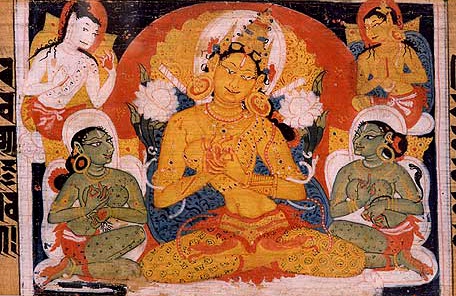
What the Tibetan tradition commonly calls “The Chapter Requested by Maitreya” is found in chapter 83 of the Aṣṭadāśāsāhasrikāprajñāpāramitāsūtra, chapter 72 of the Pañcaviṃśatisāhasrikāprajñāpāramitāsūtra, and the revised version of the latter. Certain parts of this chapter differ in their diction from the prajñāpāramitā sūtras in that all phenomena are divided into three aspects, such as “imaginary form (parikalpitaṃ rūpaṃ),” “conceived form (vikalpitaṃ rūpaṃ),” and “dharmatā-form (dharmatārūpaṃ).” These three types of phenomena and their descriptions match the three natures (parikalpita, paratantra, and pariniṣpanna). Therefore, many scholars regard the “Maitreya Chapter” as a later addition.
In general, there are two models for the relationship between the three natures. The common model (1) in Indian Yogācāra texts is that pariniṣpanna is described as paratantra’s being empty of parikalpita. Model (2), found in most of the texts discussed below and virtually all Tibetan works on gzhan stong, means that pariniṣpanna itself is empty of both paratantra and parikalpita. In Tibetan gzhan stong texts, the contrast between these two models is usually highlighted as representing one of the major differences between the views of sems tsam and gzhan stong.
In the “Maitreya Chapter,” the Buddha uses model (1), but says that both imaginary form (mere conventional designations such as “form”) and conceived form (the conditioned entities to which these designations are applied) do not exist ultimately, while only the dharmadhātu exists ultimately. When the latter is directly observed through nonconceptual wisdom, those entities are not observed. When they are observed, it is only through conception (vikalpa). This description is quite a standard explanation of the three natures as also found in the Saṃdhinirmocanasūtra (Chapters VI and VII) and many Yogācāra texts.
The “Maitreya Chapter” also offers a distinction between these three kinds of form in terms of their being ultimately real or unreal, saying that imaginary form is nonsubstantial, conceived form is substantial (by virtue of conception’s substantiality, but not because it exists independently), and dharmatā-form is neither substantial nor nonsubstantial, but is the ultimate.
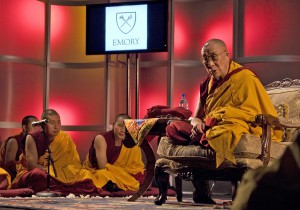
The 2011 Tsadra Foundation Fellows & Grantees Conference began today at the Emory Conference Center in Atlanta, Georgia. Participants flew in from around the world to share their research and their passion for translation, and to celebrate more than ten years of Tsadra Foundation projects.
Tsadra Fellows, grantees, and guests gathered for the opening dinner at Houston Mills House, just across the iron bridge from ECC.
The next three days will be filled with presentations from some of the best translators in the world on such diverse topics as translation theory, the Indian and Tibetan sources of gzhan stong, and the autobiographical writings of Kun dga’ grol mchog.
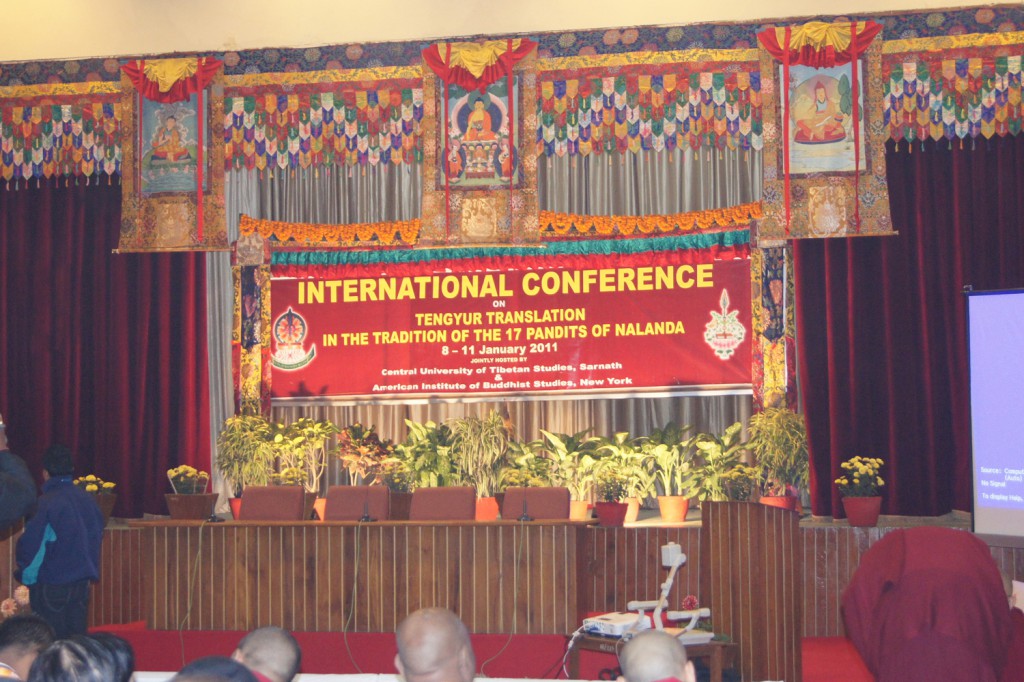
The International Conference on Tengyur Translation in the Tradition of the 17 Pandits of Nalanda
The conference began on January 8th with chants offered in three languages: Pali, Sanskrit, and Tibetan. Students at the Central University of Tibetan Studies are now able to study Pali, Sanskrit, Tibetan, and Hindi, as well as other modern languages. Recently awarded university status (2009), the institution was established in 1967 and is now directed by Geshe Ngawang Samten, who played a key role in the proceedings of this conference. The previous director, Samdong Rinpoche, was also present and gave a speech as the Prime Minister of the Tibetan government-in-exile. The university was an excellent host for the conference, despite the pervasive cold, and I’m sure everyone especially appreciated all the students and staff who helped provide hot tea and crackers each day. The tech staff also had their hands full as many people chose to prepare PowerPoint presentations. Even with the power going out daily they kept things running rather smoothly.
Shrikant Bahulkar oversaw the opening ceremonies and participants heard welcoming words from Geshe Ngawang Samten, Tenzin Bob Thurman, HH Gaden Tri Rinpoche, and others. After the opening speeches, and tea to warm us up, we heard from Tom Yarnall, Christian Wedemeyer and Paul Hackett. The topic of this opening session was to be an overview of the Tengyur, it’s history, composition, and so forth. From Dr. Wedemeyer we heard more about the history and formation of the Tengyurs and from Dr. Hackett we heard details of the composition of the various Tengyurs. From Dr. Yarnall we received an interesting argument that basically presented the particular way in which it seemed the conference conveners were conceiving of their project to “Translate the Tengyur.” The argument relied upon an interesting way of conceiving of Tibetan Buddhism and clearly described why the translation of the Tengyur is important and relevant to today’s scholars. What we heard was an introduction to one way of talking about the Tibetan Buddhist tradition as preserving the ancient Indian academic world of Nālandā, Vikramaśīlā, and so forth. Although I cannot repeat all of Yarnall’s discussion here, similar logic was presented on the official Tengyur Translation Website and it is worth repeating because it is interesting to note the kind of rhetoric used:
(1) That although the great Indian institutions such as Nālandā, Vikramaśīlā, and so on were ostensibly run by Buddhists, they were not only (or even primarily) Buddhist religious institutions; that they rather were multi-cultural, multi-tradition, cosmopolitan institutions, and hence true “universities” (as also argued by S. Dutt, L. Joshi, and others); (2) That as such, the many centuries of Buddhist arts/sciences developed in these institutions and recorded in the Sanskrit śāstras compiled therein took place in a vibrant, contentious, multi-tradition milieu in which each point had to be argued and defended; i.e., this was not a context such as Tibet (or other “Buddhist countries”) in which Buddhists were speaking virtually exclusively with other Buddhists, and thus could take for granted at least some common assumptions, perspectives, methodologies, and so on (rather, no premise or point could be taken for granted in the Indian context); (3) That therefore the Tengyur—as the repository of many of these śāstras (in Tibetan translation) which record the discourse that occurred in such a pluralistic environment very similar to our own contemporary, multi-cultural global environment—is uniquely important and relevant today (indeed, HH noted that in this way it may be even more relevant/accessible than many of the texts in the Kangyur); and (4) That therefore, the translation of the Tibetan Tengyur into modern languages and the publication of well-edited and annotated editions of these translations should be a prime priority for contemporary Buddhist scholars and institutions. (Taken from the official Tengyur Translation Website)
Dr. Yarnall (University of Columbia)
In his talk, Dr. Yarnall described the great academic institutions of ancient India in some detail, and linked their achievements with the texts preserved in the Tibetan Tengyur. He also presented a quote from the Dalai Lama in which he identifies himself as holding the tradition of Nālandā and not particularly that of the Mahāyāna or Varjayāna. Perhaps I am simply ignorant of this trend in the discourse, but I found it very interesting that the Dalai Lama and others who are scholars, students and practitioners of Tibetan Buddhism were associating themselves so strongly with their idea(l) of Nālandā University. Every participant at the conference was given a new CUTS publication, a poem by the Dalai Lama praising the Seventeen Pandits of Nālandā, published in Tibetan, Chinese, English and Hindi. The overall effect of this, along with Dr. Thurmans interjections, was the sense that the real reason for translating the Tengyur is that it is supposed to be a faithful source for understanding the “scientific” tradition of Nālandā, which in turn is representative of an “authentic” Indian culture whose “inner sciences” pacified the barbarian lands of central and east Asia and will likewise pacify the West. Note also that the AIBS publication series is titled a “Treasury of Buddhist Sciences.” I personally rather like the idea of ancient liberal arts colleges producing texts on the inner and outer sciences of India and I like pushing the ideal of a modern pluralistic environment of scholarly debate. However, even disregarding the liberal use of the term “science,” I was left with the feeling that there is probably more to the story. I have not researched the actual evidence we have for reconstructing the scholastic culture of Nālandā, but perhaps someone reading this could post some more information about it online.
Dr. Wedemeyer (University of Chicago)
Dr. Wedemeyer provided a nuanced look at the idea of “the Tengyur.” He began with the now famous joke about the student who angrily told a theologian, “If the King James Bible was good enough for Jesus, It’s good enough for me!” Which might now be rendered in our context as, “If the Dege edition of the Kangyur and Tengyur were good enough for the Buddha, they’re good enough for me.” I doubt many scholars or translators have the exact same thinking with regard to the Tengyur or Kangyur, but a lack of understanding about the complexity of the development of these collections, and their content, seems to be widespread.
The many Tengyurs are collections of texts that developed over considerable amounts of time in various places in Tibet. The library at Nālandā did not have a “Tengyur” section. It is not until centuries after Nālandā’s heyday that we begin to see the creation of Kangyurs and Tengyurs in Tibet. Dr. Wedemeyer described the Tengyur more as a genre than a fixed set of scripture. In his opening remarks, Wedemeyer said, “The distinction between Kangyur and Tengyur is itself a relatively late construction, the two were probably not distinguished before the production of the circa 1310 Old Narthang Manuscript Kangyur. That is, the very existence of the Tengyur as a separate collection from that of the Kangyur is itself a human choice, one which we may chose to follow or not. Furthermore, it would seem that the idea… the concept of a collection of writings of Indian authors distinct from the revealed Sutras and Tantras appeared before anyone thought to physically prepare this collection separately from the (?) literature. The earliest records of a Tengyur found so far seems to be sometime after 1270 by o rgyan pa rin chen dpal, who notably speaks of Tengyurs in the plural. In the following century this mode of organizing Buddhist literature took off. We read of the textual transmission, the lung, of the Kangyur and Tengyur being given around Sakya in 1300. Later a Golden Tengyur was produced in Sakya in 1322-24. And most famously perhaps, Bu ston consecrated the Zhwa lu Tengyur in 1335….Very recently two Tengyur catalogs composed by the 3rd Karmapa have come to light, whose content and whose structure vary significantly from alternative redactions….Tengyurs were often both marked by local character, individualistic productions reflecting the tastes and allegiances of their authors, and open ended, works were added and subtracted at various times in their histories….As an aside, the Kalacakra was occasionally included in the Tengyur. Bu ston notes this in his Zhwa lu Tengyur catalog, but argues that its inclusion in the Tengyur is auspicious. And so one might regard as auspicious the inclusion of a translation of part of the Kalacakra by Vesna Wallace, which inaugurates the AIBS Tengyur publication series…“
The formation of the Tibetan Tengyurs is not a simple story and so the translation—or perhaps we should speak of the “creation” of a ” Western Tengyur,” for it most certainly will be a creative production—will not be a simple story. The formation of some of the texts in the Tengyur are not simply a matter of an author composing a text in “Sanskrit” and having it translated into Tibetan. Colophons have been modified, text added or removed. Some texts come from Chinese, Tibetan or other sources. It is not always obvious who composed the texts, or even who translated them. There are duplicates included in the collections in different sections and multiple different translations of texts are included as well. Medicine, poetry, logic, ethics—you might even find a text on basket weaving—all are included. The early redactors of the Tibetan canons were focused more on an attempt to be comprehensive, than an attempt to create an authoritative, exclusive bible of Buddhism. In fact, there are non-Buddhist materials included in the Tengyur. While some texts most certainly represent what we would likely judge to be the height of philosophical and religious thinking, others may be surprisingly obscure and obtuse. It seems that some people erroneously assume that the works of Candrakirti and Nagarjuna and other philosophers are proof enough that all of the Tengyur will be worth reading. I think many modern Buddhists will find this is not the case. This, in itself, is not a problem. It simply makes the translation of the entire Tengyur a complex affair. The translation of all the texts collected in all the Tengyurs would be an amazing scholarly feat worth the effort, if only for the things translators and specialists would learn in the process. It would probably be one of the most amazing accomplishments in the history of humanities scholarship and I hope that the many great scholars at the Tengyur Translation Conference are able to guide such a project towards completion.
Throughout the conference I think it was made clear that few people participating there had a simplistic view of the contents of the Tengyur. In his opening talk, Dr. Yarnall proposed that “multi-disciplinary and inter-disciplinary approaches” should be used when translating the texts of the Tengyur in order to insure quality translations that preserve the spirit of the multicultural scholastic approach he believes was found at the historic Nālandā University. Furthermore, he suggested, translators should be trained in multicultural approaches and their translations should be aimed not merely at Buddhist practitioners, but at the world at large. This is a fascinating approach and I look forward to seeing how this may be made possible while translators work on these texts with geshes and khenpos and lamas who are steeped in their traditions. In fact, in this globalized era, such a project will certainly become an interesting example of multiculturalism and the process itself will have a great deal to teach us. Perhaps just as much, or more, than the translations themselves.
As I noted in a previous post, several presenters mentioned the idea of needing critical editions of texts for quality translations to be made. It seemed that most people leaned towards the idea that as many variant versions of a text from as many languages as possible were necessary in order to produce the kind of quality translations people wanted to see (or at least, that’s what people said out loud). However, as soon as someone with a practical head for budgets looks at the project of translating ALL the texts included in ALL the various Tengyurs, the thought of creating critical editions, or even referring to all the versions of a text during translation, may cause quite a bit of disquiet. Funding issues aside, the first problem is a lack of qualified translators who can work in Pali, Chinese, Sanskrit and Tibetan. Perhaps there can be new university programs designed to produce Tengyur text translators? Or perhaps, translators and scholars can take advantage of modern technology and use online programs to collaborate on translations, allowing specialists in each of the various canonical languages to contribute expertise to a particular translation. Perhaps the project can be taken slowly and the proper attention paid to detail. In the current climate, it seems more likely that many translations will be made using one Tibetan version of a text with modern Tibetan commentaries from a particular tradition used to elucidate the meaning. These translations will not be as much about translating the original Indian texts as they will be about transmitting a particular Tibetan tradition associated with said texts. Thus, these translations will produce new Tengyurs for a new age. These new Tengyurs will sprout like mushrooms wherever donors can be found and one day we will have a conference about how to collect all the “really authentic” ones into a big database and translate them. I, for one, shall continue to hope that quality shall win out over the quantity focused translation projects, but only time will tell.
Day One of the Tengyur Translation Conference in Atisha Hall, CUTS
In October of last year Tsadra Staff and Fellows attended the International Conference on Tibetan Buddhism at Emory University in Atlanta. The main panel discussions have now been made available online in video format. Click here for the Translating the Dharma panel with Sarah Harding, Thupten Jinpa, José Cabezón, Jeffrey Hopkins, and others. Click here to view the official website.
Comparaison de différentes traductions du Maṅgala (stances dédicatoires / Dedicatory Verses) des Stances fondamentales de la Voie médiane
de Nāgārjuna
Here are some translations of the “Dedicatory Verses” of The Fundamental Stanzas of the Middle Way. I find very, very interesting to investigate into the different translations of the same Sanskrit original in order to get a feeling of what I call “the space of translation”. As we’ll meet very soon in Altlanta in order to exchange some ideas about our work in translation, I felt it could be interesting for everyone to have a clear example of what I’m trying to express: is it possible to theorize the seeming openness suggested by all these different expressions of the same ? Can we seriously condemn certain translations in favor of other ones ? What are the criteria which could definitely define a good & authorized translation ? The matter may seem trivial, but it is not at all, and I’m sure there are still many discoveries to be done on that subject.
[Literally: without cessation, without birth, without annihilation, without eternity, without unity, without multiplicity, without coming, without going, To him who has shown that what interdependently arises is the auspicious appeasement of the conceptual constructions, the perfect Buddha, the best of “speakers”, I pay homage.]
Kumārajīva, 410
(T 1564, vol. 30, 1b17)
不生亦不滅 不常亦不斷 不一亦不異 不來亦不出 能說是因緣 善滅諸戲論 我稽首禮佛 諸說中第一
[Literally: not being born, not ceasing, not eternal, not annihilated, not one, not different, not coming, not going out, to him who can say this cause-and-conditions, good at extinguishing all plays-on-words, to the Buddha I respectfully pay homage, for he is the first amongst all who speak.]
Cog ro klu yi rgyal mtshan (fin VIIIe siècle)
/gang gis rten cing ‘brel bar ‘byung//’gag pa med pa skye med pa/ /chad pa med pa rtag med pa//’ong ba med pa ‘gro med pa/
/tha dad don min don gcig min//spros pa nyer zhi zhi bstan pa/ /rdzogs pa’i sangs rgyas smra rnams kyi//dam pa de la phyag ‘tshal lo/
David J. Kalupahana, 1986
I salute him, the fully enlightened, the best of speakers, who preached the non-ceasing and the non-arising, the non- annihilation and the non-permanence, the non-identity and the non-difference, the non-appearance and the non-disappearence, the dependent arising, the appeasement of obsessions and the auspicious.
Jay L. Garfield, 1995
I prostrate to the perfect Buddha, The best of teachers, who taught that Whatever is dependently arisen is Unceasing, unborn, Unannihilated, not permanent, Not coming, not going, Without distinction, without identity, And free from conceptual construction.
Stephen Batchelor, avril 2000
I bow down to the most sublime of speakers, the completely awakened one who taught contingency (no cessation, no birth, no annihilation, no permanence, no coming, no going, no difference, no identity) to ease fixations.
Guy Bugault (2002)
Sans rien qui cesse ou se produise, sans rien qui soit anéanti ou qui soit éternel, sans unité ni diversité, sans arrivée ni départ, telle est la coproduction conditionnée, des mots et des choses apaisement béni. Celui qui nous l’a enseignée, l’Éveillé parfait, le meilleur des instructeurs, je le salue.
[Literally : without anything that ceases or arises, without anything that is annihilated or eternal, without unity nor diversity, without arrival nor departure, such is the conditioned co-production, the blessed appeasement of words and things. The one who has taught it to us, the perfect Enlightened One, the best amongst teachers, I salute.]
Padmakara (English), 2008
To him who taught that things arise dependently, Not ceasing, not arising, Not annihilated nor yet permanent, Not coming, not departing, Not different, not the same : The stilling of all thought, and perfect peace : To him, the best of teachers, perfect Buddha, I bow down.
Padmakara (français), 2008
À celui qui, montrant que ce qui se produit en interdépendance N’a ni cessation ni naissance, Ni interruption ni pérennité, Ni venue ni allée,
Et n’est ni multiple ni un, [Montre] l’apaisement des concepts, la paix, À cet Éveillé parfait, le plus saint Des philosophes, je rends hommage.
[Literally: to him who, showing that what arises interdependently Has no cessation nor birth, No interruption nor permanence, No coming nor going,
And is neither multiple nor one, (Shows) the appeasement of conceptions, peace, To that perfect Enlightened One, the holiest Amongst philosophers, I pay homage.]
The crowd on the opening day of the conference in Atisha Hall
The “Tengyur Translation Conference: In the Tradition of the 17 Pandits of Nalanda,” was held at the Central University of Tibetan Studies (CUTS, formerly CIHTS) in Sarnath, India, with the support and attendance of His Holiness the Dalai Lama. Scholars, teachers, translators and Tibetan Lamas from many traditions attended the four day affair in the unusually cold January weather, which made Atisha Hall a large refrigerator throughout the proceedings. Despite the need to speak at the podium wearing North Face jackets and scarves, participants gave some excellent presentations and many lively discussions marked this important scholarly venture. Jointly held by CUTS and AIBS (American Institute of Buddhist Studies, Columbia, New York), the conference was to be a meeting of some of the best minds in Buddhist studies on the project of translating the entire Tengyur section of the Tibetan Canon. Such a project presents many organizational, theoretical, philological and economic problems, some of which were touched upon by various presenters. In fact, a key purpose for the conference was the assessment and discussion of such issues amongst a learned body of scholars.
Dr. Robert Thurman
The conference came together in large part due to the efforts of Robert Thurman’s “crew” at AIBS and the University of Columbia, Annie Bien and Tom Yarnall, and on the CUTS side, Shrikant Bahulkar and Ven. Ngawang Samten. Hats off to all those seen and unseen who provided for all the participants and laid the ground for the conference.
Dr. Thurman made a point to note that this conference was really the third in a set of conferences he felt built on one another, the first being the translator conference in Boulder and the second the Khyentse Foundation conference in Bir. This and other comments may have led some participants to wonder about the relationship between the organizations involved in each of these conferences, organizations which are in fact quite distinct. Although the stated projects and goals of each conference were somewhat different, probably the most important thing that links each of these conferences is the opportunity they provide for an ongoing dialog among translators and scholars who work with Tibetan texts. This, I think, is the most important outcome of these conferences and I hope it can continue. Regardless of the various organizations, politics and attempts at institution building, the translators, scholars and scholar-practitioners who attend these conferences benefit greatly from the time they share together. Every person I asked about the conference responded as most do at the conferences I have attended over the past few years: The most important aspect of the conference is the time outside of the scheduled events where they meet with colleagues and discuss finer points or are introduced to new people and ideas. However ephemeral and unquantifiable, it appears that the unchaperoned times are the real reason to attend such a conference.
One of the more concrete outcomes of the conference was the reports that were made on the state of translating Buddhist texts into a whole host of languages. Participants arrived from many countries to discuss translations of primarily Tibetan texts into English, Sanskrit, Hindi, Chinese, Korean, Japanese, Nepali, German, French, Spanish, Italian, Russian, Hebrew, and other European languages. It was an impressive list really and particularly interesting to hear about the efforts of Nepali and Hindi translators. There were a number of calls from the audience to place more focus on the importance of translating Buddhist texts into the modern languages of India, as this was where the Buddha’s teaching originated. Ngawang Samten noted that at the Central University of Tibetan Studies about 60 texts have been translated into Hindi so that key commentaries are available to Indian peoples. Although it was a little difficult to piece together a clear picture of the state of Tengyur text translation around the world, the picture painted seemed to indicate that quite a lot of work is currently underway. While some presenters described the long history of translation efforts into their mother tongues (German, French, English), others decried a sad state of affairs (Spanish, Hindi). Although there appears to be work happening around the world, compared to the mountain of texts that exist as a part of the several known Tengyur catalogs, the world’s Tibetan translators still have a long way to go. One important point that was made by quite a number of delegates at the conference was that the key factor in translating texts into their language was not seen to be money or support, but expertise and training. There simply are not enough well-trained translators capable of working on what are some of the most difficult texts in Buddhist literature. Translating Tengyur texts is not just a matter of gathering together a group of people who are excited about the project and who know a little Tibetan. Time and again scholars at the conference noted the importance of establishing schools or finding other ways to support the development of truly qualified translators. The lack of qualified translators is felt not only in Spanish or Hindi or Russian, but in every language. What to do about it is certainly a problem that needs to be addressed by any organizational body wanting to tackle such an ambitious project.
Betsy Napper, who gave some of the most practical advice, suggested that a training program could be developed in which the younger generation of translators worked on draft translations of texts and then handed off their work to elder translators. Before any actual translation work should be done, however, she suggested the project be taken on in a modular way, first developing online and bibliographic tools, then creating groups to develop critical editions of texts, and so forth.
Alexander Berzin also presented practical advice for tackling the immense project by discussing lessons learned developing his “Berzin Archives” website. Truly an amazing accomplishment, the large network of translators, transcribers, editors, proofreaders, and other specialists that Dr. Berzin has developed provides a constantly evolving archive of translations and teachings on Buddhism in many languages worldwide. Dr. Berzin was therefore able to give specific advice about the development of tools for managing work-flow, tools for managing translation in many disparate languages – such as a wiki that all translators could log into – interlinked glossaries that allow standardization of terminology, separate online glossaries for readers, and so on.
The Dalai Lama himself also offered some interesting advice: Collect all the texts from the Asian canons (Chinese, Korean, Pali, Sanskrit, Tibetan) and make sure that the texts missing from one are included in another. Once a “complete” canon is available, then translate that into modern western languages.
It remains to be seen what advice will be taken to heart as various projects to translate the Kangyur and Tengyur develop around the world. Robert Thurman’s American Institute of Buddhist Studies was the driving force behind this conference and they have been working on the project of translating texts from the Tengyur for some time. Their mission statement, as reported by Dr. Thurman at the opening of the conference, is “To create and support the necessary institutional framework within which to produce critical, readable, contemporary translations of the 3,600+ classical source texts of the “liberating arts and sciences” of the Indo-Tibetan civilization.” This is truly a massive undertaking and one that will need the support of many scholars and translators world-wide if it is to even begin to make headway. It will be very interesting to see what comes out of this exciting project in the coming years.
I am pleased to announce that under the sponsorship of Do Ngag Kunphen Ling of Redding, CT and the Mahayana Sutra and Tantra Center of Howell, NJ an extraordinary teaching event will be held in New York City this summer, from August 13 to August 21. Gyume Khensur Lobsang Jampa Rinpoche, an esteemed Lama trained in the Gelukpa tradition, has accepted a request to present a teaching on Nāgārjuna’s Five Stages (S: pañcakrama, T: Rim pa lnga pa). This verse text, consisting of five chapters, is universally recognized as a vital resource on the completion stage instructions associated with the Guhyasamāja tradition of Anuttarayoga Tantra. Two teaching sessions will be held each day. There will be no charge for any of the classes.
A major goal of this teaching is to provide Western Buddhists with an opportunity to pursue the study of Mahayana Tantric Buddhism at the most advanced levels here in the United States. In addition, the organizers wish to extend this invitation to practitioners affiliated with all the traditions of Tibetan Buddhism as well as to academic scholars who specialize in this area of study. The sole requirement for attending is that you have received a complete Anuttarayoga Tantra initiation from a qualified Buddhist master.
Gyume Khensur Lobsang Jampa Rinpoche was born in Lhasa, Tibet in 1937. He entered the Mey College of Sera Monastery at the age of ten and studied there until 1959. After fleeing to India following the March 10 Lhasa uprising, he resumed his religious training there, first at Buxar in West Bengal and then in South India in 1970 when the exile seat of Sera Monastery was established at the Bylakuppe Settlement Camp. In 1986 he was awarded the Geshe Lharampa degree. After this, he entered Gyume Tantric College, near the town of Hunsur in the Mysore District of Karnataka State. Upon completion of his tantric studies, he held the positions of Gekö (T: dGe bskos)—or Proctor—and Lama Umdze (T: Bla ma dbu mdzad), the leader that presides over the daily Tantric rituals. In November 1996, His Holiness the Dalai Lama appointed him as Khenpo, or Abbot, a position which he held for three years. During this time, he taught the curriculum of Tantric studies to successive classes of Geshe monk scholars. Khensur Rinpoche first visited the United States in 1996. After returning to the U.S. again several times, he accepted a five-year position as resident teacher at the Guhyasamaja Center in Washington, D.C. He currently resides at Do Ngak Kunphen Ling in Redding, CT.
Within the Gelukpa tradition, the instructions and practice associated with the Guhyasamāja Tantra are considered to represent the pinnacle of Mahayana Tantric Buddhism. They form one of the many bodies of instruction that the founder of this tradition, Je Tsongkapa Losang Drakpa (T: rJe Tsong kha pa bLo bzang grags pa), studied and mastered. As the Tibetan scholar and historian Gö Lotsawa Shönu Pel (T: ’Gos Lo tsā ba gZhon nu dpal) wrote in the Blue Annals:
In the lineage of disciples descending from ’Gos [Lo tsā ba Khug pa lhas brtsas], Bu ston [Rin chen grub] is recognized as having been the most knowledgeable. He taught the Guhyasamāja instructions to Khung po lhas pa gZhon nu bzod nams. They were heard from the latter by the great rJe Tsong kha pa. That individual—that is, the great rJe Tsong kha pa—benefited the overall [Buddhist] Teaching extensively and, in particular, filled [the realm that lies on] the surface of the earth with the Guhyasamāja teachings.
Later in the same work, Gö Lotsawa also wrote:
The great rJe Tsong kha pa used Bu ston’s treatise on the Five Stages and the oral instructions of gSer sDings bagZhon nu ’od upon which [Bu ston’s work] is based as the foundation for identifying a range of important topics. Then, after having thoroughly examined and analyzed both the Sūtrayāna and Tantrayāna canon in general, and, in particular, the Guhyasamāja Root and Explanatory Tantras, as well as the major Indian commentaries [on these canonical works] and various Tibetan traditions [on the Guhyasamāja practice], he composed [a series of] instruction manuals on the Five Stages, as well as his Lamp that Illuminates the Five Stages (T: Rim lnga gsal sgron), which is a detailed commentary on the meanings contained in [Nāgārjuna’s] work. By doing so, he restored the Guhyasāmaja system [of teaching and practice] that had fallen into decline.
In his Lamp that Illuminates the Five Stages, Je Tsongkapa points out that the principal aim of all Mahayanists, Tantric and non-Tantric alike, is to fulfill the needs of all sentient beings in the highest possible manner, and that this is accomplished by achieving a Buddha’s physical body. He further notes that the supreme method for achieving such a body is the completion stage practices of the Anuttarayoga Tantra path. Moreover, the Guhyasamāja Tantra works in general and the Five Stages in particular teach the unique methods for attaining the two stages of the māyādeha (T: sgyu ma’i sku), or “illusory body,” that lead ultimately to Buddhahood. Je Tsongkapa further states that while the Yoginī or Mother Tantras present detailed teachings on the unique form of knowledge that combines bliss and emptiness inseparably, they do not explain with the same fullness how to achieve the illusory body that is generated from a combination of subtle wind and mind. He then asserts that the instructions on this topic represent the unsurpassed characteristic of the Guhyasamāja Tantra system.
Gyume Khensur Rinpoche’s teachings will be based on the explanations of the Guhyasamāja instructions that are presented in Je Tsongkapa’s Lamp that Illuminates the Five Stages. He will also use two additional texts, both of which were written by the Panchen Lama Losang Chökyi Gyeltsen (T: bLo bzang chos kyi rgyal mtshan). One is an abbreviated presentation of Je Tsongkapa’s work, known as The Essence of the Lamp that Illuminates the Five Stages (T: Rim lnga gsal sgron gyi snying po). The other is a commentary that provides literal explanations of each of the verses in Nagarjuna’s root text. Its shortened title is The Treasury of the Jewel-like State of the United Pair (T: Zung ’jug nor bu’i bang mdzod).