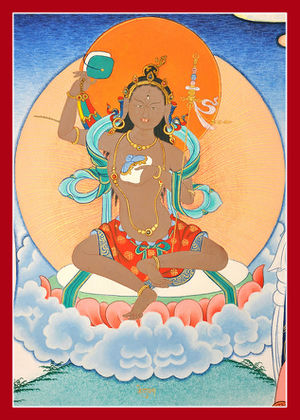
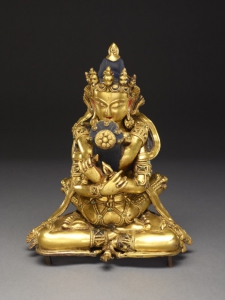
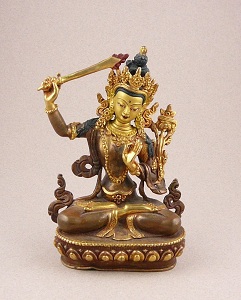
With the support of Tsadra Foundation, I ventured forth to the 11th Sakyadhita International Conference on Buddhist Women, held from December 28th through January 3rd, in Ho Chi Minh City, or Saigon, in Vietnam. There, I presented a paper entitled “Seeking Niguma, Lady of Illusion” extracted from my forthcoming book of translations of the works of this 11th century Indian saint.
Sakyadhita—”Daughters of the Buddha”—is a global coalition of Buddhist Women established in 1987. It has 2000 members and friends in 45 countries, and has an international conference every two years in a different country, and national conferences in individual countries. There is a strong emphasis on women’s scholarship and on supporting the bikkhuni sangha (fully ordained nuns) in the various Buddhist countries. In their own words:
Working at the grassroots level, Sakyadhita provides a communications network among Buddhist women internationally. The organization promotes research and publications on Buddhist women’s history and other topics of interest. It supports Buddhist women’s initiatives to create education projects, retreat facilities, training centers, women’s shelters, and local conferences and discussion groups. Members strive to create equal opportunities for women in all Buddhist traditions. The goal is to empower the world’s 300 million Buddhist women to work for peace and social justice.
Since the first small gathering in Bodhgaya with the Dalai Lama as keynote speaker, the movement has gained momentum under the able leadership of Venerable Karma Lekshe Tsomo, an American nun and author who divides her time between the University at San Diego and Asia. The conference this year in Vietnam boasted the overwhelming attendance of over 2000 people from 34 different countries, the majority of them nuns.
I really didn’t know there were so many! There were nuns of every stripe and color. The majority were, of course, from Vietnam itself, where nuns in grey and saffron robes mix beautifully. Others were also there in force: There were the brilliant dayglo-orange nuns from Sri Lanka, whose membership of fully ordained nuns has gone from 0 to over 1000 in just ten years since Sakyadhita has been there to support them.
There were the grey armies from Korea, who burst into smiles and antics at the merest glance, including one favorite singing nun who serenaded our taxi ride with “Santa Rucia.” There were several grades and colors from Thailand, the white-robed novice meji and the controversial fully ordained nuns, most bravely represented by Dhammananda Bhikkhuni (Chatsumarn Kabilsingh—more on her later). There were pink and white nuns, maybe from Nepal or Burma, and many greys and browns from the Chinese tradition, mostly from Taiwan, Singapore and Hong Kong.
There was a tight team of Ladhaki nuns who came with minimal sponsorship, seeking more. The six or so Ladakhis, along with one Bhutanese, one Singaporean, and several Indian-based nuns from Kinnaur and Dharamsala, were the only Asians representing the Tibetan tradition.
The main maroonies were Westerners, including the most venerable Jetsunma Tenzin Palmo, who is absolutely the rock star of the bikkhuni world.
The same goes for the Japanese traditions, which were represented by a decent turnout of ordained priests from San Francisco Zen Center, but little else. A good many lay people also attended from countries like Malaysia, Mongolia, Australia, Serbia, Germany, Britain, PRC, Canada, and the States.
The crowds of participants jammed into the biggest temple in Ho Chi Minh City reflect the state of that city altogether. Seriously—and I’ve been to a lot of Asian cities—I have never before dealt with traffic like that! Crossing the road was utterly harrowing. Generously, the conference paid for all taxis to and from the temple. So walking the short distance to the hotel was only necessary on the many occasions when I had to rush back at midday to a cold shower and air-conditioning. The conflict was in deciding which was more unbearable: the hot sticky smog-induced sweat or crossing the road? Each day was a different conclusion. Meals were also generously supplied by the temple, so the question too was between battling the army of nuns for the delicious vegetarian meals or just settling for the banana stolen from the breakfast-included hotel. These were the daily dilemmas for seven full days.
But I guess I should talk about content! Every day for the whole morning, papers were read by various scholars and quasi’s (like me). Each person had only ten minutes, so this basically consisted of reading as fast as possible. Foreign papers had been previously translated into Vietnamese and Chinese, and then “edited” by the government. The Vietnamese version was broadcast loudly over the speakers (and Vietnamese is not a gentle language), while English and Chinese could be heard with difficulty in the headphones connected to a little steamy booth on the upper level where nuns were diligently reading and trying to keep up. The papers ranged from excellent to a good opportunity to visit the porto-potties. The subject of the conference this time was “eminent Buddhist women”, so many of the papers were straightforward histories of women and nuns whose stories might easily have been overlooked were it not for this conference. This in itself is one great gift of the Sakyadhita organization. Many of these stories were of Vietnamese women, and I felt the sense of wonderment from the readers that there seemed to be people who actually wanted to hear their stories. The end of exclusively andocentric story-telling is surely in sight. There were other topics as well, including about the environment, Buddhist pedagogy, animal rights, women’s leadership, social work, and engaged Buddhism. Individual paper topics and abstracts can still be viewed on the Sakyadhita website.
For my own paper, cut and pasted from the introduction to the Niguma book, I explored the rather unpopular notion that our great dakinis and precious female role models in the Tibetan tradition might be male symbols of enlightenment—basically yogi pin-up girls. For the exciting conclusion to this query, you can see the paper attached, or read the book.
In the afternoons there were various workshops to choose from. The ones I attended suffered greatly from communication and translation issues, but were wonderful opportunities to get to know some of the people. Two personal consequences of the workshops were an interview in The Guardian (Asian version), and a vow of vegetarianism (OMG!). One afternoon late in the conference there was a significant workshop in the main hall that requires a little background information:
Two distressing events happened in the Buddhist world immediately before this conference that you may or many not know of. One is that, according to Thich Naht Hanh, the inhabitants of two of his monasteries in Vietnam, Bat Nha and Phuoc Hu, were violently evicted by government forces. This is of course denied by the government, and from what I’ve read, the situation is not so clear. The other event concerning Thailand and Australia is even more complicated. Very briefly, one of the senior western monks of the Thai Forest Tradition, Achan Brahm, bestowed the full bikkhuni ordination on some women before receiving the approval of the conservative monk leadership in Thailand (which he apparently knew he would not get and therefore “rushed” the ordination). Achan Brahm was then excommunicated from the order. The distressing part to western Theravadin practitioners has been that two of their senior male teachers, the highly respected Achans Amaro and Sumeda, came out in support of the leadership and against the ordination.
These two events were the elephants in the temple, and I wondered if they would ever be noticed. Of the first one, there was ne’er a whisper (which was probably wise, if we wanted to even have a conference in Vietnam). But the issue of bikkhuni ordination, it was finally announced, was going to be the subject of an afternoon workshop late in the conference. It was well attended, and there was a senior representative of the Thai Forest Tradition from Australia on the panel. I had spoken with her and another senior nun of that tradition earlier, and had only noticed great resistance to the subject. Her speech at this workshop was underwhelming at best, and a study in describing the stitching in the emperor’s new clothes at worst. Nothing of the controversy was even mentioned. So it was left to Dhammananda Bikkuni, or Dr. Chatsumarn Kabilsingh of Thailand, to finally air it. I had met Dr. Kamilsingh before, at the conference of Women Religious Leaders in Geneva, soon after her ordination as a bikkhuni. And I had watched as the Thai monks in attendance walked out of the room as soon as she took the podium.
There is great resistance to fully ordained nuns in Thailand, and it’s hard not to think that it relates to the fact that the more vows one has, the more worthy one is of the offerings of laypeople who make merit in this way. The absence of nuns with the full set of vows ensures that the monastic women have no economic support and must continue to serve monks in the monasteries to survive. Well, that’s the cynical view. The official reasons are nit-picky lineage stuff, concisely laid out at the workshop by a German professor and fully ordained nun at the University of Hamburg, Jampa Tsedroen:
“Three different Indian Vinaya schools survived down to the present day. First, the Theravāda which you find in Sri Lanka, Thailand, Cambodia, Laos, Indonesia and Vietnam. Second, the Dharmaguptaka which you find in China, Korea and Vietnam, and third, the Mūlasarvāstivāda which you find in Tibet, the Himalayan border area, Nepal, Bhutan, and Mongolia. The bhikkunī ordination only survived in the Dharmaguptaka tradition to date. The three different Vinaya schools only emerged after the Buddha’s parinirvāna, but for a long time all believed that their own school was the first. And still many believe that only their lineage is pure and unbroken. At the end of the last century there were no more bhikkunīs in the Theravada and Tibetan tradition. Some women who already kept ten precepts in accord with their tradition asked for full ordination in the Dharmaguptaka tradition. Thus the question arose whether you can mingle two Vinaya schools, or whether bhikkus could start a new order of bhikkunīs within their own Vinaya school.”
Dhammananda began her discussion by pointing out that the time limit imposed on her, and even the translation into Vietnamese, were signs of oppression. She described the situation clearly, if briefly. She mentioned that the concerned actions from the west, such as petitions and so forth (which I too had signed), were just making the situation worse. There was no conclusion to her talk, since this situation is on-going. One wonders how long these monks will hold out.
Although not as oppressive, the same kind of situation is true for nuns in the Tibetan tradition. The khenpos and lamas tell them that it’s too difficult to have full ordination and that they are better off as novices, while at the same time being gelongs themselves. I discovered that this is actually the view of most of the Tibetan tradition Asian nuns at the conference. That has to change.
I digress into all of this because it is happening right now in the Buddhist world and hopefully has been informative for you. But also because it highlights one of the main functions of Sakyadhita conferences: to inspire and uphold the Buddhist tradition of bikkhunis, and to foster equality of education and scholarship among them. Personally I think that a monastic life-style is an awesomely radical alternative lifestyle choice for a woman and a truly viable feminist stand to take, and that we should support it wherever we can.
After the formal conference was over, there were two days of visits to nunneries and orphanages run by nuns, and of course official headquarters of various government offices connected with Buddhism, in and around Ho Chi Minh City. Then there was a five-day tour to the North, which I can only describe as the tour from hell. I’d really rather not revisit it. What’s that? You insist? OK, so here it is:
Up at 4 a.m. to “avoid traffic” (not actually possible in any case), then waiting in the street until 9:00 for a fourth bus to carry the “uncounted” people (oops). With Buddhist flags flying (designed by the American Colonel Henry Alcott, little did they know), we are escorted by police out of the city. Driving driving driving until lunch at a country nunnery, driving driving driving until dusk to visit a flower theme park somewhere, and then on to a zen monastery in the dark, where a male zen master gave a talk about how it really is ok to be a woman. Really it is. Sleeping on zen mats with snoring women and heruka mosquitoes for a thankfully short night. Then up at four, before dawn, to make sure we didn’t see anything of the beautiful zen gardens there. Then driving driving driving—our city bus driver crawling over the mountains, then speeding up as the beautiful coast near Danang whizzed by. Half the passengers jumping ship into the night of Hoi An (which was on the schedule to visit—ha ha) and then arriving finally in Hue after midnight. Yes, over 20 hours of driving. I can brag that I have seen half of Vietnam—at night! One day of touring around in Hue, and actually seeing some cool stuff like the royal palace and the temple of a famous 14th century princess nun. Then the next day, flying into Hanoi and only finding out en route that our hotel would actually be several hours outside the city. OK—that’s where I lost it and took off on my own. Well actually not on my own, since several others joined me including a certain venerable. So I had a few days of wandering around in the old quarter of Hanoi, enjoying, to some extent, the masses of humanity. Hanoi, now that’s a city. Capital for over a thousand years, full of life and hope still. Almost cool, both in temperature and in attitude. (And by the way, the great legacy of the French? Coffee. Including even the weasel vomit kind.)
Then I took off on a little side adventure in Cambodia with my friend Sandy, who came over from the Burmese refugee camps in Thailand. She and I spent four glorious days wandering around the temple ruins like Angkor Wat and other Tomb Raider spots. (I tried telling one guide that I was Angelina’s mother, but he was no fool.) Angkor Wat—really impossible to describe, so I won’t. But pondering those ancient stones, the eyes of Buddha and Vishnu watching untold thousands of sunrises and sunsets, and the miles and miles of intricate carvings in multidimensional relief, I wondered if I could have been just a tad more patient with group activities.
The mysterious Niguma was an Indian woman from Kashmir who probably lived in the 11th century. Not only are the dates uncertain, but so too is almost everything about her. I will explore what there is to know and not to know about Niguma. What does stand firmly as testimony to her existence is her legacy of teachings, which form the very core of the Shangpa Kagyu lineage, one of the “Eight Great Chariots of the Practice Lineages” that were later identified as the main conduits through which experiential Buddhism spread from India to Tibet.[1]
Who was this phantasmic lady Niguma? I will include here the brief biography found in the Golden Rosary of Shangpa Biographies, but other than that one finds only hints and guesses from other sources. For instance, here is a typical description from the great Tibetan master Taranatha:[2]
The Dakini Niguma’s place of birth was the Kashmiri city called “Incomparable.” Her father was the brahman Santivarman (Tib.: Zhi ba’i go cha). Her mother was Shrımati (dPal gyi blo gros ma). Her real name was Srıjñ›na (dPal gyi ye shes). She had previously gathered the accumulations [of merit and wisdom] for three incalculable eons. Thus, in this life [as Niguma], based on the teachings of the instructions by the adept Lavapa and some others, she manifested the signs of progress in the secret mantra vajray›na, and attained the body of union. So her body became a rainbow-like form. She had the ability to really hear teachings from the great Vajradhara. Having become a great bodhisattva, her emanations pervaded everywhere and accomplished the welfare of beings.
The elusiveness of Niguma is typical of the lore of the dakini, the very embodiment of liminal spiritual experience. Additionally the difficulty of pinpointing historical information may well be due to the lack of ancient sources from India, and the lack of concern about such mundane matters by the Tibetan masters who encountered her in dreams and visions and maybe in person. After all, when confronted with the blazing apparition of the resplendent and daunting dark dakini bestowing critical cryptic advice, a background check would be rendered irrelevant. Indian Buddhist hagiographies are virtually unknown, whether of men or women.[3] In Tibet, where hagiography became a prolific genre in its own right, those of women were extremely rare, for all the usual reasons. It is in the experiences of those heroes who encountered the dakini that one finds the most information, and which are invested with the value of spiritual meaning. In the Golden Rosary of Shangpa Biographies, Niguma’s life story consists of only six folia, half of which is a supplication prayer to her, while that of her disciple Khyungpo Naljor, called a “mere mention” (zur tsam), is 43 folia, and those of brother Naropa, Taranatha, Tangtong Gyalpo and so forth where Niguma is mentioned are much longer than that. Even more distressing, I have discovered that half of the remaining half of Niguma’s life story, the part that concerns her birthplace, appears to be directly lifted from a biography of Naropa![4] Perhaps she is just an adornment on the lives of great saints, a figment of mens’ imaginations.
That, of course, is something one has to wonder and worry about in nearly all of the more ancient writings about dakinis. The idealized image of a female messenger, awesome keeper of the great mysteries to be revealed only to the deserving spiritual virtuoso, is packed with power and intrigue for both male and female practitioners. Though unique in its particulars to Himalayan Buddhism, it is found in reminiscent forms throughout the cultures and religions of the world. The mystery of the dakini herself will not be revealed because she is the very definition of mystery, and were she discovered by other than mystics, it would not be she.
But what of the actual woman behind the image? In the case of a reportedly historical woman such as Niguma, we should be able to find at least some hint of a subjective story, something to convince us that she is more than the object or projection of the practitioner’s realization. And more than the “other” of the male “self.” We seek her as the subject of her own story.
Niguma’s Home
Niguma’s life does present us with a few crumbs. First of all, her birthplace is known to be in Kashmir, a hub of Buddhist activity, particularly of the tantric type, and probably in close quarters with the Shaivite tradition and other forms of esoteric Hinduism. The specific town, or perhaps monastery, is called Peme (dpe med) in Tibetan, meaning “without comparison,” translating Anupama.[5] But we find in her biography that this is not a real town, exactly, but one that has been created by an illusionist. The first hard fact is already shaky. The story first mentions the creation myth, as it were, of Kashmir itself, a land that was once under water. According to Niguma’s biography, it was the time of the previous buddha, Kashyapa, though in other versions the story centers around Buddha Shakyamuni’s time and his disciple nanda.[6] In any case, a disciple wished to build a temple in the area of Kashmir and stealthily negotiated with the subterranean beings, or naga, who were tricked into upmerging and forking over a large area of land. It reports that the residents were amazed, though in the same story in Naropa’s biography it is the n›ga themselves who were amazed. In any case, the amazed ones commission an illusionist to create a city, which he does based on the “blueprint” of the great celestial city of the gods called Sudarshana. But this talented architect-magician died before he could dissolve the city, and so it remained. This, then, is Niguma’s home town: a divinely inspired illusion.
Family and Friends
Niguma’s family relationships are similarly slippery, particularly when it comes to her connection with Naropa (956-1040),[7] her contemporary and a great adept whose teachings on the six dharmas learned from Tilopa spread widely in Tibet. The names of her parents given above by T›ran›tha are indeed the same as those of N›ropa in his biography in the Kagyu Golden Rosary by Lhatsun Rinchen Namgyal and are similar in other biographies.[8] Those same biographies tell the story of those parents’ first child, Shrıjñ›na, and how they had to perform special supplications for a male child after her birth. We also have the name of N›ropa’s wife, Vimala or Vimaladıpı (Dri med pa or Dri med sgron ma), with whom he parted to pursue his spiritual career. N›ropa is sometimes said to be from Bengal in the east, but there is little evidence for this theory and most authors locate his birthplace in Kashmir, along with Niguma.[9] There is even some evidence that Naropa’s well-known hermitage of Pushpahari, or Pullahari, commonly identified as being on a hillock west of Bodhgaya, may have been in Kashmir.[10] In Niguma’s biography it simply mentions that he was also in the area. Despite any misinformed discrepancies, it would seem to be quite clear that Niguma and Naropa were sister and brother. Yet scholars, mostly western, have insisted on suggesting that Niguma was his consort, perhaps his sister too, in a sort of tantalizing tantric gossip. Alas it may be the great translator Herbert Guenther who started the trend. In his introduction to The Life and Teaching of Naropa he makes a most puzzling allusion:[11]
[Naropa’s] wife seems to have gone by her caste name Ni-gu-ma, and according to the widely practiced habit of calling a female with whom one has had any relation ‘sister’ she became known as ‘the sister of Nāropa.’
Guenther cites The Blue Annals and the Collected Works of bLo bzang chos-kyi nyi-ma, an eighteenth century Gelukpa scholar known as Thu’u kvan Lama, as the sources where “Ni-gu-ma is stated to have been the wife of Naropa.” However, both sources state nothing so definitive. The Blue Annals, which devotes most of a chapter to the accounts of Niguma and her lineage, mentions her only as Naropa’s sister,[12] using the Tibetan word lcam mo, a combination of lcam (an honorific) and sring mo (“sister”). The second source similarly says only that she is Niguma’s lcam,[13] as do all other sources in Tibetan that I have seen. A supplication to Niguma in the practice of the white and red Khecharı dakinis uses the unambiguous term sring mo, calling her “the single sister of the awareness-holder.”[14] Admittedly the word lcam mo can be used as mistress or wife, particularly as the senior of several wives,[15] but given this bivalent meaning plus the fact that we have the identical parents’ names and the name of Naropa’s real wife, why on earth would one choose to translate it as “wife”? Even the translator Roerich does not do so in the Blue Annals, and comments elsewhere that “in the ancient language lcam means always ‘sister’.”[16] It does seem to be that tired old need to attribute a woman’s worth to her mate that plagues the annals of history, coupled with the scholarly penchant for repeating the confident pronouncements of former scholars.
Another possible source of confusion pertains to a supposed meeting between Naropa’s Tibetan disciple Marpa and Niguma. In the Introduction to the translation of Tsangnyön Heruka’s biography of Marpa called The Life of Marpa the Translator, the following information is offered, repeating the relationship in an even stranger way:
After attaining his first realization of mahāmudrā under Maitrıpa, Marpa returned to Nāropa. This time, Nāropa sent Marpa to receive teachings from Niguma, Wisdom (Jnāna) Dākinī Adorned with Bone ornaments. She was Nāropa’s wife before he renounced worldly life to enter the dharma, and later she became his student and consort. Finally, she became a great teacher herself and her lineage of teachings was taken to Tibet (though not by Marpa) and continues to this present day. Unfortunately, our story here does not tell us very much about their meeting (xliii).
The Tibetan text reveals that Marpa was indeed sent on two separate occasions, first by Naropa and later by Shantibhadra, to meet a certain dakini called simply by her the metonym “Adorned with Bone Ornaments”.[17] Nowhere does it mention Niguma specifically by name in this or other biographies of Marpa. It is true that in later eulogies Niguma is described as wearing bone ornaments, but I believe this could be considered a regular wardrobe for dakinis, whose options were generally confined to charnel grounds. Better evidence of their identity than similar attire would be that both Marpa’s dakini and Khyungpo Naljor’s Niguma can sometimes both be found in the same great cemetery of Sosadvıpa (Tib. Sosaling), said to be just to the west of Bodhgaya and the vacation spot of many a great master, including Padmasambhava. It was also, however, a famous dakini gathering spot. In Marpa’s biography he finds the bone-deckeddakini on two occasions: once he receives the empowerment and instructions in the Four Seats Tantra from her, and a second time he receives a prophecy about meeting N›ropa (after he had already passed away).[18] Given the widespread prevalence, even requirement, of dakini encounters on the spiritual path of yogis, this account gives us nothing to cling to. Moreover, there is no account wherein Niguma receives any teachings from Naropa, though the similarity of content might lead one to believe otherwise. But how do we know that it was not the other way around—that Naropa did not receive teachings from his big sister?
Teachers
Niguma’s teacher was, famously, the Buddha Vajradhara. The only piece of specific information about Niguma’s human teachers that I have from my sources is her connection with a certain Lavapa, according to two accounts by Taranatha. However Lavapa is not mentioned by name in Niguma’s Life Story, where it says only that “she directly saw the truth of the nature of phenomena just by hearing some instructive advice from a few adept masters.” The only two named masters in the Life Story are Naropa and Ratnavajra, and then only as cohabitants in Kashmir.[19] Again, the commonly-held belief that Niguma received the six dharmas from Naropa seems to be unsubstantiated. In fact, the Blue Annals, following a similar statement in Khyungpo Naljor’s biography, quotes Niguma saying that “these six doctrines are known only to myself and Lavapa.”[20]
But it is difficult to identify this Lavapa. Taranatha provides some nice anecdotal stories of an acarya Lavapa in The Seven Instruction Lineages and discusses him again in his History.[21] He is also mentioned by Naropa’s guru, Tilopa, as one of his four human teachers and the one from whom he received dream yoga, or lucid clarity, depending on the account.[22] Some sources identify him with Kambhalapada, one of the eighty-four great adepts (mahasiddhas) of Indian Buddhism, although Taranatha does not seem to make this identity. In any case, the Lav›pa who was Tilopa’s teacher would have likely been too early to be Niguma’s teacher, and he is also associated with the conversion activities in the west of India.[23] So we are still left with a lack of information on his “Lavapa of the East,” other than that he is lesser (i.e. younger), or later. Here is another version by Taranatha, with its veiled jab at this unidentified Lavapa:[24]
She listened for a bit to instructions from Lavapa of the East, and after meditating for seven days together with the master himself, she became a dakini of timeless awareness with a rainbow body. She manifested the realization of the eighth level. It is said that Lav›pa of the East [did not gain the full rainbow body because he] left behind a palm-sized portion of the crown of his head. This Lavapa is the lesser. The name Nigu accords with the Indian language, which is Nigupta, and it is said to mean “truly secret” or “truly hidden.” In fact, it is the code-language of the dakinis of timeless awareness.
Code Language
The symbolic or code-language of the dakinis (mkha’ ‘gro’i brda’ skad) is itself “truly hidden.” Masters of meditation decipher these communications in moments of inspiration, but by the time we hear what they might be, they have already been translated and carry all the perils of that craft, including possible fraud. We can see a few indecipherable graphics called dakinicode-letters” (mkha’ ‘gro brda’ yig) in treasure texts, but even this is only a subcategory of the mystery code-language itself. In his commentary on the treasure text Lamrim Yeshe Nyingpo, the great nineteenth century master Jamgön Kongtrul explains:[25]
A person endowed with the karmic continuation and destiny will, by means of a profound coincidence of place, time, and aspiration, be able to decode the symbolic meaning of these treasure letters that are nirmanak›yas, the vajra forms endowed with all eminent aspects, and establish them correctly in writing.
Perhaps the dakini code-language is beyond verbal communication, with its necessarily dualistic and designatory nature. But then why call it “language”? Symbolic communication is specifically distinguished from non-verbal transmission in the Nyingma tripartite transmissions of dzogchen teachings, where the symbolic linage of the awareness-holders (rig ‘dzin brda’i brgyud pa) falls neatly between the non-verbal lineage of the buddhas’ ‘thought’ or intention, and the aural lineage of ordinary people. Janet Gyatso suggests that the dakini, in keeping with her playful character, is “working within language to subvert it, drawing attention to its own (dualistic) structures while never retreating outside its realm.”[26] And certainly the esoteric teachings of the tantras themselves in their written form are known to be coded. After all, the common name for those teachings is “secret mantra” (gsang sngags). The dakini code-language is a secret within that secret, and seems to be reserved for the most profound and spontaneous experiences of only very gifted practitioners.
Taranatha makes no attempt to tell us what the name “Niguma” really means in that language, leaving it rather to the initiated to find out.
In a similar way it is difficult to precisely identify Niguma’s other attributes that recur in most sources, although they are reported as quantifiable facts. She had high-level realization, placing her in the “pure” (dag pa) or non-dissipating (zag med) levels, she attained the so-called rainbow body, and most famously, she could receive teachings directly from Vajradhara. What do these qualities actually mean, other than ways to impress us? I explore these lofty attributes in my forthcoming book on Niguma
As much as I have searched for this dakini named Niguma and hoped to find her as an actual person and the subject of her own story, it may have been in vain. The more I dig, the more elusive she becomes. No doubt I am looking in all the wrong places, in old books and dusty corners. Still, I hope that this might be more than another case of the female as a vehicle of meaning for men, or that, as one post-Buddhist feminist puts it, “the place of the male as subject is unconsciously protected, whilst creating a notion of fluidity around the concept of the female body.”[27] I might have to admit, however, that she is primarily an important event in the lives of the men who saw her, rather than a historically locatable person. These, in any case, are really the only sources of information. Her own story, if it ever existed, is not to be found other than the few details that I have explored here.
[1] The so-called Eight Great Chariots of the Practice Lineages (sgrub brgyud shing rta chen po brgyad) is a system of identifying the streams of esoteric instructions (man ngag) that came into Tibet from India. Based on an initial listing by Prajñ›raŸmi (1517-1584), it was developed primarily by the great Tibetan savant Jamgön Kongtrul Lodrö Tayé (1813-1900) as a doxographical tool in his great efforts to preserve the histories and teachings of all those lineages by collecting and printing them in the large compendiums known as his Five Great Treasuries. He enumerates these eight chariots as (1) Nyingma, (2) Kadam, (3) Lamdré, (4) Marpa Kagyu, (5) Shangpa Kagyu, (6) Zhijé and its branch of Chöd, (7) Dorjé Naljor Druk (or Jordruk), and (8) Dorjé Sumgyi Nyendrup. See Kongtrul, The Treasury of Knowledge: Esoteric Instructions.
[2]Clearing up Darkness of the Mind,TCW, 17:459 (f. 22a1-4). T›ran›tha (1575-1635) gives his full name as Kunga Nyingpo Tashi Gyaltsen Palzangpo (Kun dga’ snying po bkra shis rgyal mtshan dpal bzang po). He used the Sanskrit translation of his title Drolwai Gonpo (sGrol ba’i mgon po) as his name to show his close connection with the Indian tradition, as he studied directly with Indian teachers in Tibet. T›ran›tha was an incredible realized master, historian, and philosopher, whose prolific writings encompass nearly every aspect of knowledge in Tibet, with his collected works numbering twenty-three volumes. He is thought of particularly in connection with the Jonang school, as his most common epithet Jonang T›ran›tha or Jonang Jetsun clearly indicates, but his influence is much broader.
[3] Janet Gyatso, Apparitions of the Self: “Even Indian Buddhist hagiographical narratives are scarce and are limited to idealized renderings of the life of the Buddha and a few other works” (115).
[4]The Life Story of the Supreme Learned N›ro Pa˚chen (mKhas mchog n› ro pa˚ chen gyi rnam thar) by Sangye Bum, in the Rwalung Kagyu Golden Rosary, vol. 1: 87-129.
[5] Advaitavadini Kaul mentions a monastery in the town of Anupamapur› (grong khyer dpemed) in connection with Gunakarasribhadra (Buddhist Savants of Kashmir: Their Contributions Abroad, 49).
[6] See, for example, the recounting of this tale by Bu-ston, translated by Obermiller in The History of Buddhism in India and Tibet, 89-91. One of a group of nanda’s disciples called Madhy›ntika is prophesied by nanda to be the future settler of Kashmir, “the place suitable for mystic absorption and the best resting-place.” In fulfillment of that prophecy, the events of the story unfold more or less as related here. In terms of the drastic environmental change in the geography of Kashmir that resulted, the time of the previous Buddha might be more appropriate. See also note 65??
[7] N›ropa’s dates are given as fire-dragon to iron-dragon year, which would be 956-1040. Atısha’s departure for Tibet is reliably dated to 1040, and he brought relics from the cremation of N›ropa with him. The stÒpa in which they are enshrined still survives in Nethang Dolma Lhakang temple, founded by Atısha. According to Peter Roberts’s introduction to Mah›mudr› and Related Instructions, the common erroneous dates of 1016-110 (such as in Guenther, The Life and Teaching of N›ropa ) was the result of taking literally an episode in Tsangnyön Heruka’s version of the life of Marpa in which he visits N›ropa. However it turns out that the visit and Naropa’s song are derived from one of Tsangnyön’s visions and are without historical basis.
[8] See Guenther, The Life and Teaching of N›ropa (16), with the following information: born into the Shakya clan, brahman caste, his father named Zhi ba ho cha (Shantivarman) and mother dPal gyi blo gros (Srimati) who was the daughter of the great king sKal lden grags pa. They had only one daughter, the princess dPal gyi ye shes (Srıjñ›na). N›ropa’s wife was Dri med pa (Vimala) whose mother was the Brahmini Nigu. (Note that the Sanskrit names are reconstructions from the Tibetan.) These names accord with those given in the biography by Karmapa Rangjung Dorje (1284-1339). However in The Life Story of the Supreme Learned N›ro Pa˚chen by Sangye Bum, the father’s name is given as the brahmin dGe ba bzang po, and his mother’s name as the brahmini dPal gyi ye shes (89-90; f. 2a6-b1), which in other places is actually the daughter’s name.
[9] The earliest biographies of N›ropa, such as that of Gampopa (1079-1153) and Lama Zhang (1123-1193), do not name a specific birthplace other than simply “the west.” All accounts of Naropa include the story of a ˜›kinı appearing to him and telling him to “go east” to find his guru Tilopa, which really only makes sense if he is somewhere in the west. In The Life Story of the Supreme Learned N›ro Pa˚chen, which claims to have compared five different biographies, Sangye Bum gives his birthplace as the “land of Moslems” (kha che’i yul), almost universally interpreted to mean Kashmir (88). (Recall that Moslems gained control of Kashmir in the 14th century). In case this is not clear, Karmapa Rangjung Dorje (1284-1339) specifies “ka smi ra”, transcribing the Indian “Kashmir” as nearly as is possible in Tibetan in his version of the life story (f. 26a2). Kachö Wangpo (1350-1405) is even more specific, saying: “In the east of India, the town of Jammu (‘Dzam bu) in Srinagar (Sri na ga ra), a district of Bha ga la.” Srinagar and Jammu are easily identified in the south-eastern part of the Kashmir valley, but “bhagala” is not so clear. The biography by Lhatsun Rinchen Namgyal (1473-1557), which was translated by Herbert Guenther in The Life and Teaching of N›ropa, is a verbatim copy of Kachö Wangpo’s, a very common practice in Tibetan literature where plagiarism is truly the highest form of flattery. Dorje Dze-ö ‘s biography of Naropa, translated by Khenpo Könchog Gyaltsen in The Great Kagyu Masters, has the same information. It seems that it is only in the inexplicable identification of the Tibetan transliteration “Bha-ga-la” as “Bengal” in these two translations (despite the obvious reference to Srinigar and Jammu) that N›ropa has been widely viewed in the western world as Bengali. But later Tibetan authors such as T›ran›tha have upheld Kashmir as his birthplace. One last twist to this research is that Sangye Bum’s description of “the land of Moslems”, identical to the one in Niguma’s life story, adds that it is also called “Kosala”! (89; f. 2a6) This ancient kingdom where the Buddha Shakyamuni spent most of his teaching life is nowhere near Kashmir or Bengal, but somewhere in the middle. This seems to come out of nowhere and I have no explanation for it. On Naropa’s birthplace see also Templeman, The Seven Instruction Lineages, 46 and 115, n.157.
[10] For example, in his translation of the Blue Annals, George Roerich notes that modern Tibetan pilgrims believe the location of Pullahari to be in Kashmir near Srinagar (400). And more interestingly, the colophon to Tilopa’s Esoteric Instructions on the Six Yogas (Chos drug gi man ngag) states that it was translated by N›ropa and Marpa in Pu˝hpahari in the place of the Moslems (kha che’i gnas), again referring to Kashmir (Toh. 2330, f. 271a2-3).
[11] Guenther, “Introduction”, The Life and Teaching of N›ropa, xi-xii.
[12] “N› ro pa’i lcam mo“, Gö Lots›wa, 2:854 and again on 855 (Roerich, 2:730).
[13] Th’u’ Kvan Lama, Collected Works of bLo bzang chos-kyi nyi-ma, vol. Kha, f.3a1.
[14] Increasing Enlightened Activity: the Feast offering and Concluding Rites of Red and White Kecharı in the Shangpa Tradition (Shangs lugs mkh’a spyod dkar dmar gnyis kyi tshogs mchod dang rjes chog phrin las yar ‘phel), ST, 3:300 (f. 2b5-6).
[17]rus pa’i rgyan can. The actual description is “the ˜›kinı of timeless awareness with whom it is meaningful to be connected [and who] has bone ornaments” (ye shes kyi mkha’ ‘gro ma ‘brel tshad don ldan rus pa’i rgyan dang ldan pa) (Tsangnyön Heruka, 38). Fun fact: Tsangnyön Heruka was also called “Adorned with Bone Ornaments” (gTshang smyon he ru ka Rus pa’i rgyan can).
[18] Nalanda Translation Committee, The Life of Marpa the Translator, 32 and 80, respectively. The Four Seats Tantra (Catu¯pı˛ha;gDan bzhi) is a mother tantra of highest yoga tantra. In Sangye Bum’s Biography of Marpa in the Rwalung Kagyu Golden Rosary (a collection of biographies of the Middle Drukpa masters in Rwalung), Marpa receives this from ‘Phags pa rang byung (1:136). Khyungpo Naljor did not receive this tantra from Niguma either; it did not seem to be in her repertoire.
[19]grong khyer der che ba’i pa˚˜ita n›ro ta pa dang/ rin chen rdo rje gnyis bzhugs so (ST, 1:40; f. 2b4).
[20]The Blue Annals (Deb ster ngon po) by Gö Lots›wa Zhonnu Pal (1392-1481): “chos drug gi gdams pa ‘di rnams shes pa nga dang lwa ba pa ma gtogs med “(vol. 2:856). In the translation, Roerich inserts Kambalap›da as another name for Lav›pa, though this identity is not certain in this case. The statement in Khyungpo Naljor’s life story is in Shangpa texts, vol.1:92 (f.17b4).
[21] Templeman, The Seven Instruction Lineages, 33-36; and T›ran›tha’s History of Buddhism in India, 241-245. The supplementary notes in the back of the latter (408) reveal that the translators also identify him with Kambhala, as in the Blue Annals, although the author Gö Lots›wa did not make that identity explicit.
[22]Esoteric Instructions, 137; TOK, 1:526. He is also mentioned often in the various biographies of Tilopa, including Marpa’s biography of Tilopa, The Life of the Mah›siddha Tilopa, page 5 in the Tibetan transliteration. By some accounts, it was lucid clarity that Tilopa received from Lav›pa, and T›ran›tha would seem to corroborate, although there are many versions. For a discussion of this see ibid., 69-70, note 31.
[23] Templeman, T›ran›tha’s Life of K¸˝˚›c›rya/K›˚ha, 82.
[24]A Supplement to the History of the Lineages, DZ vol. 18:102-103 (ff. 2b6-3a3). For a brief and confusing discussion of Lav›pa’s identities and dates, see T›ran›tha,The Origin of Tara Tantra, 60, n. 173. Also see some stories about this siddha in Dudjom RInpoche’sThe Nyingma School of Tibetan Buddhism 1:485-487. Here he is identified with IndrabhÒti the Younger, son of King Ja, as his teacher, whereas T›ran›tha associates with IndrabhÒti the middle. In fact much of this confusion may arise from the multiple IndrabhÒtis.
[25] Padmasambhava/Jamgön Kongtrül, The Light of Wisdom: Vol. I, 37. Translation by Erik Pema Kunsang.
“Out of land of snows comes a snow-white digital electronic pocket gadget, produced by a Lhasa-based Tibetan enterprise Tibet Luozang Digital Science & Technology Ltd.
The handheld device features an impressive array of edutainment functions: 34 dictionaries (Tibetan, Chinese, T-C, C-T, T-C-English); PDA (Palm Digital Assistant) application; database of language, cultural and historical entries in Tibetan and Chinese; trilingual WordPad; MP3 player, with USB interface with personal computer; and games…”[/vc_column_text][/vc_column][/vc_row]
in relevant areas of Tantric Studies are encouraged and invited to
present, attend, and/or participate in the conference. Graduate
students in any of these disciplines are also encouraged to present
and attend the conference. Scholars and graduate students are welcome
to attend without presenting.
We invite fully formed panels and individual papers. Proposals should
be no longer than 1,000 words. Abstracts should be no longer than 150
words. In addition, all participants should include a CV (maximum 2
pages) and a brief statement explaining what they hope to get from
attending the conference. Digital versions (preferably in .pdf format)
of proposals and abstracts, as well as CVs and statements should be
emailed to Glen A. Hayes, Dept. of Religion, Bloomfield College at =
tantricstudies@gmail.com
. PROPOSALS MUST BE RECEIVED NO LATER THAN June 15, 2010.. Acceptance
of papers will be sent out by July 15, 2010.
Some of the themes suggested by members of the Society include, but
are not limited to, the following topics:
Tantra and Power (royal, spiritual, magical)
Tribal Elements in Tantra
Women in Tantra (symbolically, literally, textually, ethnographically)
Tantric Art and Tantric Texts
Tantric Textual Theories of Practice and their Limits
Tantra and Aesthetics
Tantra, Physiology, and Landscape
Texts and Translations
Tantric Metaphors
Tantric Typologies of Self
Tantric Studies in 2010: The State of the Field
Critical Reflections on Western Approaches toTantric Studies.
LOCATION:
The conference and accommodations will be at the lovely Little America
Hotel, situated amidst a pine-forested mountain in Flagstaff, Arizona.
Special conference rates begin at $99 for single or double. A block of
rooms will be held for conference attendees until August 23, 2010. You
may visit their website at: www.littleamerica.com/flagstaff/. A
restaurant and coffee shop are located on the premises. Attendees
should fly into Phoenix and either drive up to Flagstaff
(approximately 2 hours) or take a connecting flight into Flagstaff
airport. We recommend staying for an extra day or two to arrange for
visits to the Grand Canyon (2 hours), Sedona (1 hour), and Meteor
Crater (1 hour)—among the many local attractions.
FEES: Attendees will pay a fee of $75 ($35 for graduate students) to
cover conference and STS expenses.
Proposals go to Glen Hayes, while inquiries regarding the Society for
Tantric Studies can be sent to Richard K. Payne:
Dr. Richard Payne, Dean
Yehan Numata Professor of Japanese Buddhist Studies
Institute of Buddhist Studies
at the Graduate Theological Union
2140 Durant Avenue, Suite 30
Berkeley, California 94704
telephone: 510.809.1444
facsimile: 510.809.1443
email: rkpayne1@mac.com
Society for Tantric Studies
Call for Papers
The Society for Tantric Studies invites papers for its next conference, to be held in Flagstaff, Arizona from Friday September 24 through Sunday September 26, 2010. The Society for Tantric Studies (STS), founded in 1985, is a forum of exchange for scholars engaged in the academic study of Tantra both in its traditional Asian contexts and more recently in diverse global manifestations. The conference provides an opportunity for scholars to collaborate across traditional boundaries of religious traditions (e.g. Hinduism, Buddhism, Jainism), present-day nation-states and geography (e.g. India, Tibet, China, Japan), and academic disciplines (e.g. history of religions, anthropology, art history, linguistics, sociology). Above all, the STS is committed to critical and creative inquiry. It is not an advocacy forum for Tantric practice and neither endorses nor prohibits particular approaches to either the study or the practice of Tantra. Scholars with doctorates in related academic disciplines (such as Religion, Asian Studies, Sociology, Psychology, Anthropology, Art, History, Philosophy ,or Women=92s Studies) researching and/or teaching in relevant areas of Tantric Studies are encouraged and invited to present, attend, and/or participate in the conference. Graduate students in any of these disciplines are also encouraged to present and attend the conference. Scholars and graduate students are welcome to attend without presenting.
The first presenter on this panel was very well meaning and had some mildly interesting things to say, but as with much of the “Buddhism and Science” dialog, it was mostly a bunch of “sound and fury, signifying nothing.” Beginning with a quote from Lopez’s new book on the subject, Dr. Cho tried to argue for a slightly more positive reading of the exchange between Buddhism and science than Lopez allows for, but ended with a warning about “the prison that the label of science creates.” It seemed obvious that the talk was well-meaning, but the content was a string of sentences full of jargon, most of which I found my Orwellian self translating into simpler, clearer, language. (In case you haven’t read it, Orwell’s 1946 essay “Politics and the English Language” is a must read for any writer. In it, he argues for clear speech and writing over convoluted “academic” English.)
I will be attending the AAR meeting in Montreal this week. Please take a look at this list and let me know which sessions you would most like to hear about. I’ll try my best to get to as many as I can.
Discussion on the Intermediate State in the Mahâvibhâsha
Translated from the Chinese version by Xuanzang Apidamo da pibosha lun, T 1545, vol. 27, p. 356-64 玄奘譯阿毘達磨大毘婆沙論卷第六十九-七十 結蘊第二中有情納息第三之七-八
– Why have the venerable ones included a discussion about the intermediate state 中有 in this varga (納息 category) ? – In order to put an end to heresies and manifest the right view. Indeed, some, like the Vibhâjyavâdins 分別論者, maintain that birth in the three worlds does not imply any intermediate state. Others explain that it is sure that birth in the Worlds of Desire and Form imply an intermediate state : such is the view of the Logicians ( ? 應理論者). – What, then, are the criteria of the Vibhâjyavâdins allowing them to assert the non-existence of the intermediate state ? – They refer to textual evidence 至教量 by quoting a sûtra 契經 which says that one who has committed one of the five actions « with immediate retribution » 五無間業 will for sure be immediately reborn in hell. This immediate rebirth in hell is a clear proof of the non-existence of any intermediate state. A gâthâ 伽他 says : « You who are reborn today, you quit your lofty position And utterly decline to approach Yamarâja 琰魔王. You’d like to go forwards but have no provisions 資量, And if you want to rest in between, you’ll find no place to stop over. » This « no place to stop in between » 中間無所止處 allows them to ascertain the non-existence of this intermediate state. Answering to our objections, they also prove 說過難證 this non-existence saying : as there is no gap between a form and its reflection 影光中無間隙, in the same way there is no gap between death and rebirth. How do you, Logicians, they say, prove the existence of an intermediate state with valid criteria ? – We use a valid cognition derived from an authoritative text which says that « the one who enters its mother’s womb must have a direct experience of three things : 1) the mother’s body must be in time and fit 時調適 ; 2) father and mother must unite ; and 3) the gandharva 健達縛 must appear right in front of them. » So, what gandharva could it be if not a being in the intermediate state ? Who or what could make this experience once the previous aggregates are destroyed ? A being in the intermediate state is thus referred to as the gandharva. Moreover, since texts mention « parinirvâna in between » 中般涅槃, if there is no intermediate state, how is such a parinirvâna possible ? Another text reads : « When this body is destroyed and the next is not yet born, a mental sentient being, stopped by desire, engages in appropriation. » 意成有情依止於愛而設施取。 If the Bhagavân spoke thus, we can be definitely sure that there must be an intermediate state. If it were not the case, what would this « mental sentient being » refer to ? Moreover, their denial can be countered by other evidences, for instance : if an individual dies here [in Jambudvîpa] to be reborn in the Northern Continent of Uttarakuru, etc. 北俱盧等, and if there is nothing like an intermediate state, there will be an interruption between the destruction of its present body and the birth in the next one. In that case, the next body would exist unpreceded and this one would be nothing in spite of its existence – thus goes the nature of things 法亦應爾. What basically does not exist would exist and the existing would return to nothingness. But as such defect is impossible, we have another evidence of the necessary existence of the intermediate state.
– Explain to us then, Logicians who admit the existence of the intermediate state, how you can show that the Vibhâjyavâdins are wrong even though they refer to an authoritative text. – The text they quote does not have a definitive meaning 不了義 and obviously shows a particular intention 有別義趣 in that, when describing the five greatest crimes, it denies other realms and karmas but not the intermediate state. It denies other realms in that the « criminals » can only fall in hell and cannot go into any other realm of existence. Those who have committed one of the five greatest crimes can only, at the moment of death, fall into naraka 捺落迦. As for « denying other karmas », the immediate karmic result 無間業 refers in this case to the next life 順次生 and not to this one 順現, nor to the lives following the next one 順後次. These crimes have such a strength that at the moment of death it is sure that the dead will fall into naraka where he or she will endure retribution. Such is the intended meaning of this text. If we were to take this text litterally, we would have to admit that the five of those crimes have to be committed to fall immediately into hell, whereas it is the case if only one, two, three or four of them are committed. Moreover, this « immediate » fall in hell would have to happen just at the second instant after the effective accomplishment of the crimes. But we have heard of individuals who fell into hell one century after they committed such a crime. So one must not hold to the letter of the text in order to cling to the non-existence of the intermediate state. The previously quoted gâthâ can be explained in the same way inasmuch as it denies other realms and karmic consequences but not the existence of the intermediate state. – How do you, Logicians, explain the Vibhâjyavâdins’ objection and affirm the positive existence of the intermediate state ? – Their objection is not valid because it does not pertain to the Three Baskets, as the dharma of the ordinary people is not the dharma of the wise and sublime beings. One must not use vulgar truths in order to object to the truth of sublime beings. Otherwise, one would have to admit the validity of invalid examples, and that would bring no evidence 若必須通應說喻 過喻,既有過為證不成。Thus it is not possible to compare a form and its reflection with sentient beings who belong to a totally different category : what relationship is there between something deprived of sense faculties and mind, and something endowed with life and death ? Moreover, if form and reflection are simultaneous, how could death and rebirth happen at exactly the same time ? Moreover, this very example of form and reflection having no gap in between is a good proof of the existence of the intermediate state, because this absence of a gap in between describes the immediacy of the intermediate state after death, and the same thing related to the intermediate state and conception. So we can see that there is an intermediate state. – How can the Vibhâjyavâdins still hold on to the non-existence of the intermediate state if they understand the textual interpretation of the sûtra by the Logicians ? – If a text has no definitive meaning, it has to be interpreted. Such is the case with the text mentioning the three things (i.e. mother, sexual union and presence of a gandharva). Here, the gandharva is not a musician with a drum, etc., but an aggregate (or a set) of mental factors 蘊行. Because of this aggregate of mental factors, the Logicians explain that, either called gandharva or mental factors, this is a proof of the existence of the intermediate state. Besides, what could it denote if not a set of mental factors ? But the Vibhâjyavâdins answer objectingly : – You say that the four kinds of birth 四生 necessarily follow an intermediate state. Concerning births from a womb or an egg, the three things of the above quoted sûtra are possible, but how could they work for births through humidity or miracle 濕化二生 ? So your quote is no sufficient proof. To that the Logicians answer : – The explanation with the three things has been given [by the Buddha] according to his listeners. The idea of being valid for the four kinds of birth has come afterwards in the minds of those who are searching proofs against the existence of the intermediate state 三事入胎隨應而說,誰令三事要遍四生? 非設此言便遮中有。 The Vibhâjyavâdins explain the second quote as follows : – You say there are « intermediate gods » who enter nirvâna while in that [intermediate state] 有中天住彼入滅, and that is what the sûtra calls « parinirvâna in between » 中般涅槃. This can fit in the case of those [non-returners] who leave the World of Desire and enter nirvâna before they have reached the World of Form. But the same name applies not only to all those who have the same karma to be reborn in the World of Form 受色界眾同分 and enter nirvâna within a short period of time, but also to those who have been reborn in the World of Form and enter nirvâna before their span of life has been exhausted 壽量未盡而入滅. Therefore this name is no proof of the existence of the intermediate state. They also ask the Logicians where has the Buddha spoken of « intermediate gods » 中天 ? The texts only mention twenty-eight classes of gods, beginning with the Four Great Kings and going up until the gods in the sphere of Neither Perception Nor Non-Perception, but no « intermediate gods ». Since they also mention « parinirvâna during life [in the World of Form] » 生般涅槃, you should also admit the existence of gods called « life » who enter nirvâna while in that [intermediate state]. Furthermore, as sûtras also speak of [non-returners] « who enter parinirvâna through practice » [in the World of Form] 有行般涅槃, etc. up to those « who enter parinirvâna through progressing higher and higher » 上流般涅槃, you’ll have to admit the existence of gods called « who practice », etc., up to « who progress higher and higher ». Therefore, since there are no gods with such names, how could there be gods called « intermediate » ? [The Vibhâjyavâdins go on arguing :] Neither is logical your assertion that « those who enter parinirvâna in between » refer to the [non-returners] who have left the World of Desire but have not yet reached the Realm of Form because, as there is no intermediate state, in what bodily support could they enter parinirvâna ? Your assertion is empty of reality. The same applies to the other definitions you give of « attaining parinirvâna in between » because those who have the karma to be reborn in the World of Form but have not yet reached the time to do so and enter parinirvâna are precisely the beings described as « those who enter parinirvâna during life [in the World of Form] ». Moreover, you’d have to admit that there are individuals who « enter parinirvâna in between » in the Formless World, since there are some who have been reborn there and enter nirvâna before long as their « knots » (or « bonds », 結 samyojana) are exhausted. But if it were the case, one should also say that the Formless World is a place for the « seven good brave ones » 七善士 – which would contradict the sûtras, because those non-returners only go to the World of Form [except the so-called highest samâdhi-loving non-returners in the Peak of Existence 有頂樂定不還]. Finally, your calling « having reached parinivâna in between » the [non-returners] who enter nirvâna before the end of their span of life in the World of Form is neither logical, because many sentient beings experience untimely death 夭, with the exception of the human inhabitants of Uttarakuru and the bodhisattvas experiencing their last rebirth from Tushita heaven 都史多天. All the others who enter nirvâna with untimely death should be called « having reached parinirvâna in between » – then the thing would not be exclusive to the non-returners in the World of Form, and that goes against logics. Going through the third quote, they say that « mental sentient being » 意成有情 refers to a being in the Formless World. They tell the story of a religious Vâtsîputrîya Brahmacârin 出家犢子梵志 who, bereft of the stains of the World of Desire 已離欲染, had obtained the power of the divine eye 得天眼通. He had a fellow student who had already left the stains of the World of Form 色染 and, before the end of his present life, had been reborn in the Formless World. The Vâtsîputrîya Brahmacârin used his divine eye but could not see his friend either in the World of Desire nor in the World of Form. He therefore thought that he must have been annihilated 斷滅. In order to clarify his doubts, he went to the Buddha and told him : « Venerable Gautama, for one who wants to attain liberation, when the present body has been destroyed and the next one has not yet been born, on what dharmas does the mental sentient being take support in order to engage into appropriation ? » The Bhagavân answered : « You should know, Brahmacârin, that after death and before rebirth, a mental sentient being can engage into appropriation by taking support on desire (愛 thirst for becoming, trishnâ). What the Buddha meant was : « The fact that your fellow student, when he was dead in this life and wanted to be reborn in the Formless World, has engaged into appropriation with the support of desire, only means he has not been annihilated 非謂斷滅. » The Logicians explain this by saying that the expression « mental sentient being » (ssk. manomayasattva) used in the text has many meanings. It may go for the intermediate state, the manifestation body 化身, the first human beings in a kalpa 劫初人, or the two upper worlds 上二界. – So, [they ask the Vibhâjyavâdins,] how can you know it refers to the Formless World and not to the intermediate state ? The Vibhâjyavâdins answer : – How can you know it refers to the intermediate state and not to the Formless World ? – Precisely because of this text 即以此經 which says that when this body is destroyed and the next one has not yet been born, a mental sentient being engages into appropriation with the support of desire 依愛立取. When this body is destroyed and the next one has not yet been born, tell us where else than in the intermediate state could this mental sentient being find itself. It is impossible that the expression « has not yet been born » 未生 goes for the Formless World. Your way of understanding this text is definitely not logical 定不應理. Someone asks the Vibhâjyavâdins : – How can you explain this position of the Logicians who answer to your objections and still assert the existence of the intermediate state ? – In the process of going from death to birth, there must be some way of gaining a new life in order to abandon the previous one, in the same way *Câruka 折路迦 was walking along the grass and trees : placing first the front foot and only then moving the rear one. That is why there is no interruption between death and rebirth 死生中無斷過. The Logicians say that this statement is very mistaken. They explain that when a human being is going to be reborn in hell, (s)he must first get the aggregates of a denizen of hell, and only then can (s)he abandon his/her human aggregates. If things happened like you say, the destination would be defective and the body it supports would also be defective 若爾趣壞所依身 壞 ; two minds would be simultaneous within one body. By « defective destination » we mean that one would pertain at the same time to both the realm of hells and the human realm. « Defective body » : a simultaneously hellish and human twofold body. « Two minds in one body » 一身內二心俱生 : the simultaneity of the mind at the moment of death and the mind at the moment of birth. If two minds arise within one sentient being, his or her body cannot be one. Thus we can see that the Vibhâjyavâdins’ proposition does not release them from our objection. – If these two commentators [of the Three Baskets] say, or hold on to, two opposite opinions about the intermediate state, which one is the best ? – The explanation of the Logicians is the best. Their opponents do not understand the textual authority nor what has been answered to their objections. The Vibhâjyavâdins are just experiencing the fruit of ignorance, the fruit of darkness, the fruit of non-recognition and the fruit of their not having eagerly practiced. That is why they reject the existence of the intermediate state. This state is a reality in accordance with the essence and attributes of realities. We have thus debated in order to stop heresies and show the perfect logics of our school [i.e. Sarvâstivâda]. Moreover, it was not only to stop them and expose our views, but also to manifest the truth about everything and enlighten students.
– Are all manners of intermediate state included in the realms or not ? What are the defects of these two alternatives ? Indeed, if they are icluded in the [five] realms of existence, one must theoretically explain why. This would mean that the five realms include the four births and/or the four births include the five realms. – The four births include the five realms but the five realms do not include the four births. And if they do not include them [the births ?], in what does it mean that they do not include the intermediate state ? How does the Dharmaskandhashâstra [by Shâriputra] understand this point ? On could ask in the same way as this treatise : « What is the realm of the eye ? » – [It includes] the eye as a pure form derived from the four elements, and the eye faculty (organ), the eye source, the eye realm (or element), the eyes of the denizens of hell, animals, hungry ghosts, gods and men, the eyes obtained through practice, and the eyes of beings in the intermediate state. – Then, how does the Prakaranapâda [by Vasumitra] understand this point ? One could ask in the same way as this treatise : « What is the the eye faculty ? » – A pure forme derived from the four elements which can look and see the realm of the eye and the sources of vision included in (= pertaining to) the eye (or visual) faculty. – Then, if the eyes of the denizens of hell, animals, hungry ghost, gods and men, as well as the remaining eyes, such as the eyes of beings in the intermediate state, are not included in the realms of existence, how shall we understand what the venerable Dharadatta 達羅達多1 explains when he says, for instance, that « the intermediate state belongs to the realm one is heading for 中有趣向彼趣即彼趣攝, in the same way as a sprout of rice which is not yet rice can be called rice » ? This means that the intermediate state, leading to all realms of existence, is included in (or belongs to) all realms of existence. – If that is what Dharadatta means and we understand him correctly, how shall we understand what is explained in the Prajñaptishâstra [by Maudgalyâyana] ? – The Prajñaptishâstra must explain it this way : The four births and five realms mutually integrate little by little according to categories and species. If such is not the case, one should know this text is faulty. – Then, what about the Dharmaskandhashâstra ? – It should explain that it will not mention again all the kinds of eyes we saw before but pay special attention to the eyes of beings in the intermediate state as belonging to the realms of existence in terms of their peculiar subtlety. Like the general of the robbers who belongs to the gang but whose crimes are heavier : when admonishing the robbers, their general must be admonished with more strength. Or like women, who are more sensitive to desire and therefore sin more because of desire, should be admonished with more alacrity than men when it is time to rid people of the defects of desire. The same happens with the intermediate state : it belongs to the realms of existence but because of its subtlety it must be shown in a peculiar way. Thus can we understand what the Dharmaskandha means when saying that the intermediate state does not belong to the realms of existence. – If thus we should understand the Dharmaskandha, what about Dharmatrâta’s statement ? – He must not be taken literally because his works are not part of the Three Baskets. Stanzas are sometimes right, sometimes wrong, and Dharadatta is a stanza writer. Many a word of his exceeds the real and must not be clung to. One should look for his intention in order to understand what he really means : that beings in the intermediate state have a shape (appearance) analogous to the general appearance of the beings in the realm they are heading for. This means that a being in the intermediate state on its way to hell will have a hellish figure, etc. The same for those heading for the human realm of existence. Nevertheless, a being in the intermediate state does not belong to any of the five realms. Some critical remarks : the second thesis is valid, because a « realm » refers here to a destination, the place where one is going to, and the intermediate state is no destination in itself in the same way a road is not a goal in itself. Moreover, the realms are not disorderly (confused) but the intermediate state is. Therefore the intermediate state is not one of the five realms. Furthermore, the realms are fixed, and the intermediate state is not, like wind, sun, or flame : thus the intermediate state is not one of the five realms. Again, if the realms of existence are effects (results, consequences), the intermediate state is a cause, and as a cause is not its effect, the intermediate state is not one of the realms. In the same way a cause is not an effect, the doer is not the done, the taker is not the taken, nor the goer the place he or she is going to. All that should be well known. Furthermore, everything in the realms of existence is « visible » (gross), but in the intermediate state is invisible (subtle) 相麤相細 : the subtle being invisible, the intermediate state is not one of the realms of existence. In the same way the subtle is not visible, the subtle cannot be seen. What is not crisp and clear is not crisp and clear : this should be well understood. Moreover, the intermediate state taking place between two realms (or destinations) of existence, it is neither one nor the other. Like spaces between fields, cities, or worlds are not part of the fields, etc. Moreover, as realms are attracted by the good and bad actions done in the basic (here = previous) existence(s), and their preparatory karma is attracted by the intermediate state 彼加行業招於中有 since their causes are different, realms and intermediate state are not mutually inclusive.
– In what world, level, or realm does the intermediate state take place ? – To this question some answer the following : There is no intermediate state for the beings with a violent (strong) karma, but it takes place for those with a slow and blunt karma. So, heavens and hells « have » no intermediate state because of the strength of the karma they imply. Men, animals and hungry ghosts sometimes have an intermediate state, sometimes not, since their karma is not fixed [in terms of strength or softness]. Some say sentient beings born miraculously do not have any intermediate state because of the strength of their karma. « Three lives » [三生 before arhatship] sometimes have an intermediate state and sometimes not, because their karma is not fixed. Some other teachers say those who call for rebirth through actions with fixed results will have no intermediate state, and those who call for it through actions with uncertain effects will have an intermediate state. One must say that birth in the Worlds of Desire and Form have an intermediate state, because these different places are set in a continuity (or series) which is not interrupted by the becoming-of-death nor the becoming-of-birth 連續處別死有 生有令不斷故. – Why is it sure that [rebirth in] the Formless World has no intermediate state ? – Because it is not a vase nor a field 田器 for such a state. Dharmas with form are such fields and vases, but a rebirth in the Formless World has no form whatsoever. Furthemore, we have just seen that the continuity of the different places [for existence] was not interrupted by death and rebirth, and that allowed for the existence of the intermediate state ; as there is no such thing as a « different place » in the Formless World, no intermediate state is possible in that condition. Moreover, if worlds, levels and realms 界地處 depend on two kinds of karmic retribution, there must be an intermediate state. These two kinds of karmic effects can be : 1) immediate karmic results, and 2) results in the next life ; or 1) immediate retribution, and 2) full maturation effect [I don’t understand well the differnce between 受業 and 異熟] ; or 1) subtle karmic results, and 2) gross karmic results. However, as in the Formless World there is only one kind of karmic retribution, then intermediate state is impossible in that condition – and this retribution can only be of the « next life » type 順生有受業乃至 順麤果業. Moreover, if these places are conditioned by fundamental karmic retributions [i.e. the full maturation effects of killing, stealing and sexual misconduct] and results derived from practice, there can be an intermediate state. In the Formless World, one only gets retributions of fundamental actions, thus there is no intermediate state. Moreover, if two kinds of of karmic results are possible, the intermediate state is also possible. These are : 1) karmic results with form, and 2) karmic results without form ; or 1) karmic results similar to their cause, and 2) karmic results not similar to their cause 相應不相應業 ; or 1) karmic results with support, and 2) karmic results without support ; or 1) karmic results with object, and 2) karmic results without object ; or 1) compounded karmic results, and 2) uncompounded karmic results ; or 1) karmic results with precaution, and 2) karmic results without precaution (? 有警覺無警覺). As in the Formless World, one gets the full maturation results of only one type of karma, there is no intermediate state. This one type of karma ranges from the karmic results without form to karmic results of actions done with precaution. Moreover, there must be an intermediate state if the worlds, levels, and realms get the full maturation results of the actions of the subject and object of the realm of existence. Now, in the Formless World, one only gets the full maturation effect of the the destination karma, so it is not preceded by any intermediate state. It should be known that the case is the same with the subject of destination and continuation, and their objects – whereto and along what. Moreover, the intermediate state is possible if the world, level, and realm are full maturation effects of physical, verbal, and mental actions. Thus there is no intermediate state before rebirth in the Formless World, because it is only the full maturation effect of mental actions. Moreover, the same reasoning applies with the positive actions of the five aggregates : as the Formless World results from only four aggregates [excluding the aggregate of form], it cannot be preceded by any intermediate state. The same applies with the ten positive actions : the Formless World results from the last three of them [of mind] : no intermediate state. The same applies with the black-black, white-white, and black-and-white actions. As neither can result in the Formless World, there is no intermediate state before that condition. The same applies with the « fresh and white » causes and effects (? 鮮白因果). The Formless World has such causes but no such effects, so it is not preceded by an intermediate state. And the same applies with coming and going : as there are no such movements in the Formless World, rebirth in that condition is not preceded by any intermediate state. [359b 6-16] If one dies here and is reborn here [the same place ? 若此處死還生此處 I don’t understand], as we have heard ? ? ? 如聞有死生自屍中既無去來, why would an intermediate state be necessary ? Both becomings [or states, i.e. death and birth] would not interrupt the continuity ? When a sentient being is dead, it can be reborn in the lower realms, or in the human realm, or amongst gods, or it can enter parinirvâna. If it is going to be reborn in the lower realms, its consciousness disappears 滅 in its feet ; in the human realm, it disappears in its navel ; among heavenly gods, in its head ; and if it is going to enter parinirvâna, in the heart. The dead and ? ? ? commit suicide by poisoning etc.( ? ? ? 諸有死已生自屍中為蟲等者) as long as they are not dead, they love their own face (自面 themselves ?) very much, and so, when they are dead, they (simultaneously ?) are reborn on ( ?) their face ( ? ? ? 故彼死已生自面上). So, they come from their feet and are reborn on their face : if there were no intermediate state, who could continue ( ? !) There are no dying and being reborn in the same place 無此處死還生此處. Because, in order to leave this body and get another body, ther must be a shift (a moving 移轉). If that were possible, there would be no form, and therefore the Formless World is definitely not preceded by an intermediate state ( ? 設有是事無色亦無故無色界定無中有). – Those who die in the Formless World and are going to be reborn in the World of Form can directly see 現前 the intermediate state according to their future rebirth, so there is no kind of future : then, what is the use of an intermediate state ? – They have made, before, actions that attract their intermediate state. Even if there is no [projection in the] future, they are pulled by the strength of this intermediate state and will follow it.
– Can one change the intermediate state or not 可轉不 ? – Yes, the Dârshtântikas [譬喻者 the future Sautrântikas] say, it is possible because all karmas can be changed. If the karma of the five « immediate crimes » can be changed, so much the intermediate state. If the five greatest crimes could not be changed, those who have committed them [i.e. everyone] could never overpass the Peak of Existence (應無有能出過有頂 or Summit of Becoming). As the positive karma [that leads] to the Peak of Existence is most sublime [according to the Lesser Vehicles], there must be individuals who can overpass that Peak. Thus the five greatest crimes can be changed 故無間業亦可移轉. – The Âbhidharmikas 阿毘達磨諸論者 say that the intermediate state cannot be changed in terms of world 界, realm 趣, nor place [處 within a realm] because the karmic results in the intermediate state are very powerful 極猛利. – If you say that the intermediate state cannot be changed in terms of the world [it leads to], [it means that] you have not understood the story of the bhikshu who was born in a [high] caste and became a monk of the Buddha. He did not attend to many teachings and only stayed in an aranya (阿練若 forest retreat), firlmy keeping his vows and enjoying dhyâna 寂靜. Because of causes created in past lives, he practiced « mundane samâdhis » 世俗定, and thought that by achieving the first mundane dhyâna 起世俗初靜慮, he woud reach the fruit of Entering the Stream 預流果, etc., and that if he achieved the fourth mundane dhyâna, he would gain the fruit of arhatship 阿羅漢果. Such was the pride of his whole life : he called an achievement what he did not achieve, a finding what he did not find, an understanding what he did not understand, and a realisation what he did not realise : thus he did not look for further progress. At the moment of his death, he saw the intermediate state of the Fourth Dhyâna Heaven, and thought : « Having cut all the bounds forever, I shall pass into parinirvâna and never be born again. Why do I have this experience of the intermediate state ? If one follows wrong views, one denies liberation. If liberation exists, I must have reached it. » Because of the wrong view of criticizing nirvâna, the intermediate state leading to the Fourth Dhyâna Heaven disappeared and the monk experienced the intermediate state leading to Avîci hell. His life ended and he was reborn in that hell. This is an example of how the intermediate state can change in terms of realms. How can you think differently ? – This change happened when he was still alive. So we are right. The monk did not see his future intermediate state, but he just had signs of his next rebirth, etc. – Now if you deny the possibility of change in terms or the realms of existence themselves, what do you understand of the story of those men who did good and bad actions ? The story goes there were two men in the kingdom of Shrâvasti : the one was always practicing virtue and the other always practicing non-virtue, to the point that for their whole life the good-doer never did anything wrong, and the wrong-doer never did anything good. When the time came for the good-doer to die, the negative karmic results he had to experience during his second next life [not the next one, but the one after] were so strong that he suddenly had a vision of the intermediate state that precedes a rebirth in hell. He thought : « During my whole life, I have always done positive things, never did I commit any wrong. I should then take birth in the realm of gods : why does this hellish intermediate state appear to me ? » Thinking of that, he said : « It certainly means that the bad karmic effects I’ll have to experience within two lives are ripe today and thus appear to me in the form of this hellish intermediate state. » Then he remembered all the good he had done during this ending life and deeply rejoiced at it. Because of this superiorly positive thoughts, the hellish intermediate state dissolved and suddenly the intermediate state that precedes a rebirth among the gods appeared to him. Then his life ended and he was reborn in a heaven. As for the bad-doer, when his last moments arrived, he had the opposite vision : the karma causing his after-next rebirth was so positive that he had a sudden vision of a heavenly intermediate state. So he thought : « I’ve done negative things during all this life, and I should be reborn in hell ; why do I have such a vision ? » Then he allowed wrong views to arise, and rejected good, bad, and the full maturation effects of acts. « And should this story of the retribution of good and bad be true, I’ll never comply with it ! » So, because of the strength of this wrong view that denies karmic causality, the vision of the heavenly intermediate state disappeared as suddenly as the vision of the hellish intermediate state manifested. Therefore, his life came to an end and he was reborn in hell. Isn’t it a proof that the intermediate state can change in terms of realms ? – This change happened when the men were still alive and not when they were in the intermediate state : this does not contradict our position. When sentient beings reach the end of their lives, they have signs of their next rebirth, do they wish it or not 有愛非愛生相現前. This we can read in the sûtras, for instance : when a practitioner who has trained in virtue reaches the end of his life, he sees wonderful palaces and pavilions, gardens, woods, ponds, etc., as well as dancers and musicians carrying incense and flowers, nice rows of richly adorned carts, etc., and all those behave as if they were welcoming him. But the one who has done wrong all his life sees at that time deep gorges and ravines, moats of blazing fires with smoke, knife-mountains and sword-trees, shrubs with poisonous thorns, foxes, wolves, wild dogs 野干 and cats, and graves ; dirty and bad crowds seem like approaching to welcome him [etc., etc., like in the previous story. Don’t know which sûtra they come from…] If the intermediate state cannot change in terms of places, then how do you understand the story of « Solid Shadow » 影堅 ? He was an ancient king of Magadha who accumulated positive acts which allowed him to be reborn in Tushita. When he was dead, on his way to Tushita, his intermediate state body passed along the Bahushrutîya heavenly abodes on the slopes of mount Meru, where precisely at that time nice and fragrant foods were being prepared : the king smelled these perfumes and was very attracted to them. He thought : « I think I’ll stop here for the time being, and I’ll go to Tushita only in my next life. » The Tushita-ward intermediate state vanished instantly and changed into the intermediate state preceding a rebirth in the Bahushrutîya heaven : there he was reborn. Isn’t this story a proof that the intermediate state can change in terms of place ? How can you maintain the contrary ? – This is a long story which goes thus : [<abridged, p. 360 b> I don’t understand quite well, but at one moment, the jailed king asks Mahâmaudgalyâyana who has miraculously come visit him in jail in which of the six divine realms of the World of Desire food is the best. Being answered in the Bahushrutîyas, the starving jailed king vows to be reborn there as the prince heir, etc.] So, this change in the intermediate state is just a karmic consequence of something which happened before, outside the intermediate state.
– How long does one stay in the intermediate state ? – At least as long as one has not found a new rebirth. While in the intermediate state, one looks for circumstances of birth with the six gates of the sources of perception 六處門, hurrying to their gathering 速往和合. – So, if in the intermediate state one meets circumstances of rebirth which are all gathered, one hastes to them until conception happens. But if one does not meet with their coming together, which is indispensable for birth, how is it possible for that situation not to last too long ? For instance, if the father is in Kashmir and the mother in China – or the opposite –, the circumstances of birth will hardly unite. How then can the being in the intermediate state haste to conception 如何中有速往結生 ? – It must be known that as the parental karma of sentient beings can be fixed or not [certain or not], the parents can sometimes change and sometimes not. In the case when parents can be any, one goes to another place where parents unite until conception happens. If the father can be anyone and the mother cannot, it means that even if the woman is a virgin who has taken the five vows and keeps them, she will unite with any man, so that the being in the intermediate state can haste towards conception. In the opposite case, even if the man is a honest fellow who has taken the five vows and keeps them, he will have to unite with any kind of woman so that the being in the intermediate state can haste to conception. If both parents cannot be replaced, the sentient being who has reached his/her last moments will be led to them by his/her karma. Even if (s)he does not like them in spite of these fixed circumstances, (s)he will head for them willing their union. And while (s)he will be heading for them, poison will not harm him/her, blades will not wound him/her, fire will not burn him/her, water will not drown him/her, and none of all the possible unlucky biased circumstances will be able to impede him/her reaching to their union, so that this being, as soon as dead, will be ready to enter the appropriate intermediate state and haste to conception. – Beings who are always excited 欲常增者 can follow the intermediate state being in its haste towards conception, but those who are rarely excited, how can they be up to the intermediate state being’s haste towards conception ? Thus, horses are rutting 欲心增盛 in spring but not in other seasons ; buffaloes in summer, dogs in autumn, and bears in winter : how can beings be ready for the intermediate state being and what can cause them to unite so that it can be conceived ? – It is the strong karmic power of the being in the intermediate state which causes its parents to be excited when it is not the usual time for that so that it can head for their union and be conceived. Other teachers say that the being in the intermediate state can also be conceived by other members of the same family so that no chance be lost. For instance, if horses rut in spring and not in any other season, donkeys are always excited, so much so that one who was to be reborn as a horse will be reborn a donkey for a matter of time. The same applies to one who had to be a buffalo – which ruts in summer –, but for reasons of time will be reborn, let’s say, a wild bull – which is constantly rutting. The same with dogs and raccoon dogs ; the same with bears and « silvertip bears » 熊犤… All those look alike and we can say that there is no fundamental change [of direction] in the intermediate state just because changes are impossible while in the intermediate state. Thus, beings do not stay long in the intermediate state where they head for conception in order to be quickly reborn. The venerable Sharmadatta 設摩達多 (?) says that the intermediate state lasts 49 days for the most, because this is the maximum time it takes to be conceived 四十九日定結生. The venerable Vasumitra explains that the stay in the intermediate state lasts 7 days at the most, because the gains and losses 贏劣 of the body there do not last long. – If all the circumstances of rebirth are gathered within 7 days, conception is possible. Such being the case, if they are not gathered in time, is the being in the intermediate state destroyed 斷不 ? – No, its is not. The intermediate state lasts as long as these circumstances of birth are not gathered : because it dies and is reborn [in the intermediate state] without being destroyed. A bhadanta [大德 a meritorious monk] says : This state has no fixed limitation. For those whose circumstances of birth are quickly gathered, the intermediate state does not last long. For those whose circumstances of rebirth take a long time to be gathered, the intermediate state lasts until conception is made possible through the coming together of these circumstances. Thus, the stay in the intermediate state has no fixed limitation.
– Are those in the intermediate state big or small ? – Those who head for a rebirth in the World of Desire look like 6 or 7 year old children. Those heading for a rebirth in the World of Form have the same size as the beings they are going to be reborn amongst. – But if the beings in the intermediate state who are heading for a birth in the World of Desire look like 6 or 7 year old children, how can they desire or hate their [future] parents because of hallucinations 於父母起顛倒想 ? – Although they appear that small, their faculties 根 are strong. They can do the same things they could do before [本有 seems sometimes to mean past life, sometimes next !] : the old man you see in the [small] picture hanging on the wall is still old even though the picture is small. – How do the bodhisattva look like in the intermediate state ? – As he was in his flourishing years during the life he has left : he is adorned with the 32 major marks, and the 80 minor marks are like his jewels ; he has a golden aura which radiates eight feet 尋 around him. Therefore, the bodhisattva in the intermediate state sheds light on a hundred koti of worlds with 4 continents, just as if 100 000 suns were shining at the same time. His deep and marvelous Brahma voice makes men enjoy listening to him ; like beautiful singing birds, his voice is pure and clear. He knows and sees without obstruction, far away from all confusion and impurity. If such is the intermediate state for the bodhisattva, what does this stanza by Dharmasubhûti 法善現 mean for you ? « The white elephant, majestic and auspicious, With his six tusks and four legs (feet), Perfectly knew the way to his mother’s womb, Where he slept like a rishi in the forest. » This has not to be « believed », as it is no part of the Three Baskets. What the stanzas ( ? free poems) say can be correct or not. Many a verse by a poet has gone beyond truth. In order to understand it, one must look for its hidden meaning : here, according to the omens in a dream. That is to say, in that kingdom [i.e. Kapilavastu], such omens in dreams are seen as auspicious. Therefore, the bodhisattva’s mother who dreamed that went to the soothsayer (or seer) for an interpretation. All the brahmins who heard it declared it was very auspicious, and for this reason, what Dharmasubhûti wrote does not go against what we explained. The bodhisattva had not fallen in the lower realms for 91 kalpas – so much for his last incarnation he got this intermediate state and entered his mother’s womb. That is why the wise should not think the bodhisattva’s form in the intermediate state must necessarily be a white elephant’s.
– Are the faculties in the intermediate state complete or not 諸根為具不具 ? – Yes, they are. And it is the case for all beings in the intermediate state, because the first full maturation effect must be complete and wonderful (? = perfected 初受異熟必圓妙 ?). Some explain that there can also be defective faculties in the intermediate state (or : there can also be a/ some missing faculties in the intermediate state 中有諸根亦有不具), and those will be the same [defective or missing faculties] as in the previous life, because, as the imprint of a seal has the form of the seal, a being in the intermediate state is « projected » by the life he or she has just left (ambiguous : 如是中有趣本有故). If, during his or her life, this being had some defective faculty, our first proposal is logical, inasmuch as in the position of the intermediate state, the faculties must not be defective while using the six sources-doors of perception to look everywhere for a birth-place. Here we speak of the faculties of the eyes, etc., and not of male and female « faculties » (organs, functions), because these last two do not happen in the intermediate state preceding rebirth in the World of Form. But those are not fixed in the World of Desire’s intermediate state. Those who are going to be born either from an egg or a womb do not have these sexual characters until they are settled in the egg or the womb. If it were not the case, this would mean that they are not going to be reborn in either way.
– How is the appearance (« bodily shape » 形狀) of all beings in the intermediate state ? – They all look like what they are going to be in the life to come 中有形狀 如當本有. That is to say : one who is going to be reborn in the hell realm will have the appearance of a hell being, etc., and one who is going to be reborn as a god will have the appearance of a god. This is because intermediate state and « basic state » 本有 are propelled by one and the same karma 一業引. Some explain it is not logical to say that a being who enters the intermediate state when « this » life has taken end has the appearance he had in « this » life, like the imprint of a seal, because what would be the form of a being who died in the Formless World on its way to its next rebirth in the World of Desire ? And how would it be possible for gods to have in the intermediate state the appearance they are going to have in the hell they are falling into ? The same question applies for a hell being going to a divine heaven. Furthermore, those who die in the World of Form to be reborn in the World of Desire will not be man or woman in the intermediate state 所受中有應非男女. Those who die in the World of Desire to be reborn in the World of Form will necessarily be man or woman. Therefore the first proposal is logic [i.e. the being in the intermediate state looks like it will be]. – If the being in the intermediate state has the appearance it will have in its next life 如當本有 [I doubt again the meaning of 當本有 : next or past, because :] the womb of a bitch, for instance, will contain the sudden arising of either one of the 5 realms, and if a hellish intermediate state being appears, how wan’t she be burnt in her womb – as we know there are many burning fires in hell ? – The intermediate state being does not burn long during its intermediate state : it is just as if it paid a short visit in hell. The Vijñaptishâstra says : Sometimes, in the hell of Resurrections 等活捺落迦, a cold wind arises and a voice is heard that says : « Ressuscitate ! Ressuscitate ! » Then the beings come instantaneously back to life. If it happens thus in the « basic realm », how much more in the intermediate state. We can suppose that if a lasting burning is not seen nor felt there, it is because the beings in the intermediate state have an extremely subtle body 身極微細. The same for fire [i.e. subtle ?]. If the intermediate state of all the realms dwell in one womb, they do not burn each other because that is impeded by karma. The same with the mother’s womb : so she is not burned. – If a being staying in a small place dies to be reborn in the World of Form, how can it have a big form in the intermediate state leading to the World of Form ? – The body of form in the intermediate state is subtle and cannot be obstructed : how couldn’t it hold in a small place ? Although the appearance of a being in the intermediate state is the same as in its « basic becoming », what happens to it, its karma, etc. are not necessarily of the same kind.
– How do the beings move (walk, etc.) in the intermediate state ? – Those promised to hell go there head below and feet above. A gâthâ says : « Falling into hell, Feet above and head below : From having despised the rishis And practiced austerities in love with solitude. » The beings promised to heavens go feet below and head above. For men going there, they are like an arrow shot in the sky which rises until it reaches the celestial realms. The beings in the intermediate state going to other realms move like animals 皆悉傍行, like a bird flying in the sky, they go to their birth-place. Furthermore, like the rishi (or « immortal ») on the picture that flies upwards, the [future] animals head for their birthplace. – Are the ways of moving in the intermediate state always like that ? – This is to be explained : not necessarily. This fits with someone who ended its life among human beings 依人中命終者. Those who die in hell to be reborn in hell do not necessarily move head below and feet above. Those who die among the gods to be reborn in a heavenly realm do not necessarily move feet below and head above. Those who die in a hell to be reborn in the human realm will rise head first. Those who die amongst gods to be reborn in the human realm will topple over. As for hungry ghosts and animals, the intermediate state depends on the destination in order to be known. Other teachers explain that moving in the intermediate state is always the same because the perceptible karmas 表所造業 are different. Since the hellish karma is extremely vile 穢下, at the beginning of the intermediate state 初受中有, the head is necessarily under the heels ; afterwards, according to destination, the position while moving is not fixed. As the karma of those who have been born amongst gods [or who are going to be reborn as a g. ? 生諸天業] is extremely superior, the intermediate state begins head above but afterwards it will depend on the destination. The three remaining karmas (i.e. human, animal, and hungry ghosts) are not that extremely high or low. Thus in the beginning a being in the intermediate state will move like an animal [flying, crawling, etc.] and then it will depend on its destination. Some explain that all beings in the intermediate state have different perceptible karmas (= results ?) because they first get the full maturation effect of their actions : as the hellish intermediate state beings experience the effects of an extremely vile karma, they will move feet above and head below. As gods enjoy the results of the highest karmas, they will move feet below and head above. As the three remaining intermediate state beings experience the effects of medium karmas, their heads and feet will not be above or below in a fixed way, but according to the destination they are aiming at.
– Does one wear clothes when one is « living » in the intermediate state ? – In the intermediate state of the World of Form, everyone is wearing clothes, because in that world the sense of shame and modesty (慚愧 shrî-apatrapâ) is strong. Shame and modesty are the clothes of the dharmakâya 法身衣服, and since the dharmakâya, there, wears the best of clothes, the sentient beings also do. So in that intermediate state one is always wearing clothes. In the intermediate state of the World of Desire, most do not wear clothes, because in that world, shame and modesty do not prevail. Only the bodhisattvas, and « white and pure [i.e. perfectly keeping their vows] bhikshunîs » 白淨苾芻尼 always wear supreme clothes when they are in the intermediate state. Other teachers explain that in the intermediate state the bodhisattvas do not wear clothes, and only the white and pure bhikshunîs do wear their whole set of [religious] clothes. – Why don’t bodhisattvas wear clothes in the intermediate state but white and pure bhikshunîs do ? – Because white and pure bhikshunîs have offered clothes to monks coming [to beg] from everywhere. – In that case, as bodhisattvas have, in their past lives, offered wonderful clothes to the monks, and the clothes offered by nuns, which become dust, cannot compare with the bodhisattvas’ offerings, why don’t the latter wear clothes in the intermediate state ? – Because the prayers of aspiration of the nuns are not the same as the bodhisattvas’ prayers. When such a nun has offered clothes to monks, she makes a vow saying : « May I throughout all my lives wear clothes, etc., and even in the intermediate state, may I never be naked ! » So, because of this kind of vow, she will always be reborn in places which are rich in clothes. When she will be in the intermediate state of her last rebirth 彼最後身所受中有, she will be wearing clothes. She will enter her mother’s womb and get out of it without her clothes having left her even for a while. The more she will grow, the more her clothes will grow in order to fit her. When, later, she will have right faith in the Buddha-Dharma and become a nun, the clothes she was wearing will turn into nun robes 變為法服, and when she will have taken the full set of vows, her clothes will be the five elements of a nun’s robe 五衣. She will eagerly practice genuine dharmic meditation and quickly realize the fruit of arhatship. Then, when it will be time for her to pass into parinirvâna, she will be wrapped in her same robes on her cremation pyre. As for the bodhisattvas, during three immeasurable kalpas 三無數劫, they have been practicing an immense variety of eminently sublime positive actions which they have entirely dedicated to the unsurpassed Bodhi in order to benefit beings and establish them in peace and happiness. Because of these practices and vows, when the bodhisattvas reach their last body (incarnation), their position is the most venerable among all beings. There is not one being who does not derive immense benefit from only meeting them. Therefore, even though they have all the major and minor marks in the intermediate state, the bodhisattvas do not wear clothes : their and the nuns’ prayers of aspiration not being the same, one should not object to this difference. All those who have made the same prayers than nuns will wear clothes in the intermediate state. So, our first proposal was the right one. As the merits of the bodhisattvas are very strong in terms of shame and modesty, to the extent that no other beings in the World of Desire can compare to them, they should all wear clothes in the intermediate state.
– Does one rely on pinda food 段食 in the intermediate state ? – In the World of Form’s intermediate state, one does not rely on food. In the World of Desire, one must. – How is the pinda food in the World of Desire ? – There are several explanations. Some say that in the intermediate state of the World of Desire, the beings eat what they find when they reach a place with food, and they drink the water they find when they reach a place with water. Thus are they relieved [from hunger and thirst]. But this is not logical, because there are many beings in the intermediate state, and it is very difficult to give charity to them all 中有極多難周濟故. A sûtra says that the intermediate state is as crowded as, for example, the grains of rice spilled from a bag and placed in a granary or a cauldron 如從袋等瀉粳米等置倉鑊中. The sentient beings of the five realms who are in the intermediate state are dispersed in all kinds of places in exceeding numbers. If everything that can be eaten and drunk in the world was gathered to give them, one could not even feed only those who entered the intermediate state from the species of dogs. So much less could one feed all the beings in the intermediate state. Moreover, the body of a sentient being in the intermediate state is extremely light and delicate 極輕妙, thus if it is given heavy gross food, this body will fall apart 散壞. The right explanation is : as beings in the intermediate state eat odours and no gross matter 食香非食麤質, we are free from the above defects. So, those who have merits 有福者 take sustenance on the light and grateful odours of pure flowers, fruit, and food which have been offered them 歆饗 ; and those who do not have merits take sustenance on the light and subtle odours of dirty, foul smelling foods that have been offered them. Furthermore, even if the odours they eat are very little and there are many intermediate state beings, they will all be relieved.
– So, the intermediate state and the beings in it have many different names : they are called beings in the intermediate state, gandharvas, in-search-of-existence, and mental beings. – What are the reasons of the name « intermediate state » ? – Because it comes after the becoming-of-death and before the becoming-of-birth : in between these two « becomings » (有 âbhava), its « own body » [自體 i.e. itself as something] arises. As it is included in the realms (有 becoming) of Desire and Form, it is called « middle becoming » [中有 literally]. – There are other « becomings » between two becomings (or existences) the « own body » of which does arise. Why isn’t it an intermediate state included in the three realms (worlds of existence) ? – This name « intermediate state » means that this in-between-two-(other)-states is light and subtle to the extent it is difficult to see, explain, and understand. Whereas there are other « intermediate states » between other states that are gross and heavy, and therefore easy to see, explain, and understand, and those are not THE intermediate state. Again, it is a state between two existences (becomings, states), a sphere and a « life » (birth) which are not included in the [five] realms of existence, thus its name. Other intermediate states, with their limits and modes of life, being included in the five realms of existence, do not deserve this name. Again, « intermediate state » means that, in that in-between, you have abandoned the previous realm but have not yet reached the one coming after. Other states can happen in between two others but they have not yet abandoned the previous one, or they have already reached the next : they do not thus deserve this name. – What about the name gandharva ? – It is because they « survive » eating odours. This name works only with beings in the intermediate state of the World of Desire. – What about the name « in-search-of-existence » 求有 ? – It is because they are looking for a becoming-of-birth through the six sources-gates of perception. If in the intermediate state the thoughts of searching next existence flow in a strong continuity, it does not seem like one is going to stay there long : whence this name. – What about the name « mental » (litt. « made of manas », manomaya in ssk.) ? – It is because [this being] is born from « mind » (manas). The sentient beings can be born from mind, karma, full maturation of acts, and sexual desire. Among beings born from mind, one can count 1) the human beings at the beginning of a kalpa ; 2) the beings in the intermediate state ; 3) the beings in the Form and Formless Worlds, as well as the miraculous bodies. Those born from karma are the denizens of hell, as the sûtra says : « The beings in hell are bound by their karma and cannot escape it. They are born from their past deeds and not according to what pleases their minds. » Those born from the full maturation effects of their actions are the flying birds, and hungry ghosts and spirits : it is because of the retribution of their light and vigorous actions that they can fly in the air or cross walls with no obstruction. Those who are born from sexual desire are the six classes of gods in the World of Desire, and human beings. As all beings in the intermediate state are born from manas, they move « riding their manas », and thus are called « mind-made ».
In a text, the Buddha explains that « entering a mother’s womb depends on the coming together of three factors. The parents must have the impure thought of uniting ; the mother’s body is ready for that, has no illness, and it is the right time. The gandharva appears in front of them. It then has two thoughts that arise little by little until it enters the mother’s womb. » The « coming together of three factors » : father, mother, and gandharva, which must unite. « The parents have the impure thought of uniting » : they both are sexually aroused and unite. « The mother’s body is ready for that, has no illness » : she is ready when she has desire and enjoys it. Here, the Discipline Holders 持律者 explain : because the mother has desire, her body and mind are entirely « murky » 渾濁, like in spring and summer waters flow « entirely murky ». This phrase refers to the not refraining herself [of the mother]. « No illness » means that the mother’s belly is « pure », with no wind, heat, nor phlegm which could oppress her through their interaction. So that during the next 9 or 10 months she will be able to bear a child without harming it. The « right time » : all mothers have dirty and bad affairs. Every month they have blood flowing out. If this is too abundant, she will not be wet enough to conceive. She will be able to when her blood is not too little, nor too abundant, nor too dry, nor too wet. At the time when the being in the intermediate state is ready to enter its mother’s womb, it is said that there will be two drops of her blood left – and these two drops will slowly unite with the last drop of the father’s sperm until conception happens (the embryo begins). « The gandharva appears in front of them » : easy to understand. « Then it has two thoughts that arise little by little, and it enters the mother’s womb » : at the moment before entering the womb, the gandharva will have two different thoughts, of desire and hate, towards its parents, which will little by little appear in its mind, and only then will it enter the womb. If it is a male intermediate state being who is going to enter the womb, he will have desire for the mother and hate for the father, thinking : « If this man leaves the place, I shall unite with this woman ». After that thought, he will have a hallucination : he will see the man exiting and going away, and he will see himself unite with the woman. When the couple has united and sperm and blood are emitted, he will consider the father’s sperm as his own ; then, rejoicing, he will faint. Because of this fainting, he will become « gross », and once he is gross, he will enter the womb : he will see himself squatting on his heels in the right part of his mother’s chest, facing her spine. At that time, the aggregates of the intermediate state will disappear, and the aggregates of the becoming-of-birth will appear : this is called conception. In the case of a female intermediate state being, when she will enter the womb, she will have desire for the father and hate for the mother, thinking : « When this woman will have left the place, I shall unite with this man. » Having thought thus, she will hallucinate and see the woman leaving and going away. Then she will see herself in union with the man, and when the parental sperm and blood are emitted, she will think the mother’s blood is hers. She will be full of joy at this thought and faint. Having fainted, she will turn gross, and as soon as gross, she will enter the mother’s womb. She then will see herself squatting on her heels in the left part of the mother’s chest, facing her belly. At that moment, the aggregates of the intermediate state will disappear and the aggregates of the becoming-of-birth will appear : conception will have happened. Many sentient beings have this kind of hallucination before entering the womb. Only bodhisattvas, when they enter it, conceive their fathers as their fathers and their mothers as their mothers, and even if they can have right wisdom, they will develop the wish to go closer to their mothers. Pushed by this wish, they will enter their mother’s womb – and the rest will be as above.
– What is the entrance way of the intermediate state being into its mother’s womb ? Some explain that, as the beings in the intermediate state cannot be stopped by anything, it can enter it the way it likes. – But if this being cannot be stopped by anything, how can it stay in its mother’s womb ? – It is blocked there by the strength of karma. The power of karma in beings is unconceivable and can even block unblockable things or beings. So there is no such theoretical problem here. It must be explained that an intermediate state being must follow the gate of birth (i.e. vagina) in order to enter the womb, because it is what he or she desires. And it is for this reason that the elder of two twins is the last-born. Yes, because the one who has entered the womb first will go out last. – And what is the way taken by a bodhisattva ? – He enters it by the right armpit because he perfectly knows how to enter the womb, and towards his mother he has an idea of mother entirely free from any sexual desire. Some others explain the passage by the gate of birth goes along with the things of sex like organs and glands, as well as the things of birth itself. Other teachers explain that, because of the extreme strength of the bodhisattvas’ merits and wisdom, when they enter their mothers’ wombs, they do not have any perverse idea of uniting with their mothers. The kings with a wheel and the Solitary Buddhas have many merits and much wisdom, but not as extremely powerful [as the Buddhas’], and at the moment of entering the womb, although they do not have any perverse idea [nor hallucination], they have sexual desire. Therefore, the way to the womb is the gate of birth.
– The Vijñaptishâstra explains that if the parents have a karma with powerful merits, but the child has a humble karma in terms of merits, it will not enter the womb. If parents have a humble merit-karma, and the child a superior karma, it will not be able to enter the womb. This entering is possible only when father, mother, and child have equal merits. – Will an intermediate state being enter the womb if its father is a rich man and its mother a poor woman ? Or if its father is a poor man and its mother a rich woman ? – When a rich man and a poor woman unite, the man must contempt himself and overestimate the woman. Vice versa for a poor man and a rich woman. The child ready to enter the womb knows these feelings and will bring them along.
– As beings in the intermediate state are extremely tenuous, they can cross walls, mountains, trees, etc. But do they obstruct each other? – Some explain that beings in the intermediate state do not obstruct (= bump into) each other. Being extremely tenuous, when they touch (brush against) each other, they do not feel it. Others explain that they obstruct each other because when they meet, they begin to speak. – In that case, why say they do not obstruct each other ? – One does not call « intermediate state » other cases of non-obstruction ( ? 於餘無礙非謂中有). – Then, do all beings in the intermediate state obstruct each other ? – Those of the same « species » do, others don’t. Thus, hellish intermediate state beings obstruct (cannot walk across) other hellish intermediate state beings, etc., and gods realm intermediate state beings obstruct other gods realm intermediate state beings only. Some explain that inferiors can be blocked by superiors because they are (more) gross. Superiors do not block inferiors because of their tenuousness. So, the hellish intermediate state beings block ( ? are blocked by ?) the five realms’ intermediate state beings. The animal realm intermediate state beings block four ; the hungry ghost intermediate state beings block three ; the human intermediate state beings block two ; and the divine intermediate state beings only block gods.
– Which are the quickest : the super-knowledges or the beings that move in the intermediate state ? – Some say that the intermediate state beings are quick because a text says that « karma is stronger than magical powers ». In that case, the super-quick-walk of the abhijñas is not worth the intermediate state beings’. – In that case, for what reason does the above quote say thus ? – It speaks of the non-obstructive aspect of the intermediate state beings’ run, not of its speed. Thus, the magical powers of the Buddha can stop any power of any sentient being. The Solitary Buddhas can overcome all those but the Buddha’s. Shâriputra can triumphate over them all except the Buddha’s and Pratyekabuddhas’. Maudgalyâyana the Great can block all magical powers, except those of the Buddha, the Pratyekabuddhas, and Shâriputra. The powers of beings with acute faculties can block the powers of those with numb faculties. No Buddha, nor Pratyekabuddha, nor any of the Listeners, nor any magical charm or drug can block a being in the intermediate state so that it does not head for the place where it will be reborn. But it must go where conception will happen according to the (right) species. And as this text says that the powers of karma are superior to those of super-knowledges, if one were to say something about their speed, one should say that the abhijña walking speed is (far) greater than the intermediate state being’s.
– Can beings in the intermediate state see each other ? – They can. – Who can see whom ? – Some explain that hellish intermediate state beings can only see hellish intermediate state beings. Animal intermediate state beings can see the intermediate state beings of two realms ; hungry ghost intermediate state beings can see the intermediate state beings of three ; human intermediate state beings can see the intermediate state beings of four ; and the divine intermediate state beings can see the intermediate state beings of the five realms. Others explain that the hellish intermediate state beings can see the intermediate state beings of the five realms, etc., and the same until the divine intermediate state beings included. – Can the eyes of a being in a « basic state » see beings in the intermediate state ? Some explain that the eyes of hell beings, animals, hungry ghosts, and men cannot see beings in the intermediate state. Only the eyes in the gods realm can. Some explain that the eyes of the Four Great Kings and their retinue can see all the intermediate state beings, except those from the states above them ; the eyes of the Gods Enjoying the Miracles of Others can see all beings in the intermediate state below, but not above themselves. The same with the Gods in the First Dhyâna Heaven, etc., until the Fourth. Some others say that the eyes of the gods in the World of Desire cannot see beings in the intermediate state. The eyes of the gods in the World of Form can see beings in the intermediate state, with the only exception of those above their respective levels. In that case, no « natural » eyes can see the intermediate state beings of the Fourth Dhyâna Heaven. It must be explained here that the fact that, in its basic state, no natural eye can see beings in the intermediate state means that only divine eyes which have been acquired through extremely pure practice can see beings in the intermediate state. – How can we know that ? – Because one can read in a text : « All men and women which keep pure shîla and cultivate positive dharmas will get a mental body when their life is finished, which will look like a white cloth shining or a bright night, and extremely pure divine eyes will be able to see it. » All men and women who violate pure discipline and practice negative dharmas will get a mental body when their life is finished, which will look like a black… light or a dark night, and extremely pure divine eyes will be able to see it. » According to this, it is known that beings in their basic state cannot see the bodies of those in the intermediate state with their natural eyes.
aEvery Friday afternoon at the University of Washington a group of scholars and students gather their laptops, electronic tablets, projectors, and infrared images of ancient birch bark scrolls and hike up to a windowless room on the mezzanine floor of Gowen Hall for some not so old-fashioned detective work. The objective of their sleuthing is to coax a little meaning from the most ancient Buddhist manuscripts known to still exist. An image of one piece of one side of a birch bark scroll (the original buried in the vaults of the British Library) is projected on the wall and the group attempts to decipher the small scribblings of an ancient scribe.
Revised Version of “The Buddha from Dölpo” Now Available
The Buddha from Dölpo is a revised and enlarged edition of the only book about the most controversial Buddhist master in the history of Tibet, Dölpopa Sherab Gyaltsen (1292–1361), who became perhaps the greatest Tibetan expert of the Kalacakra or Wheel of Time, a vast system of tantric teachings. Based largely on esoteric Buddhist knowledge from the legendary land of Shambhala, Dölpopa’s insights have profoundly influenced the development of Tibetan Buddhism for more than 650 years. Dölpopa emphasized two contrasting definitions of the Buddhist theory of emptiness. He described relative phenomena as empty of self-nature, but absolute reality as only empty of other (i.e. relative) phenomena. He further identified absolute reality as the buddha nature or eternal essence present in all living beings. This view of an “emptiness of other,” known in Tibetan as shentong, is Dölpopa’s enduring legacy. The Buddha from Dölpo contains the only English translations of three of Dölpopa’s crucial works. A General Commentary on the Doctrine is one of the earliest texts in which he systematically presented his view of the entire Buddhist path to enlightenment. The Fourth Council and its Autocommentary (which was not in the first edition of this book) were written at the end of his life and represent a final summation of his teachings. These translations are preceded by a detailed discussion of Dölpopa’s life, his revolutionary ideas, earlier precedents for the shentong view, his unique use of language, and the influence of his theories. The fate of his Jonang tradition, which was censored by the central Tibetan government in the seventeenth century but still survives, is also examined.