The Complete Rinchen Terdzö Published by Shechen Monastery!
Thanks to the hard work of many people over the course of many years (and perhaps lifetimes), the most complete edition of the Rinchen Terdzö Chenmo (རིན་ཆེན་གཏེར་མཛོད་ཆེན་མོ་) in seventy-one volumes is finished and printed.
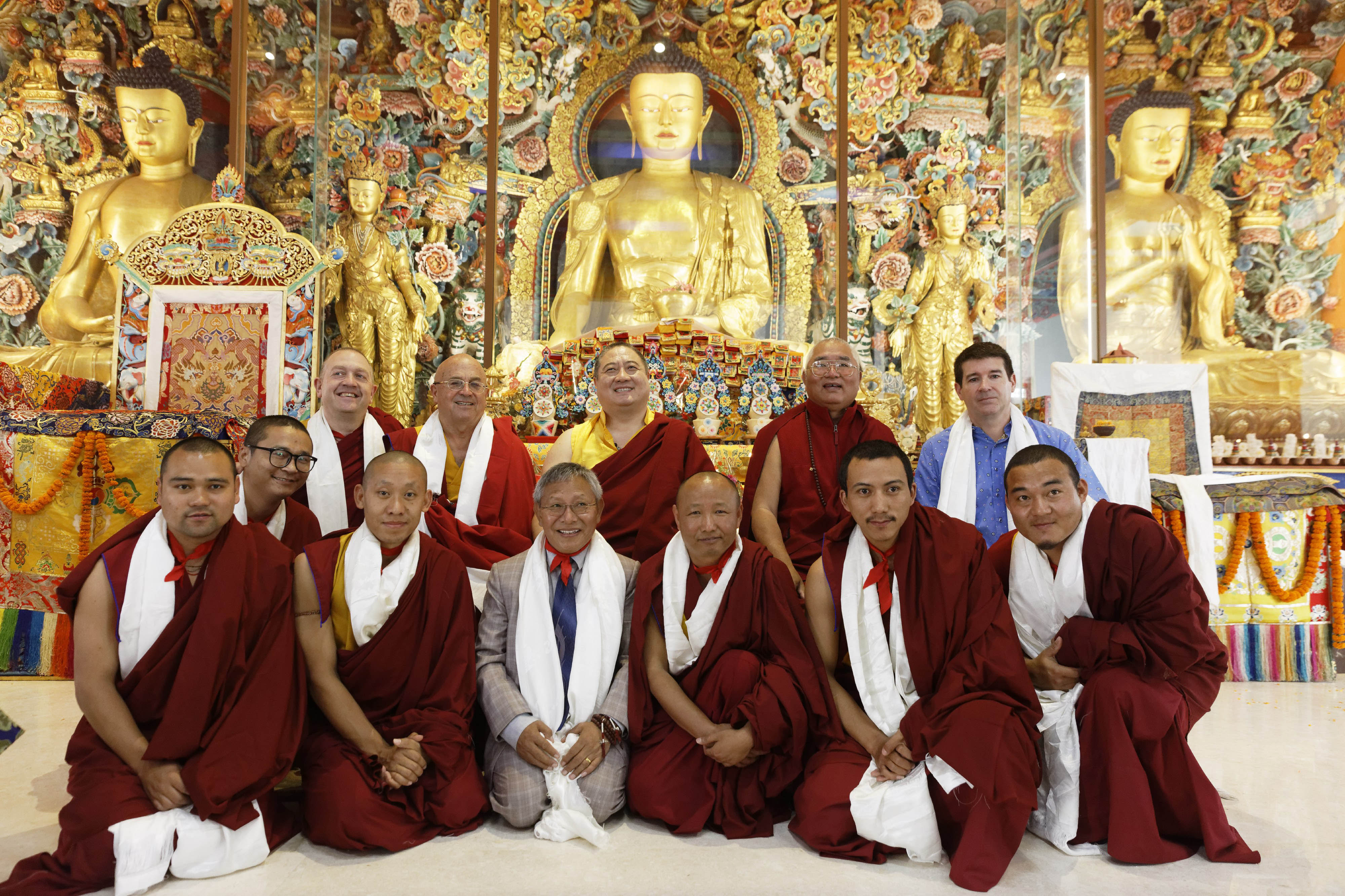
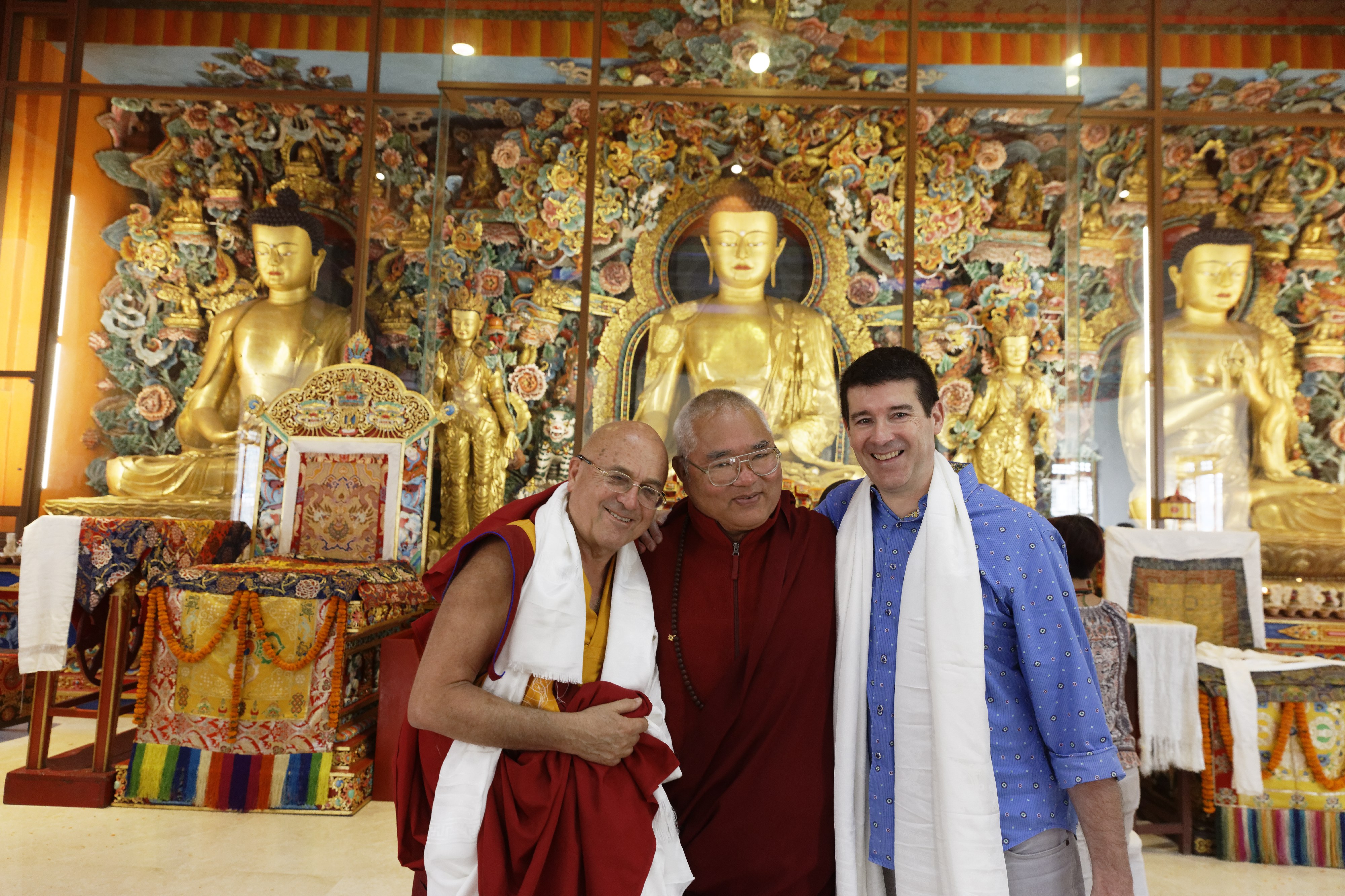
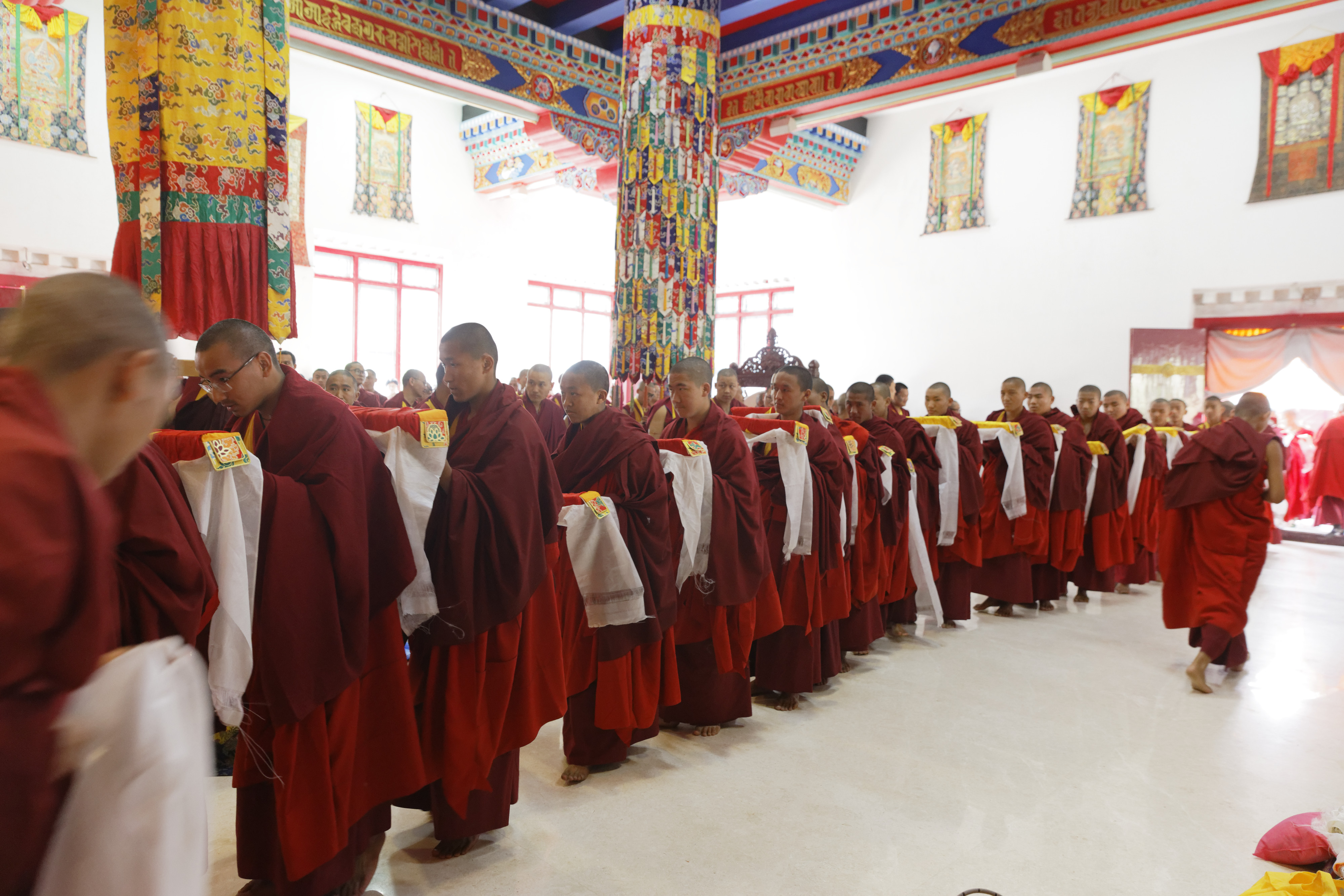
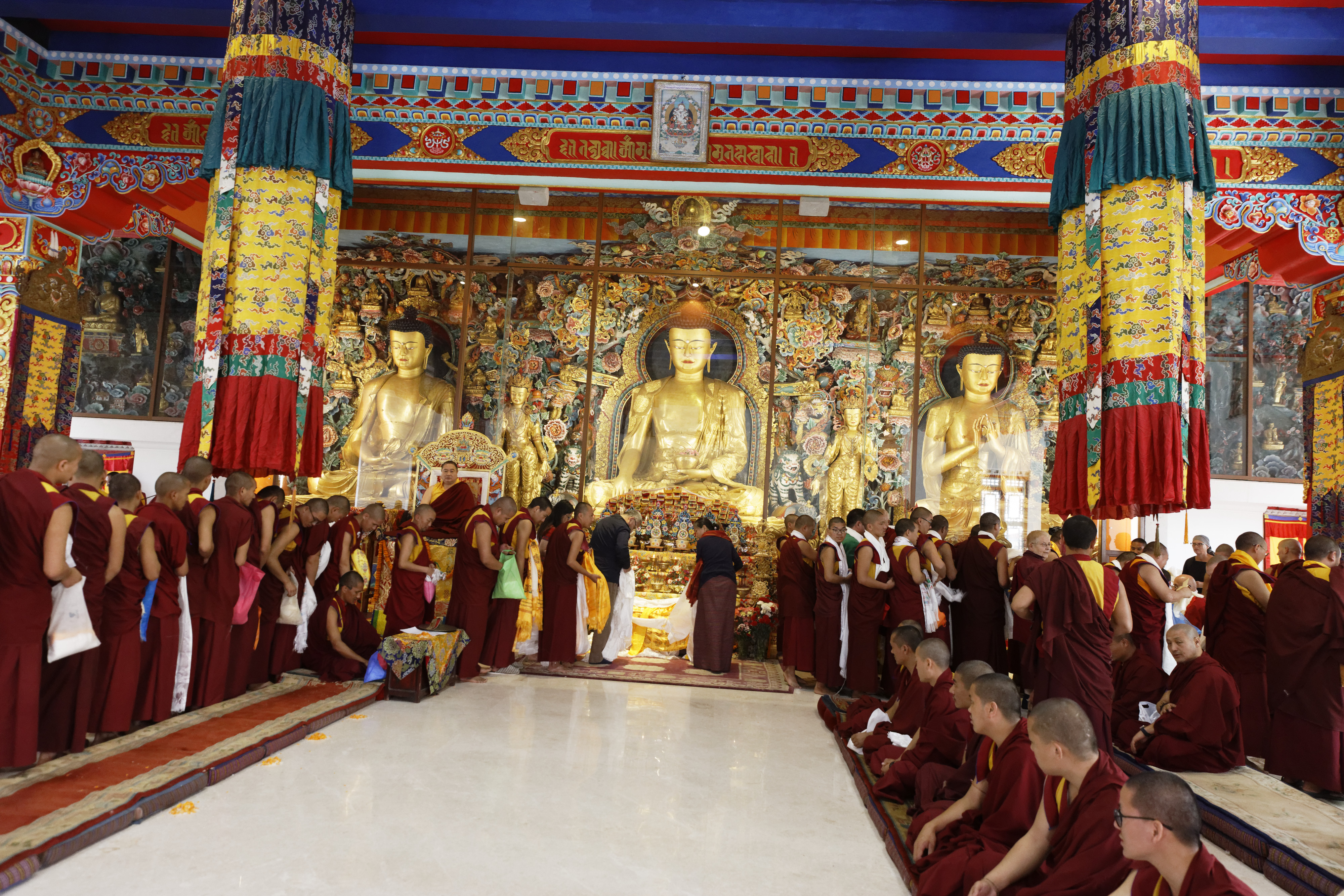
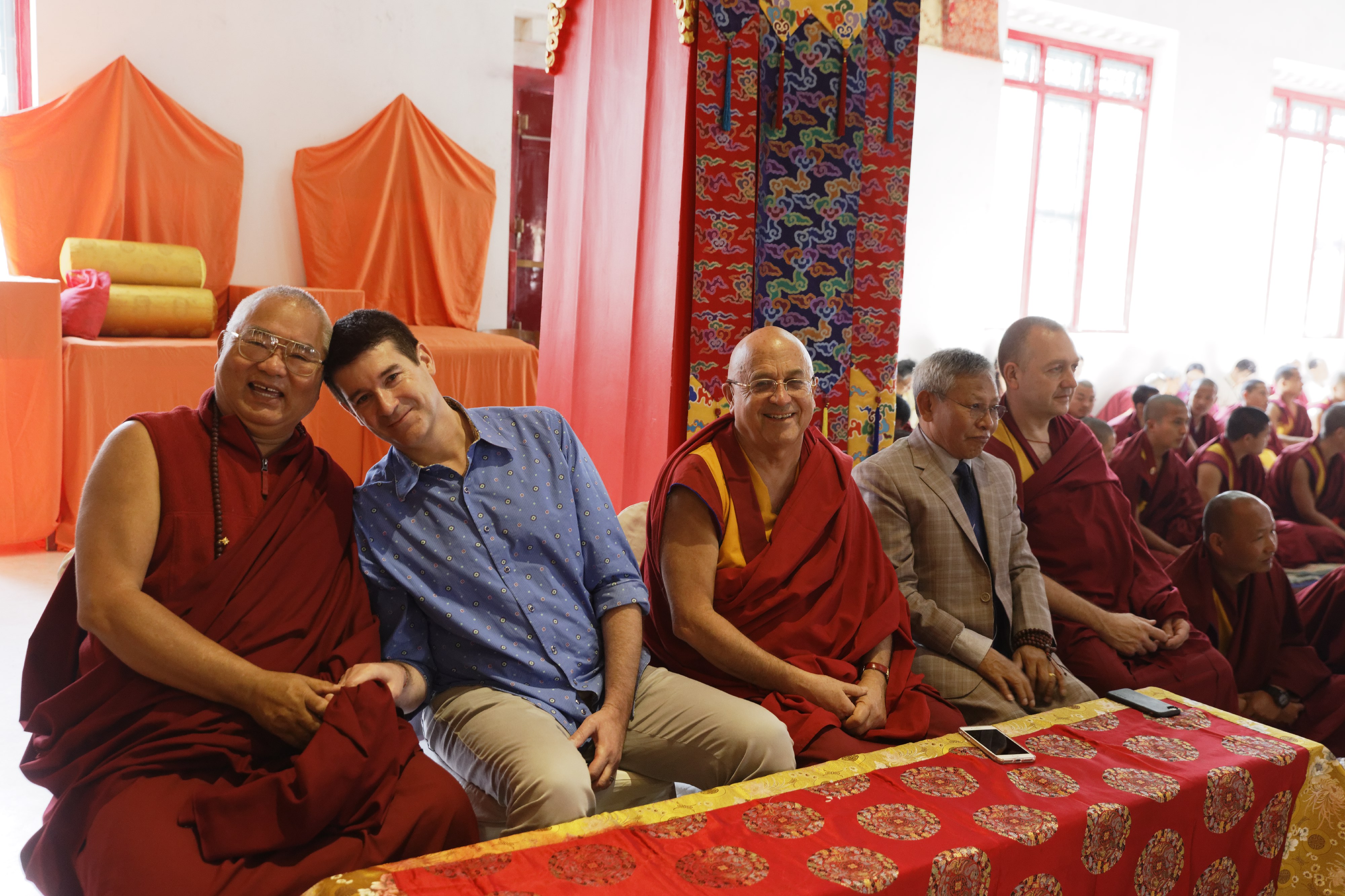
Shechen Monastery held a celebration on March 29, 2018, to commemorate the conclusion of this important project. Kyabje Shechen Rabjam Rinpoche and Shechen Monastery honored Dakpo Tulku Rinpoche and his team–Matthieu Ricard, along with Sean Price and Eric Colombel of Tsadra Foundation–who all put a concerted effort into the project’s completion which was more than thirteen years in the making.
Matthieu Ricard, Dakpo Tulku, and Eric Colombel of Tsadra Foundation.
Limited printed copies of the collection are available from Shechen Monastery. To access the entirety of the texts digitally, search through the collection, or learn more about it, see the online catalog here: Rinchen Terdzö Chenmo: The Great Treasury of Rediscovered Teachings.
The Rinchen Terdzö website presents a searchable catalog of all texts in the Rinchen Terdzö Chenmo and includes full unicode Tibetan texts with metadata. Currently, (2018) volumes 1-64 and 68 have been updated and we will finish work on the final volumes of the Shechen edition this year.
The Rinchen Terdzö Chenmo is the largest of the Five Treasuries that Jamgon Kongtrul the Great (‘jam mgon kong sprul blo gros mtha’ yas, 1813-1899) compiled throughout his life. This extraordinary collection is comprised of the main Rediscovered Treasures (gter ma) of Tibetan Buddhism and the texts necessary to bestow the related empowerments and explanations to practice them.
Jamyang Khyentse Wangpo traveled for thirteen years throughout Central and Eastern Tibet in order to collect the texts and receive the transmissions for the many lineages that had become almost extinct and held by only a few people. The actual redaction and editing of the Rinchen Terdzö was accomplished by Jamgön Kongtrul at the monastery-hermitage of Dzongsho Deshek Dupa, a secluded mountain retreat located between Dzongsar and Kathok, where Khyentse Wangpo had revealed a set of termas related to the Eight Herukas (grub pa bka’ brgyad).
Wooden-blocks were then carved at Palpung Monastery creating a sixty-volume edition. From this edition, another set of wooden-blocks was carved at Tsurphu Monastery with three additional volumes. These three included the ‘dod ‘jo’i bum bzang, which was compiled by Minling Terchen Gyurme Dorje (1646-1714) and is considered to be the “seed” of the Rinchen Terdzö, the autobiography of Jamgön Kongtrul, and the root text of Chogyur Lingpa’s Lamrim Yeshey Nyingpo with a detailed commentary by Jamgön Kongtrul. (Read more of the introduction by Matthieu Ricard.)
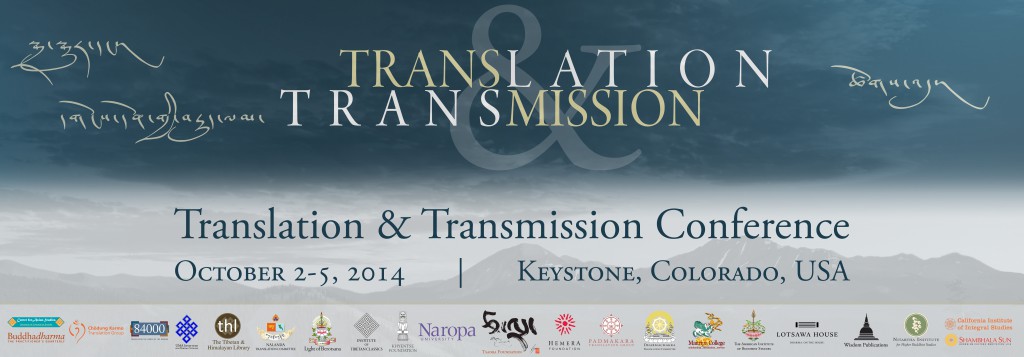
You can now view videos of each plenary session, listen to audio from workshops, and enjoy pictures from throughout the 2014 Translation & Transmission Conference on the updated conference website:
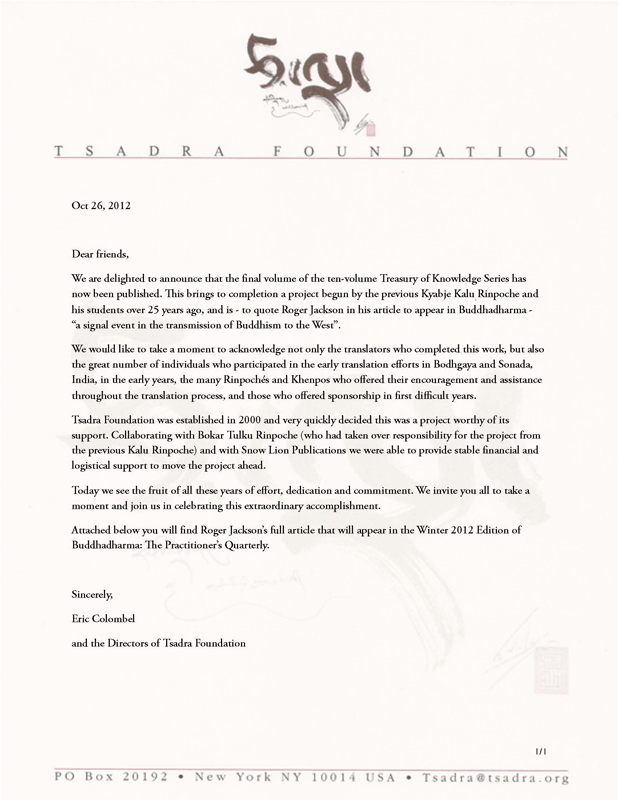
We are delighted to announce that the final volume of the ten-volume Treasury of Knowledge Series has now been published. This brings to completion a project begun by the previous Kyabje Kalu Rinpoche and his students over 25 years ago, and is – to quote Roger Jackson in his article to appear in Buddhadharma – “a signal event in the transmission of Buddhism to the West”.
We would like to take a moment to acknowledge not only the translators who completed this work, but also the great number of individuals who participated in the early translation efforts in Bodhgaya and Sonada, India, in the early years, the many Rinpoches and Khenpos who offered their encouragement and assistance throughout the translation process, and those who offered sponsorship in first difficult years.
Tsadra Foundation was established in 2000 and very quickly decided this was a project worthy of its support. Collaborating with Bokar Tulku Rinpoche (who had taken over responsibility for the project from the previous Kalu Rinpoche) and with Snow Lion Publications we were able to provide stable financial and logistical support to move the project ahead.
Today we see the fruit of all these years of effort, dedication and commitment. We invite you all to take a moment and join us in celebrating this extraordinary accomplishment. Attached below you will find Roger Jackson’s full article that will appear in the Winter 2012 Edition of Buddhadharma: The Buddhist Practitioner’s Quarterly.
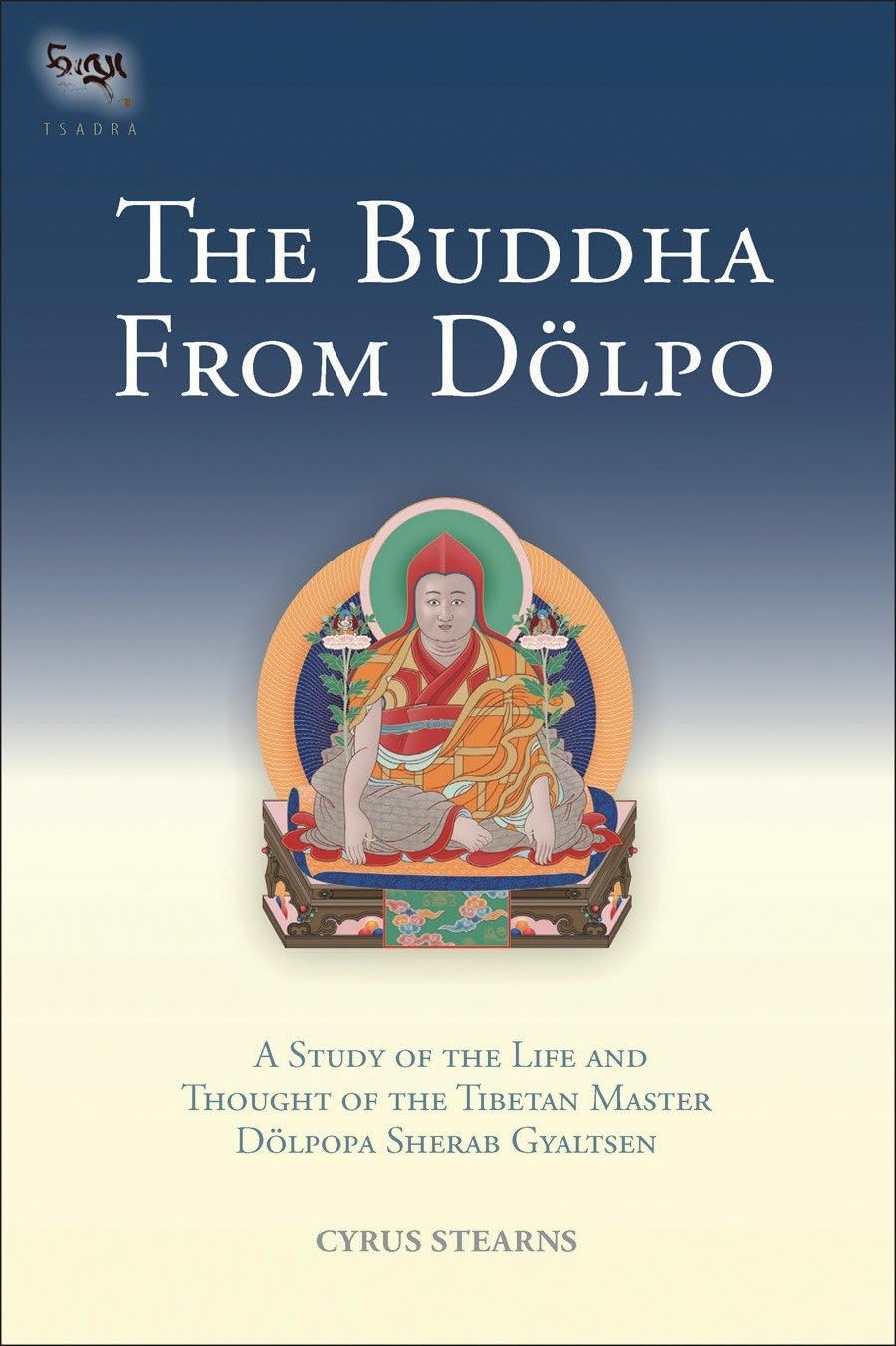
Revised Version of “The Buddha from Dölpo” Now Available
The Buddha from Dölpo is a revised and enlarged edition of the only book about the most controversial Buddhist master in the history of Tibet, Dölpopa Sherab Gyaltsen (1292–1361), who became perhaps the greatest Tibetan expert of the Kalacakra or Wheel of Time, a vast system of tantric teachings. Based largely on esoteric Buddhist knowledge from the legendary land of Shambhala, Dölpopa’s insights have profoundly influenced the development of Tibetan Buddhism for more than 650 years. Dölpopa emphasized two contrasting definitions of the Buddhist theory of emptiness. He described relative phenomena as empty of self-nature, but absolute reality as only empty of other (i.e. relative) phenomena. He further identified absolute reality as the buddha nature or eternal essence present in all living beings. This view of an “emptiness of other,” known in Tibetan as shentong, is Dölpopa’s enduring legacy. The Buddha from Dölpo contains the only English translations of three of Dölpopa’s crucial works. A General Commentary on the Doctrine is one of the earliest texts in which he systematically presented his view of the entire Buddhist path to enlightenment. The Fourth Council and its Autocommentary (which was not in the first edition of this book) were written at the end of his life and represent a final summation of his teachings. These translations are preceded by a detailed discussion of Dölpopa’s life, his revolutionary ideas, earlier precedents for the shentong view, his unique use of language, and the influence of his theories. The fate of his Jonang tradition, which was censored by the central Tibetan government in the seventeenth century but still survives, is also examined.
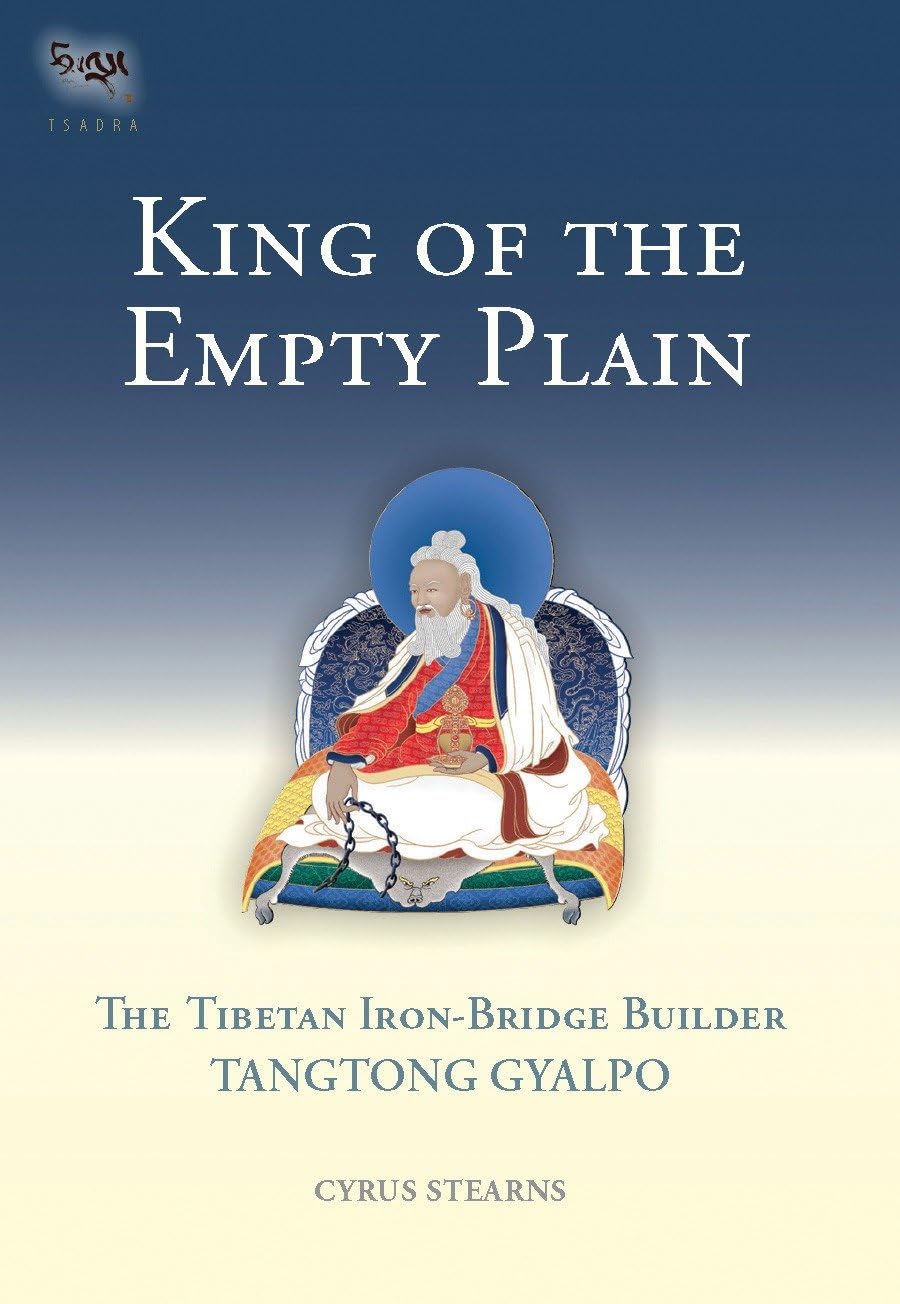
King of the Empty Plain: The Tibetan Iron-Bridge Builder Tangtong Gyalpo.
By Cyrus Stearns. Snow Lion Publications, 2007. 682 pages. $49.95.
Review by Andrew Quintman:
In King of the Empty Plain: The Tibetan Iron-Bridge Builder Tangtong Gyalpo, Cyrus Stearns pairs for the first time a detailed historical examination of the acclaimed Tibetan adept Tangtong Gyalpo (Thang stong rgyal po, 1361?–1485) with a complete and annotated translation of this best known biography. The life story serves as an important example of classical Tibetan hagiography, but is also significant for the insights it provides into Tibetan social history, patterns of religious patronage, traditions of sacred geography and pilgrimage. The result here is a model of careful scholarship, nuanced interpretation, and cogent analysis, qualities that exemplify the author’s earlier work. The book was long anticipated, concluding a project launched nearly three decades ago as part of a Masters Thesis at the University of Washington.
Its appearance underscores Stearns’s position as a foremost contemporary translator and interpreter of Tibetan religious literature. Tangtong Gyalpo—whose name translates eponymously as “King of the Empty Plain”—holds a celebrated position in Tibetan history for his contributions to Himalayan art, architecture, and engineering, as much as his transmission of esoteric and visionary Buddhist teachings. He is renowned for his longevity, credited to a mastery of tantric ritual practice, and for his unconventional life style believed to express a form of divine madness. He is perhaps best remembered, however, for his construction of iron chain-link bridges throughout the Himalayan region, an activity that earned him the epithet “Iron-Bridge Man” (lcags zam pa). Tangtong Gyalpo was, as Stearns notes in unequivocal terms, “The greatest engineer in Tibetan history, one of its most prolific architects, and an innovative artist. His many iron bridges, monasteries, and stūpas have enriched Tibetan culture for over five hundred years. The extant to which he changed his country’s spiritual topography through concrete activities based on mystical theory remains unparalleled in Tibetan history” (58). Quantitatively, King of the Empty Plain is an impressive contribution. An introductory chapter precedes some 400 pages of translation. Annotations to the biography appear in more than 1,000 footnotes. The book incorporates some 77 black and white illustrations and ten color plates, many reproduced for the first time, interspersed throughout relevant parts of the text. It concludes with the translation of a rare manuscript describing the adept’s death, reproducing the original text (typeset in Tibetan font) on the facing pages. With prefatory matter, bibliographies, and index, the book clocks in at nearly 700 pages, claiming substantial ground on the bookshelf.
Stearns introduces the biography not so much with a panoramic survey of text and context as with a series of four micro-studies, each addressing a central theme encountered in Tangtong Gyalpo’s life story: (1) the tradition’s literary sources and, through them, an analysis of the yogin’s exceptional lifespan; (2) his teachings and transmission lineages; (3) the construction of bridges and religious structures; and (4) the tantric practice of divine madness. The introduction opens with an exhaustive survey of the source materials that comprise the biographical tradition, tracing the relationship for the first time of titles that came to light decades ago. The narrative originates in the prophetic text ostensibly spoken by the Indian tantric master Padmasambhava, and the adept’s many self-written edicts. A group of direct disciples composed the first extensive biographical works in the decades following Tangtong’s death. These eventually culminated in a seventeenth-century version, the first to be widely disseminated in printed form, thus eclipsing early manuscript accounts; it is this best-known biography that forms the bulk of King of the Empty Plain. Referring to Tangtong Gyalpo as a “Tibetan Methuselah,” Stearns also addresses here the adept’s exceptional, and controversial, lifespan of 125 years. The author concludes his analysis in favor of the Tibetan sources: “The tradition of [Tangtong Gyalpo’s] longevity should not be dismissed by using the argument that such a long life was attributed to him simply to instill confidence in practitioners of his longevity techniques…. It is more probable that his teachings were treasured and passed down through the centuries precisely because of his longevity” (14).
Stearns turns next to the religious systems of Tangtong Gyalpo and his followers. The adept maintained close ties to the school known as the Ancients or Nyingma (Rnying ma)—he was recognized as an emanation of the Nyingma founding figure Padmasambhava—and specialized in several systems of esoteric tantric practice. Traditional accounts, however, describe his training under some 500 teachers in India, Nepal, and Tibet, and he is revered as having mastered all forms of Tibetan Buddhist practice. Tangtong later became famous for blending these transmissions with his own visionary revelations. Although his nonsectarian system of doctrine and praxis, referred to as the “Iron-Bridge Tradition” (lcags zam lugs), appears to have died out as a discrete lineage, many elements survive within the mainstream institutions of contemporary Tibetan Buddhism.
The next section surveys Tangtong Gyalpo’s career as a metallurgist, civil engineer, architect, and bridge builder. His projects were varied and widespread, all carried out—the life story informs us—with the bodhisattva’s motivation to benefit others. The biography enumerates an impressive résumé of achievements: 58 iron bridges, 60 wooden bridges, 118 large ferries, 120 temples, 111 stūpas, more than a dozen copies of the Tibetan Buddhist canon, and many thousands of religious statues and images. Stearns surveys the history of bridge construction in Tibet prior to Tangtong Gyalpo and underscores the logistical and economic difficulties of projects on this scale. He also highlights the apotropaic powers Tibetans invest in such structures, a theme running throughout the biography where bridges and stūpas are employed to subdue barbarian tribes and local demons, or to repel invading armies of the Mongol empire.
The preliminaries conclude with a discussion of Tangtong Gyalpo’s unconventional and frequently transgressive behavior, a style of activity variously described as crazy wisdom or divine madness. Although scholars have discussed religious madmen in Tibet from sociological, historical, and anthropological angles, here Stearns emphasizes the tradition’s own gloss on such activity, largely drawing upon Tibetan commentarial literature on tantric theory and practice. In this context, unconventional activity is referred to as “deliberate” or “secret behavior,” and described as a means for augmenting meditative concentration by eradicating fixation on dualistic appearances.
Stearns briefly reflects on Tangtong Gyalpo’s activities in light of India’s tantric siddhas and the apparent efflorescence of religious madmen in Tibet during the fifteenth-century. These four examples of scholarly pyrotechnics offer significant contributions to our understanding of Tangtong Gyalpo, his activities, and his legacy. A number of topics do seem to have slipped through the cracks, however: Tangtong’s central role in establishing Tibet’s performing arts tradition receives scant attention. The biography’s place in the development of Tibetan life writing as a genre is also largely overlooked. There are, for example, interesting parallels between Tangtong’s poisoning at the hands of a jealous king (261) and the famous poisoning of Milarepa (Mi la ras pa, ca. 1040–1123). We find even closer resemblances in the death scenes of these two acclaimed adepts. The real missing element in the sum of these introductory essays, however, is a broader and more sustained—well—introduction and guide to the biography that follows. This may point to a question underlying the book’s intended audience. As part of the Tsadra Foundation Series (founded, according to the publication data, “in order to support the activities of advanced Western students of Tibetan Buddhism”), it aspires to an Englishspeaking audience of Buddhist practitioners. The level of scholarship with which it begins may draw rather more interest from scholars and specialists of Tibetan history and religion. The text of the biography often appears fragmented, a composition of discreet vignettes lacking the tight narrative arc found in other examples of Tibetan life writing, attesting perhaps to its composite nature and complex history. The translation, conversely, is elegant and fluid. Admirably, Stearns avoids Sanskritizing technical terms wherever possible, opting instead for a nearly seamless English text (one strange exception is dharmakāya, rendered somewhat cumbersomely by the compound “dharmakāya reality body”).
Stearns’s meticulously prepared annotations, based largely on his study of earlier versions of the biography, offer a trove of historical detail for the diligent reader, as well as insight into the messy and often contradictory business of life writing in Tibet. Above all, King of the Empty Plain is a compelling story, hagiography on a grand scale replete with the fabulous and the miraculous while still reflecting the religious and social realities of medieval Tibet. In one episode, Tangtong Gyalpo kidnaps a local patron deity, forcing residents to assist with a construction project as ransom. Later, we hear villagers conscripted into compulsory labor rejoice upon witnessing the adept buried beneath a landslide as they cry, “The adept has died. Now we don’t have to work” (368). Local monks, too, verge on rebellion when they refuse to pay the road toll implemented in order to fund Tangtong’s grand stūpa at Riwoché. King of the Empty Plain is a work that bears study at length and on many levels.
Andrew Quintman, Princeton University
To be published in Journal of the American Academy of Religion