The Complete Rinchen Terdzö Published by Shechen Monastery!
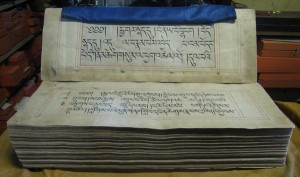
Thanks to the hard work of many people over the course of many years (and perhaps lifetimes), the most complete edition of the Rinchen Terdzö Chenmo (རིན་ཆེན་གཏེར་མཛོད་ཆེན་མོ་) in seventy-one volumes is finished and printed.
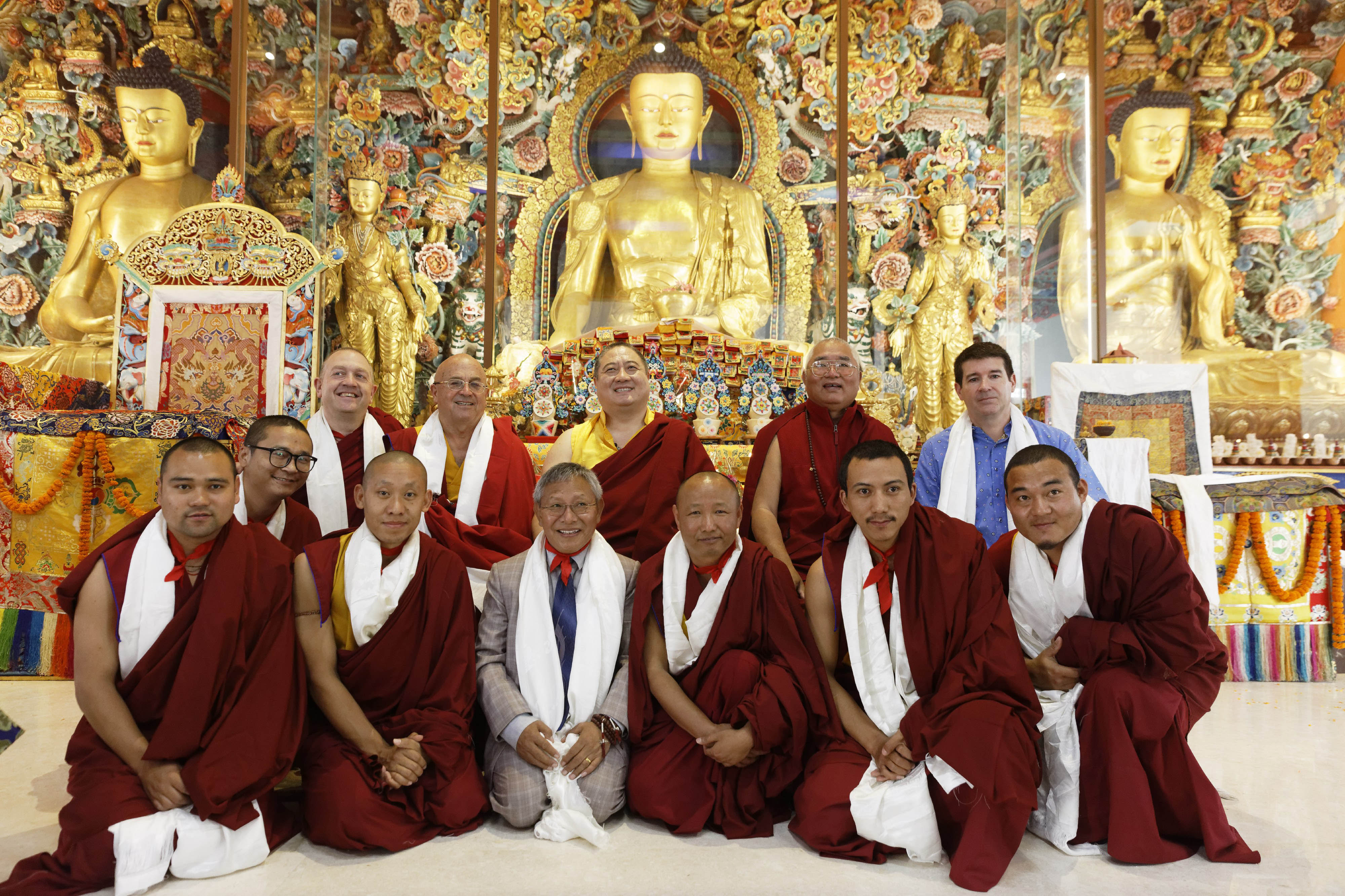
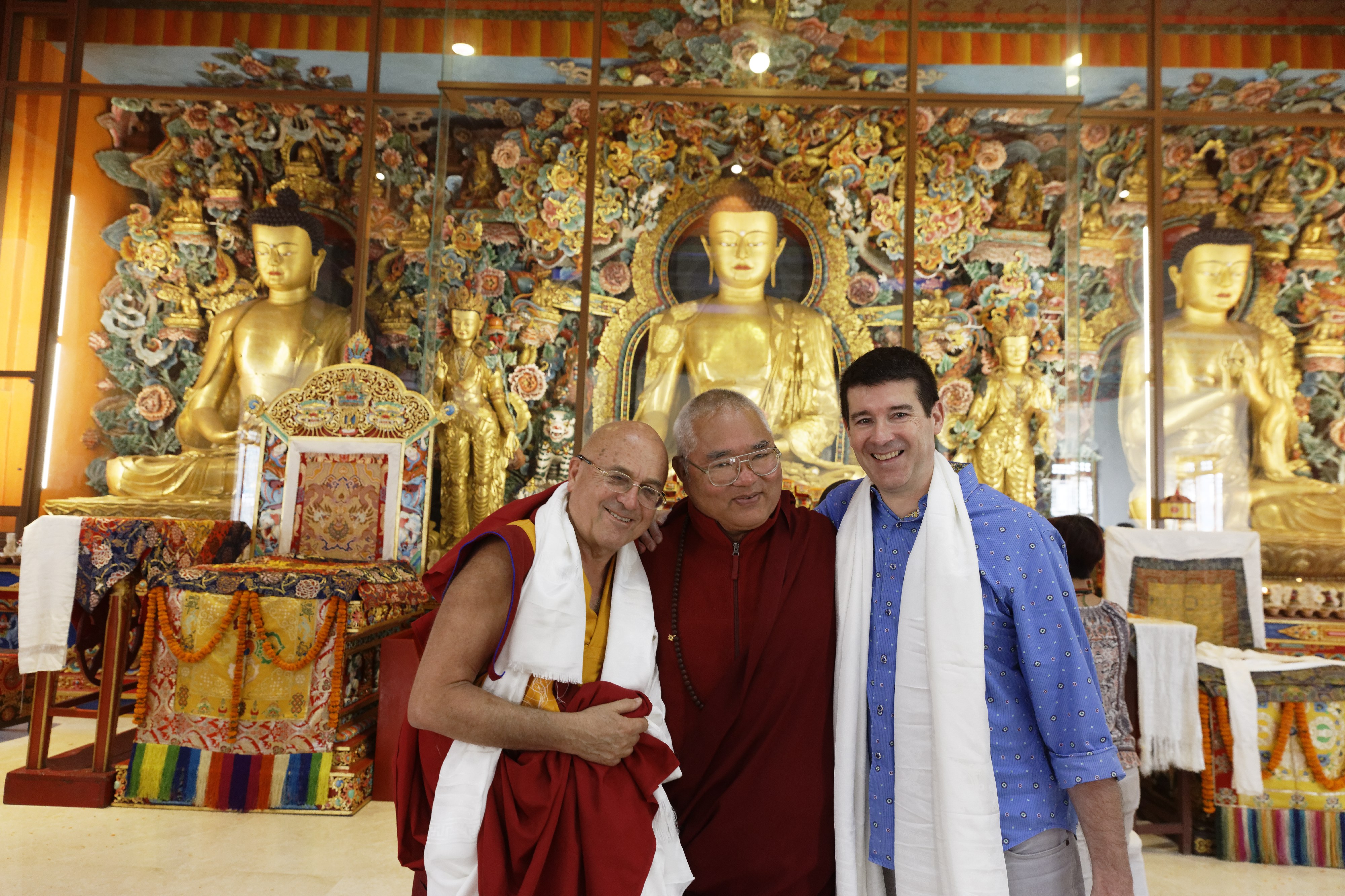
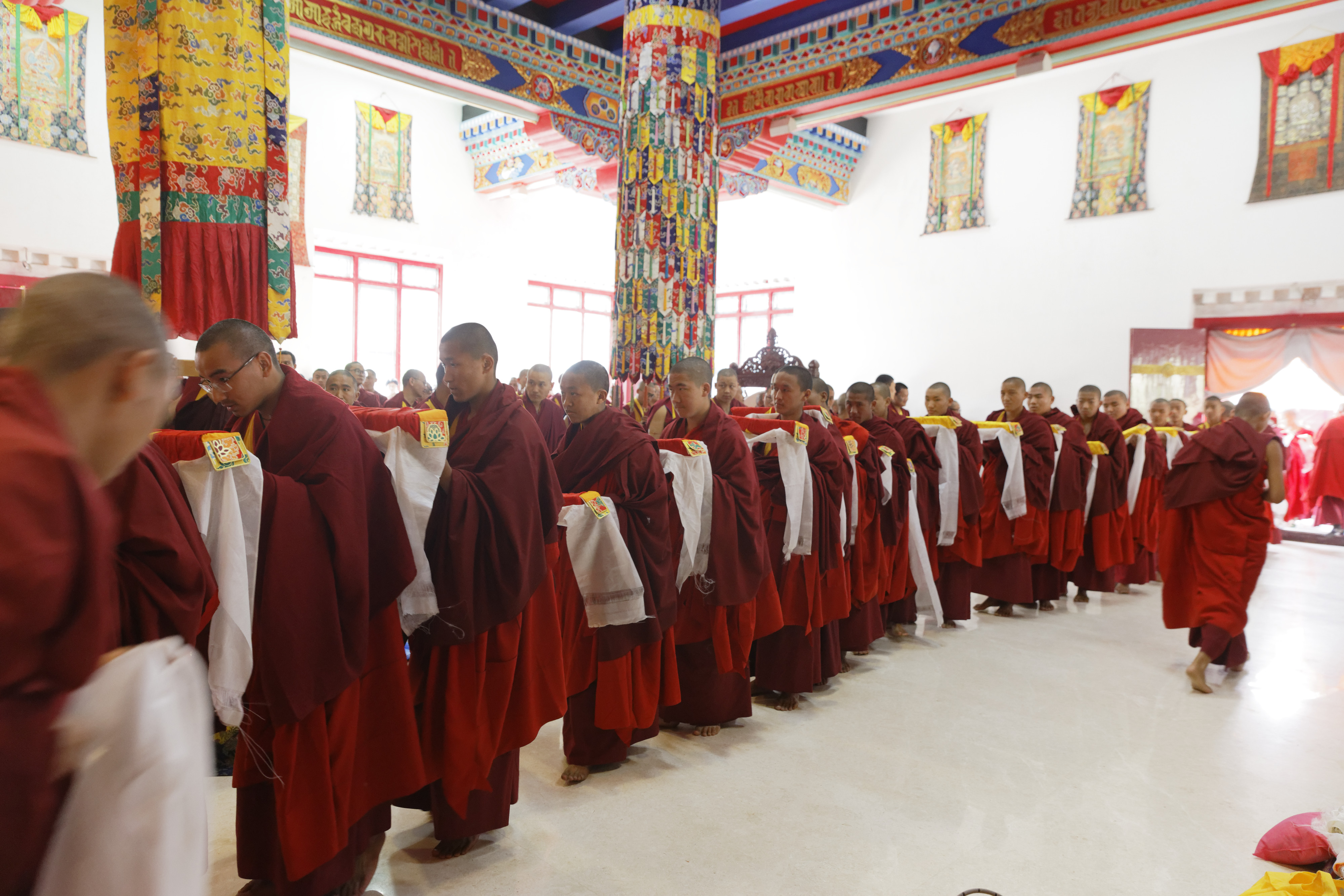
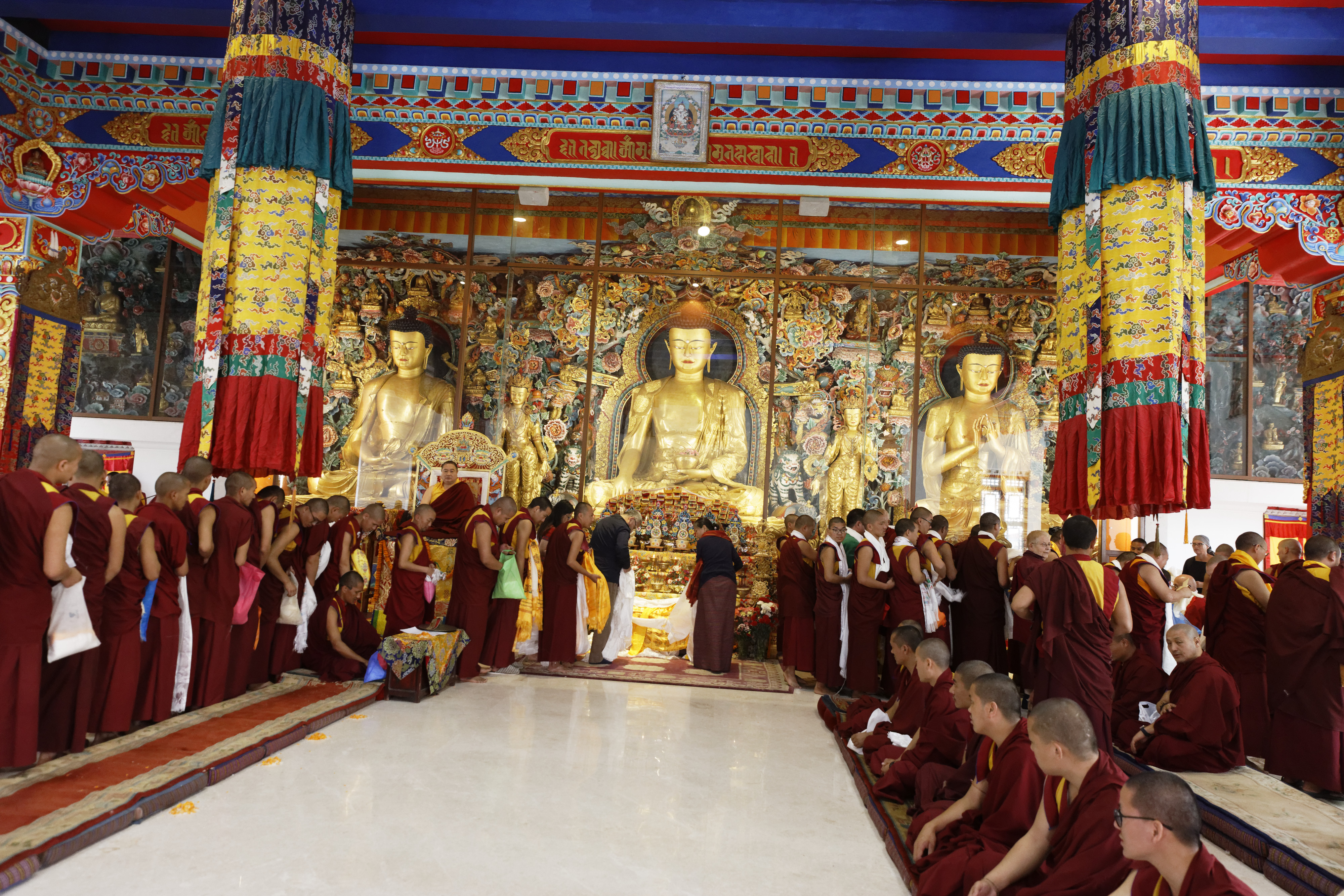
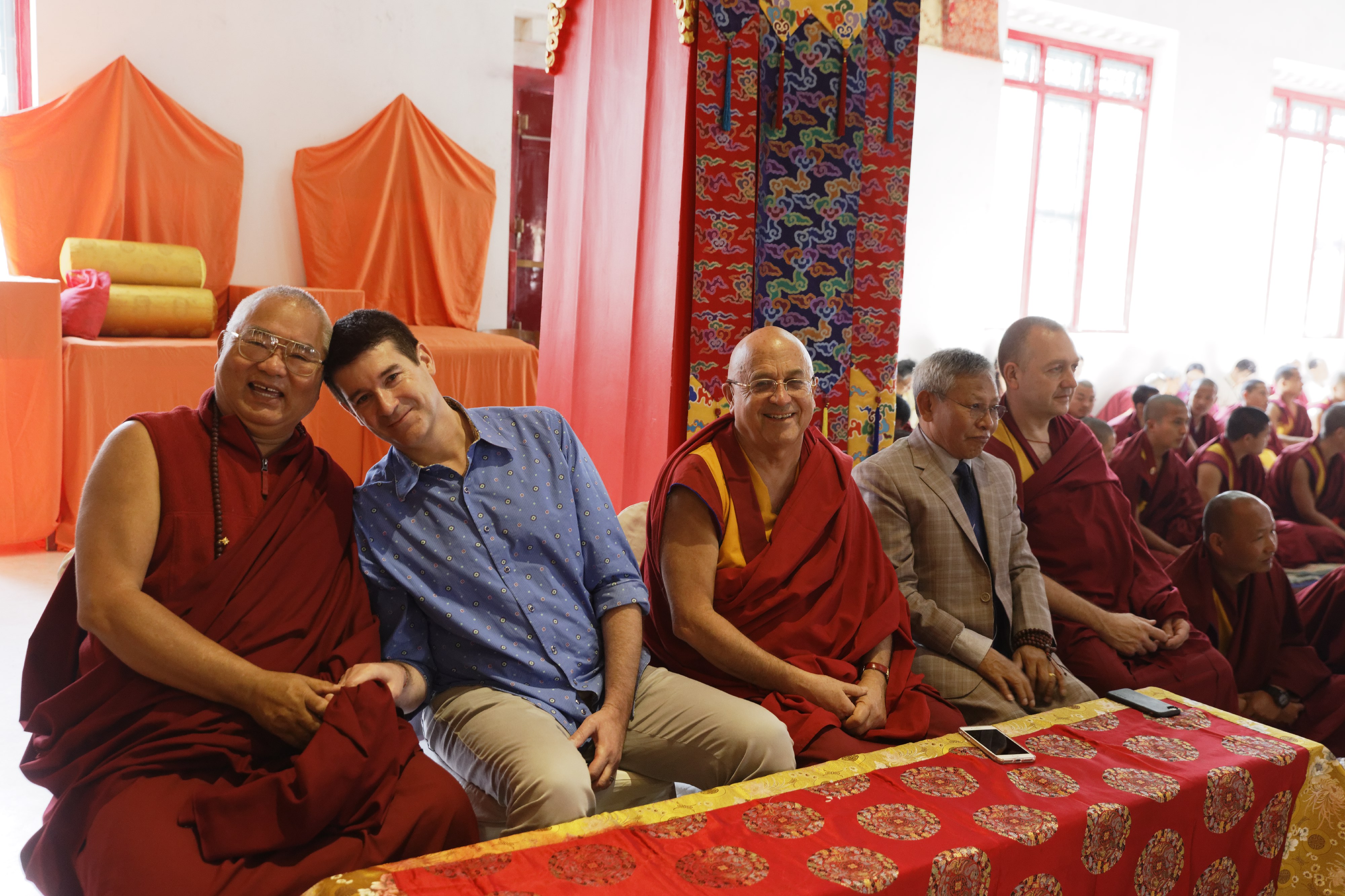
Shechen Monastery held a celebration on March 29, 2018, to commemorate the conclusion of this important project. Kyabje Shechen Rabjam Rinpoche and Shechen Monastery honored Dakpo Tulku Rinpoche and his team–Matthieu Ricard, along with Sean Price and Eric Colombel of Tsadra Foundation–who all put a concerted effort into the project’s completion which was more than thirteen years in the making.
Matthieu Ricard, Dakpo Tulku, and Eric Colombel of Tsadra Foundation.
Limited printed copies of the collection are available from Shechen Monastery. To access the entirety of the texts digitally, search through the collection, or learn more about it, see the online catalog here: Rinchen Terdzö Chenmo: The Great Treasury of Rediscovered Teachings.
The Rinchen Terdzö website presents a searchable catalog of all texts in the Rinchen Terdzö Chenmo and includes full unicode Tibetan texts with metadata. Currently, (2018) volumes 1-64 and 68 have been updated and we will finish work on the final volumes of the Shechen edition this year.
The Rinchen Terdzö Chenmo is the largest of the Five Treasuries that Jamgon Kongtrul the Great (‘jam mgon kong sprul blo gros mtha’ yas, 1813-1899) compiled throughout his life. This extraordinary collection is comprised of the main Rediscovered Treasures (gter ma) of Tibetan Buddhism and the texts necessary to bestow the related empowerments and explanations to practice them.
Jamyang Khyentse Wangpo traveled for thirteen years throughout Central and Eastern Tibet in order to collect the texts and receive the transmissions for the many lineages that had become almost extinct and held by only a few people. The actual redaction and editing of the Rinchen Terdzö was accomplished by Jamgön Kongtrul at the monastery-hermitage of Dzongsho Deshek Dupa, a secluded mountain retreat located between Dzongsar and Kathok, where Khyentse Wangpo had revealed a set of termas related to the Eight Herukas (grub pa bka’ brgyad).
Wooden-blocks were then carved at Palpung Monastery creating a sixty-volume edition. From this edition, another set of wooden-blocks was carved at Tsurphu Monastery with three additional volumes. These three included the ‘dod ‘jo’i bum bzang, which was compiled by Minling Terchen Gyurme Dorje (1646-1714) and is considered to be the “seed” of the Rinchen Terdzö, the autobiography of Jamgön Kongtrul, and the root text of Chogyur Lingpa’s Lamrim Yeshey Nyingpo with a detailed commentary by Jamgön Kongtrul. (Read more of the introduction by Matthieu Ricard.)
Are you looking to develop your Tibetan language skills? Opportunities abound for language study this summer in the United States and South Asia. Most programs offer either classical or colloquial courses, and many are offered for credit through affiliated universities. Online courses are also available in self-study and interactive formats and are a great way to get started right away.
Tsadra Foundation’s Research Center will offer for the first time a short intensive program this summer during the last two weeks of August (13 – 25). The courses, offered for three levels of students–beginning, intermediate, and advanced–will combine the study of spoken and written Tibetan with opportunities to develop skills in translation and oral interpretation for advanced students. Lama Sarah Harding will teach the advanced reading class and Doctor Jules Levinson will facilitate oral interpretation practice from Tibetan to English. Visit the website for more information.
Colloquial Tibetan Studies
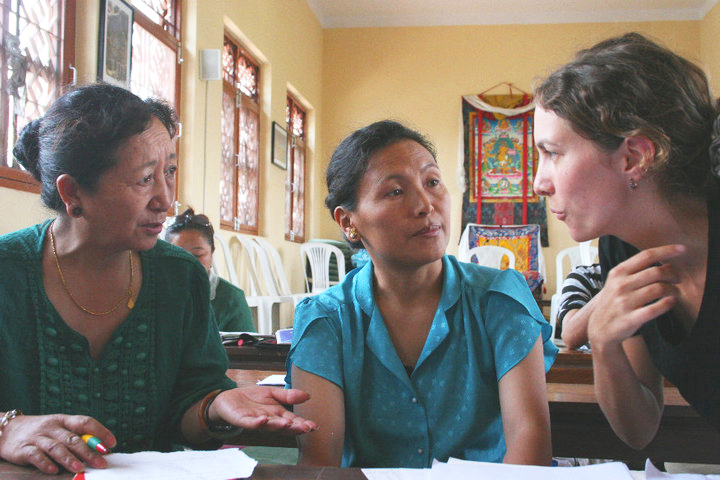
University of Virginia’s Summer Language Institute offers an intensive course in colloquial Tibetan which runs for eight weeks (June 17 – August 10) and is hosted on campus at UVa in Charlottesville, Virginia, USA. Franziska Oertle, who has taught Tibetan at Rangjung Yeshe Institute in Nepal and the Institute for Buddhist Dialectics near Dharamsala, India, will be teaching alongside her colleague Gen Phuntsok Dorje this summer. The course is offered for the equivalent of twelve academic credits, but also for non-credit-earning study. More information can be found here.
University of Wisconsin’s South Asia Summer Language Institute will also offer summer intensive courses in modern South Asian languages, including colloquial Tibetan and Sanskrit, from June 18 through August 10 in Madison, Wisconsin, USA. Apply for this program here.
For those interested in travel to South Asia, two notable programs for colloquial Tibetan language study are Rangjung Yeshe Institute, Kathmandu University’s Centre for Buddhist Studies (RYI) and Esukhia. RYI also offers classical Tibetan courses on campus in Kathmandu.
RYI’s summer intensive programs offer three levels–beginner, intermediate, and advanced–of colloquial and classical Tibetan, and two levels–beginner and intermediate–of Sanskrit. These programs run from June 13 through August 10. Students have the option to live with Tibetan host families, experience the bustling city of Kathmandu, and explore sacred sites in the surrounding valleys. Read more information about these courses and apply for them here.
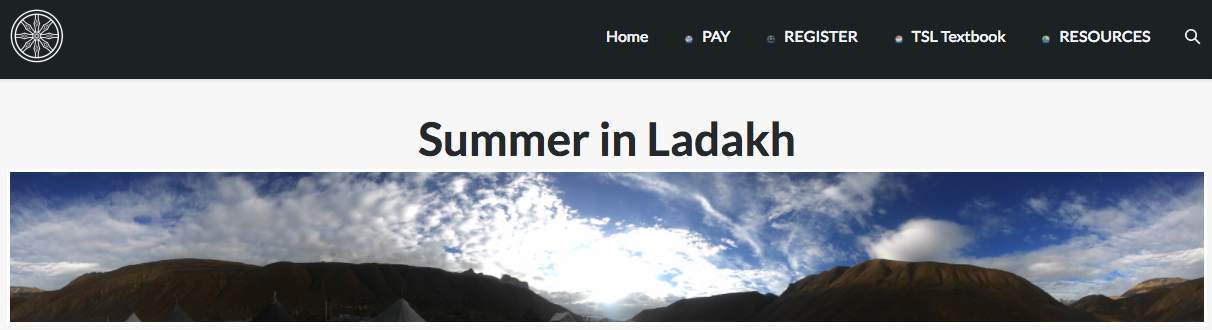
Esukhia, based in McLeod Ganj, Himachal Pradesh, India, runs a summer intensive program in Ladakh for either one or two months of study starting July 2 and running through August 25. This program features homestay experiences with Tibetan families living in the small town of Choglamsar just outside of Leh. Visit Esukhia’s website here.
Classical Tibetan Studies
Studying classical Tibetan is also a possibility in an intensive format this summer, both for-credit and not-for-credit. Maitripa College, in Portland, Oregon, offers intensive classical Tibetan language study which introduces students to vocabulary and grammatical structures and guides them through translating portions of texts by the end of the eight weeks. Read more about Maitripa’s program here.
Rangjung Yeshe Gomde California offers an intermediate-level classical Tibetan course through the Dharmachakra School of Translation which is accredited by Kathmandu University. The course is based on Rangjung Yeshe Institute’s summer intensive courses, but available with the backdrop of the Eel River in the coastal range of Northern California. Find more information about this program here.
Another program in California, USA, The Mangalam Research Center for Buddhist Languages, will offer second-year classical Tibetan and Sanskrit this summer. The program is best suited for advanced undergraduates and graduate students. Read more about this course here.
Online Study
If you are unable to travel this summer, not to worry! Possibilities for online study are plentiful.
The University of Toronto offers two levels of classical Tibetan study based on Joe Wilson’s Translating Buddhism from Tibetan entirely online. The introductory course is twelve weeks long and will introduce you to the needed grammatical structures to learn to translate from Tibetan to English. Students can work with a moderator and study for credit through the University of Toronto. If you are not seeking credit, the entire course is freely available for self-study. You can begin studying at any time by visiting this website.
Esukhia offers one-on-one colloquial Tibetan classes online over Skype using a curriculum they developed based on vigorous research into language learning pedagogy. Sign up and start studying immediately.
Rangjung Yeshe Institute also offers two semesters of classical Tibetan courses online and a self-study Tibetan alphabet course. Completing the two semester-length online courses will prepare you to attend most intermediate-level classical Tibetan courses. Both semesters can be taken for academic credit and feature a course moderator in addition to the online course materials. The courses can also be taken on a self-study basis. Read about the courses and apply for them here.
David Curtis offers courses in classical Tibetan via teleconference through the Tibetan Language Institute. A new round of David’s courses begins in April. Sign up here.
Neljorma Tendron teaches four levels of online classes which are focused on comprehension of dharma terminology with the aim of reading and understanding one’s liturgical practice texts. Visit her website here for more information
Sonam Chusang, an adjunct professor at the University of British Columbia, hosts beginning classes in the Tibetan alphabet, pronunciation, and spelling, and a beginning level of both colloquial and classical Tibetan. You can read more about these classes here.
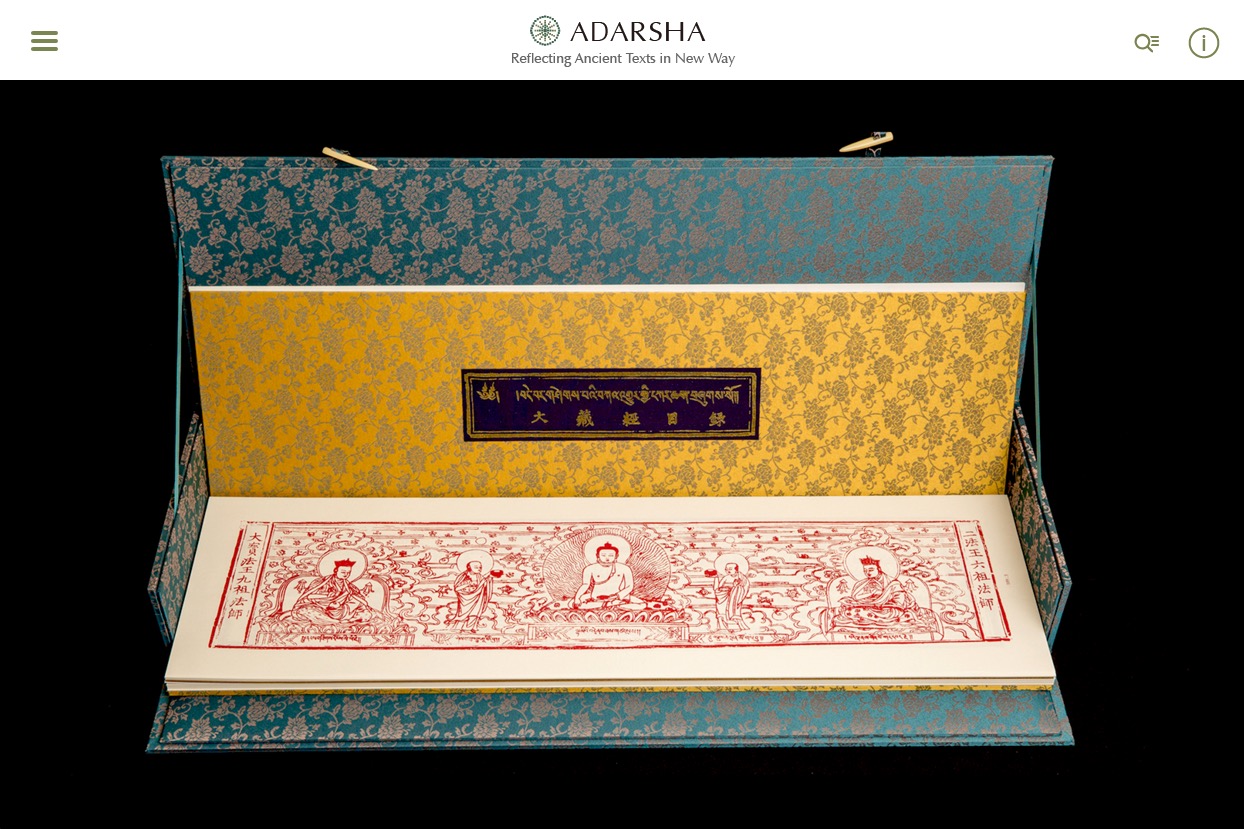
The Karmapa announced this project in 2014 and although it is still in development, this app is already up and running well on the iPad for searching the Jiang Kangyur in Tibetan script. It looks like they will be adding the Tengyur and other sources soon. A website for easy access on any computer is also in development and can be found at adarsha.dharma-treasure.org.
From the description on their website:
ADARSHA is an app that lets you read and conduct searches of ancient documents in a digital format. There are three main categories of texts: (a) Kangyur (the words of the Buddha translated into Tibetan); (b) Tengyur (commentaries by Indian scholars translated into Tibetan); and (c) Tibetan Buddhist scriptures.
The software features a fast search engine and simple user interface that meets the needs and habits of the common user in searching and reading material. Searches can be made in Unicode Tibetan or Wylie, and there are summaries of the scriptures for the convenience of the academic community.
His Holiness the 17th Karmapa Orgyen Trinley Dorje named the software ADARSHA (Sanskrit), which means “clear mirror,” with the hope that users will be able to clearly see their own minds reflected in the scriptures as if they were looking at a clear reflection in a mirror.
Congratulations to His Holiness the 17th Karmapa and all those at the Dharma Treasure Association working on this project!
For the stunning price of $4,700 you can order 7 DVDs of the high quality digitized them spang ma edition held in the National Library of Mongolia. The Peking edition is 5 DVDs for $3,700.
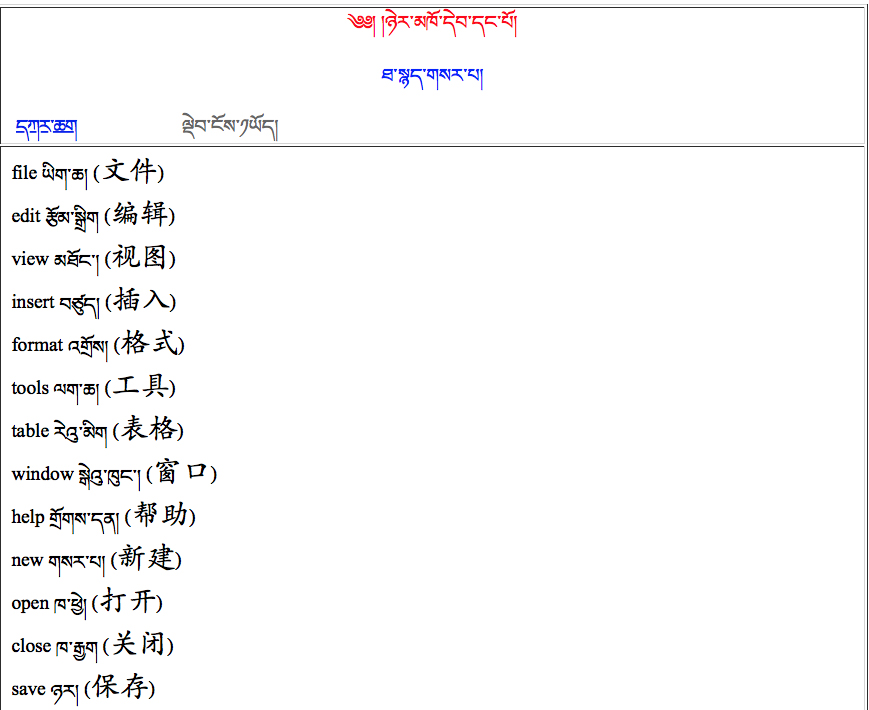
བོད་ཀྱི་རིག་མཛོད་དྲ་བ། features many eTexts in Tibetan. The page has selections from ལོ་རྒྱུས་ , སྒྲ་རིག་པ་ , གསོ་བ་རིག་པ་ , ཚད་མ་རིག་པ་, and many more. The page also features a list of new words entering the Tibetan language.