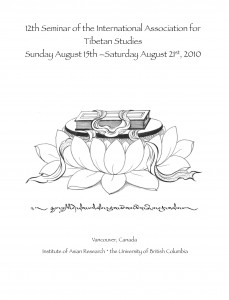
The 2010 International Association of Tibetan Studies Conference will open tomorrow morning in Frederic Wood Theatre at UBC in Vancouver. The UBC campus has already been filled with a veritable who’s who of Tibetan Studies and I am looking forward to listening to as many of these eminent scholars as possible. Tomorrow will include a welcoming ceremony including addresses by professor Tsering Shakya and Dr. Charles Ramble. I will then spend most of the day at the Contributions to Tibetan Literature: Texts, Genres and Generic Terms panel, which will include papers titled:
” “Collected Writings” (gsung ‘bum) in Tibetan Literature: Towards a Systematic Study of Their Compilation, Redaction and Composition and its Use for Genre Classifications,” “Tools of the Trade of the Tibetan Translators,” and “Classifying Literature or Organizing Knowledge? Some General Remarks on Genre Classifications in Tibetan Literature.”
Do leave me a note if there is some discussion you simply must hear about, otherwise I will be attending things I am interested in, such as the Madhyamaka panel, the Tibetological Library and Archive Resources panel, and Buddhist Texts and Philosophy, and The History of the Rang-stong/Gzhan-stong, and the list goes on. It is impossible to attend all of the truly fascinating panels at this years IATS, but I hope to be able to discuss a few of the most interesting here on this blog over the course of the next week.
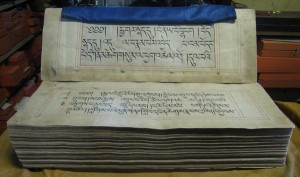
For the stunning price of $4,700 you can order 7 DVDs of the high quality digitized them spang ma edition held in the National Library of Mongolia. The Peking edition is 5 DVDs for $3,700.
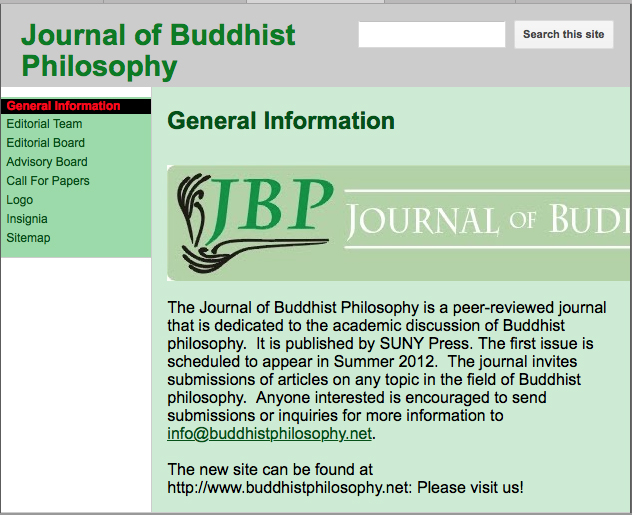
The first issue is scheduled to appear in Summer 2012. The journal invites submissions of articles on any topic in the field of Buddhist philosophy. Anyone interested is encouraged to send submissions or inquiries for more information to journal.of.buddhist.philosophy@gmail.com
Tsadra Foundation will be represented at the conference by Karl Brunnholzl, Sarah Harding, Stephanie Johnston and Marcus Perman. Blog posts will be made from the conference in mid August.
In case you were unaware, the newly updated version of the Times New Roman font now includes diacritics from the Latin Extended Additional character area, which includes dots above and below letters and other key characters used for representing Sanskrit and other languages used in Buddhist studies. If you are a Tsadra Fellow and you don’t have access to the new version of the font, or are not sure where to get it, let me know and I’ll get it to you ASAP. Just email: Marcus@tsadra.org
You will need to re-register and formally request full access again. It is quite easy and response time is short (24hrs or so). Just click on “LOGIN REGISTER” at the top right corner of the screen. When you get to the login screen, click the tab labeled “Register (new user)” and fill out the form, remembering to check the box next to Request Full Access.
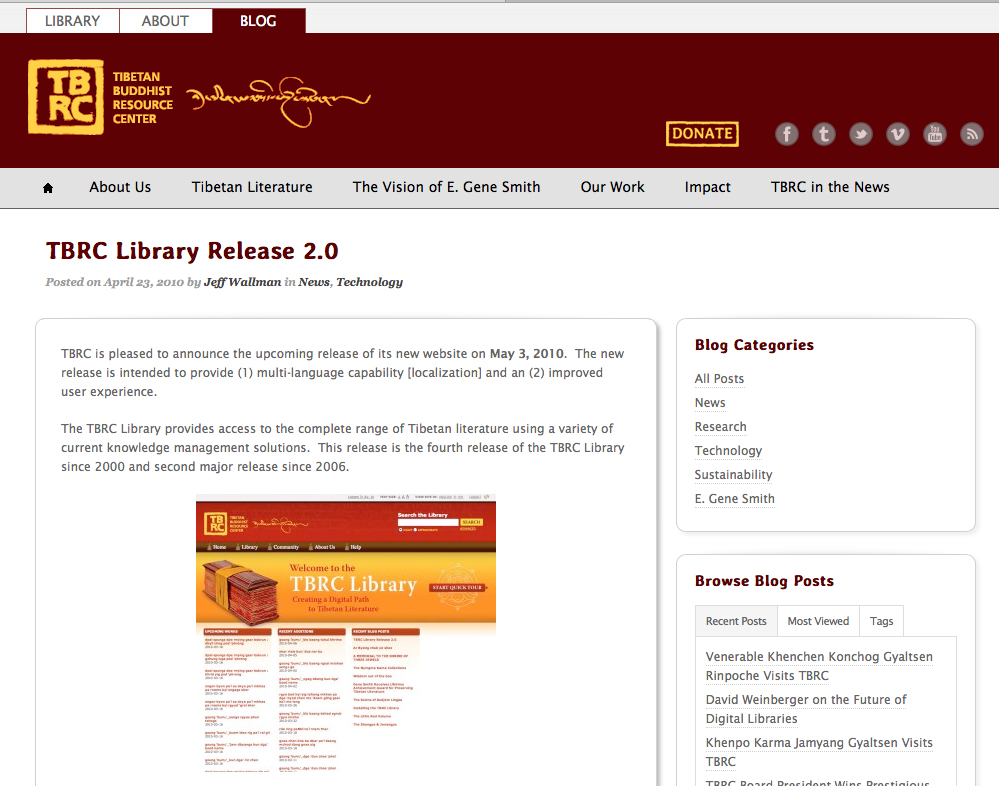
An important note for people who have been previously accessing the texts at TBRC (from Jeff Wallman):
“One very important change is that we completely rewrote our authentication module. The net change is that all password account holders will need to register themselves. This should be easier to manage since account holders can choose their own user name and password.
In addition, we ask that you formally request full access to text downloads. This is necessary because we want to keep a record of account holder names, emails, and interests, but also so that we can improve the performance of the application. You might be pleasantly surprised that the new interface to the digital texts (we call it the digital pecha viewer “DPV”) is easier to use!”
Summer Program: Words of Wisdom: Toward a Western Terminology for Buddhist Texts Berkeley, CA, USA. June 14-July 2, 2010 Presented by the Mangalam Research Center for Buddhist Languages, Berkeley, and co-sponsored by the Center for Buddhist Studies, University of California at Berkeley and the Ho Center for Buddhist Studies, Stanford University.
Core Faculty: Luis Gomez, Michael Hahn Associate Faculty: Alex von Rospatt, Paul Harrison, Carmen Dragonetti, Fernando Tola
Putting the Dharma into the words of a new culture is a task that has traditionally unfolded over several generations. In the West, where the languages of educated discourse are sophisticated and rich with layers of meaning, the challenges of being able to convey the Buddhist teachings as faithfully as possible are especially daunting.
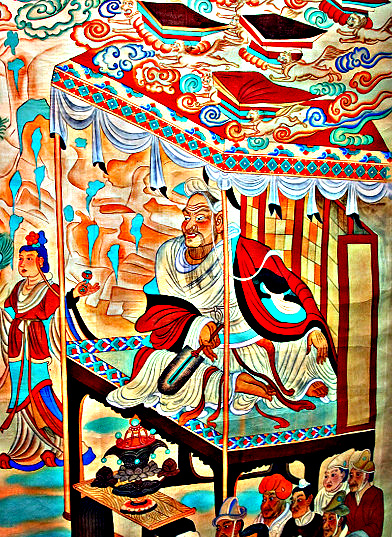
This intensive three-week program, intended primarily for graduate students in Buddhism, Indology, or allied fields, is a small step toward a clear and consistent terminology or (more modestly) developing skills and strategies for finding the best translation equivalents in contemporary English. The text for the program is the_Vimalakīrtinirdeśa Sūtra_. We will read the Sanskrit together with the Tibetan and Chinese translations. This close reading will address problems of interpretation, as well as the technical and stylistic challenges faced by the translator of classical Buddhist texts. Students should have facility in Sanskrit; knowledge of Tibetan or Chinese will be helpful.
Format and Facilities
Guided by distinguished faculty, students will meet 5 hours a day, five days a week to work with the challenges posed by the text. Sessions will be held 9:30 am – 12:30 pm and 3:30 pm – 5:30 pm. Meals are provided, and housing is an easy walk. Students will have access to the libraries of the Mangalam Research Center and the University of California (a 15-minute walk). Rapid Transit to San Francisco is half-a-block away.
Focus
The focus will be on key terms of the Vimalakīrtinirdeśa in the context of the profound Mahāyāna vision it sets forth. We will examine vocabulary choices in both source and target languages, sensitive to subtle shifts in meaning between languages with different philosophical underpinnings. Among the topics to be explored and skills to be honed:
Sanskrit roots, etymology, and the relation of Buddhist Sanskrit to other forms of Sanskrit
issues of context and intertexuality.
comparison with the Tibetan and Chinese, with reference to commentaries.
stylistic choices and terminology in existing translations in both canonical and modern languages
general issues in the theory and practice of translation as they arise in rendering a classic Buddhist text into a modern idiom.
Costs
Tuition: $1,200 (includes lunch daily). Food and lodging: $1,350. Total cost: $2,550.
Applications
The program is intended for advanced graduate students, but applications from all qualified candidates will be considered. Please submit an application by March 15, 2010 to summerprograms@mangalamresearch.org. Include a short statement of purpose, a description of language skills and how acquired, and a 1–2 paragraph letter of endorsement from your principal adviser. Students completing the program will receive a certificate from the University of California Buddhist Studies program indicating that this program carries the equivalent of 8 semester units. Maximum number of participants is 15. Applicants will be notified by April 10, 2010.
With the support of Tsadra Foundation, I ventured forth to the 11th Sakyadhita International Conference on Buddhist Women, held from December 28th through January 3rd, in Ho Chi Minh City, or Saigon, in Vietnam. There, I presented a paper entitled “Seeking Niguma, Lady of Illusion” extracted from my forthcoming book of translations of the works of this 11th century Indian saint.
Sakyadhita—”Daughters of the Buddha”—is a global coalition of Buddhist Women established in 1987. It has 2000 members and friends in 45 countries, and has an international conference every two years in a different country, and national conferences in individual countries. There is a strong emphasis on women’s scholarship and on supporting the bikkhuni sangha (fully ordained nuns) in the various Buddhist countries. In their own words:
Working at the grassroots level, Sakyadhita provides a communications network among Buddhist women internationally. The organization promotes research and publications on Buddhist women’s history and other topics of interest. It supports Buddhist women’s initiatives to create education projects, retreat facilities, training centers, women’s shelters, and local conferences and discussion groups. Members strive to create equal opportunities for women in all Buddhist traditions. The goal is to empower the world’s 300 million Buddhist women to work for peace and social justice.
Since the first small gathering in Bodhgaya with the Dalai Lama as keynote speaker, the movement has gained momentum under the able leadership of Venerable Karma Lekshe Tsomo, an American nun and author who divides her time between the University at San Diego and Asia. The conference this year in Vietnam boasted the overwhelming attendance of over 2000 people from 34 different countries, the majority of them nuns.
I really didn’t know there were so many! There were nuns of every stripe and color. The majority were, of course, from Vietnam itself, where nuns in grey and saffron robes mix beautifully. Others were also there in force: There were the brilliant dayglo-orange nuns from Sri Lanka, whose membership of fully ordained nuns has gone from 0 to over 1000 in just ten years since Sakyadhita has been there to support them.
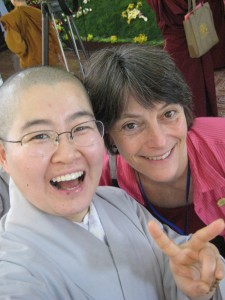
There were the grey armies from Korea, who burst into smiles and antics at the merest glance, including one favorite singing nun who serenaded our taxi ride with “Santa Rucia.” There were several grades and colors from Thailand, the white-robed novice meji and the controversial fully ordained nuns, most bravely represented by Dhammananda Bhikkhuni (Chatsumarn Kabilsingh—more on her later). There were pink and white nuns, maybe from Nepal or Burma, and many greys and browns from the Chinese tradition, mostly from Taiwan, Singapore and Hong Kong.
There was a tight team of Ladhaki nuns who came with minimal sponsorship, seeking more. The six or so Ladakhis, along with one Bhutanese, one Singaporean, and several Indian-based nuns from Kinnaur and Dharamsala, were the only Asians representing the Tibetan tradition.
The main maroonies were Westerners, including the most venerable Jetsunma Tenzin Palmo, who is absolutely the rock star of the bikkhuni world.
The same goes for the Japanese traditions, which were represented by a decent turnout of ordained priests from San Francisco Zen Center, but little else. A good many lay people also attended from countries like Malaysia, Mongolia, Australia, Serbia, Germany, Britain, PRC, Canada, and the States.
The crowds of participants jammed into the biggest temple in Ho Chi Minh City reflect the state of that city altogether. Seriously—and I’ve been to a lot of Asian cities—I have never before dealt with traffic like that! Crossing the road was utterly harrowing. Generously, the conference paid for all taxis to and from the temple. So walking the short distance to the hotel was only necessary on the many occasions when I had to rush back at midday to a cold shower and air-conditioning. The conflict was in deciding which was more unbearable: the hot sticky smog-induced sweat or crossing the road? Each day was a different conclusion. Meals were also generously supplied by the temple, so the question too was between battling the army of nuns for the delicious vegetarian meals or just settling for the banana stolen from the breakfast-included hotel. These were the daily dilemmas for seven full days.
But I guess I should talk about content! Every day for the whole morning, papers were read by various scholars and quasi’s (like me). Each person had only ten minutes, so this basically consisted of reading as fast as possible. Foreign papers had been previously translated into Vietnamese and Chinese, and then “edited” by the government. The Vietnamese version was broadcast loudly over the speakers (and Vietnamese is not a gentle language), while English and Chinese could be heard with difficulty in the headphones connected to a little steamy booth on the upper level where nuns were diligently reading and trying to keep up. The papers ranged from excellent to a good opportunity to visit the porto-potties. The subject of the conference this time was “eminent Buddhist women”, so many of the papers were straightforward histories of women and nuns whose stories might easily have been overlooked were it not for this conference. This in itself is one great gift of the Sakyadhita organization. Many of these stories were of Vietnamese women, and I felt the sense of wonderment from the readers that there seemed to be people who actually wanted to hear their stories. The end of exclusively andocentric story-telling is surely in sight. There were other topics as well, including about the environment, Buddhist pedagogy, animal rights, women’s leadership, social work, and engaged Buddhism. Individual paper topics and abstracts can still be viewed on the Sakyadhita website.
For my own paper, cut and pasted from the introduction to the Niguma book, I explored the rather unpopular notion that our great dakinis and precious female role models in the Tibetan tradition might be male symbols of enlightenment—basically yogi pin-up girls. For the exciting conclusion to this query, you can see the paper attached, or read the book.
In the afternoons there were various workshops to choose from. The ones I attended suffered greatly from communication and translation issues, but were wonderful opportunities to get to know some of the people. Two personal consequences of the workshops were an interview in The Guardian (Asian version), and a vow of vegetarianism (OMG!). One afternoon late in the conference there was a significant workshop in the main hall that requires a little background information:
Two distressing events happened in the Buddhist world immediately before this conference that you may or many not know of. One is that, according to Thich Naht Hanh, the inhabitants of two of his monasteries in Vietnam, Bat Nha and Phuoc Hu, were violently evicted by government forces. This is of course denied by the government, and from what I’ve read, the situation is not so clear. The other event concerning Thailand and Australia is even more complicated. Very briefly, one of the senior western monks of the Thai Forest Tradition, Achan Brahm, bestowed the full bikkhuni ordination on some women before receiving the approval of the conservative monk leadership in Thailand (which he apparently knew he would not get and therefore “rushed” the ordination). Achan Brahm was then excommunicated from the order. The distressing part to western Theravadin practitioners has been that two of their senior male teachers, the highly respected Achans Amaro and Sumeda, came out in support of the leadership and against the ordination.
These two events were the elephants in the temple, and I wondered if they would ever be noticed. Of the first one, there was ne’er a whisper (which was probably wise, if we wanted to even have a conference in Vietnam). But the issue of bikkhuni ordination, it was finally announced, was going to be the subject of an afternoon workshop late in the conference. It was well attended, and there was a senior representative of the Thai Forest Tradition from Australia on the panel. I had spoken with her and another senior nun of that tradition earlier, and had only noticed great resistance to the subject. Her speech at this workshop was underwhelming at best, and a study in describing the stitching in the emperor’s new clothes at worst. Nothing of the controversy was even mentioned. So it was left to Dhammananda Bikkuni, or Dr. Chatsumarn Kabilsingh of Thailand, to finally air it. I had met Dr. Kamilsingh before, at the conference of Women Religious Leaders in Geneva, soon after her ordination as a bikkhuni. And I had watched as the Thai monks in attendance walked out of the room as soon as she took the podium.
There is great resistance to fully ordained nuns in Thailand, and it’s hard not to think that it relates to the fact that the more vows one has, the more worthy one is of the offerings of laypeople who make merit in this way. The absence of nuns with the full set of vows ensures that the monastic women have no economic support and must continue to serve monks in the monasteries to survive. Well, that’s the cynical view. The official reasons are nit-picky lineage stuff, concisely laid out at the workshop by a German professor and fully ordained nun at the University of Hamburg, Jampa Tsedroen:
“Three different Indian Vinaya schools survived down to the present day. First, the Theravāda which you find in Sri Lanka, Thailand, Cambodia, Laos, Indonesia and Vietnam. Second, the Dharmaguptaka which you find in China, Korea and Vietnam, and third, the Mūlasarvāstivāda which you find in Tibet, the Himalayan border area, Nepal, Bhutan, and Mongolia. The bhikkunī ordination only survived in the Dharmaguptaka tradition to date. The three different Vinaya schools only emerged after the Buddha’s parinirvāna, but for a long time all believed that their own school was the first. And still many believe that only their lineage is pure and unbroken. At the end of the last century there were no more bhikkunīs in the Theravada and Tibetan tradition. Some women who already kept ten precepts in accord with their tradition asked for full ordination in the Dharmaguptaka tradition. Thus the question arose whether you can mingle two Vinaya schools, or whether bhikkus could start a new order of bhikkunīs within their own Vinaya school.”
Dhammananda began her discussion by pointing out that the time limit imposed on her, and even the translation into Vietnamese, were signs of oppression. She described the situation clearly, if briefly. She mentioned that the concerned actions from the west, such as petitions and so forth (which I too had signed), were just making the situation worse. There was no conclusion to her talk, since this situation is on-going. One wonders how long these monks will hold out.
Although not as oppressive, the same kind of situation is true for nuns in the Tibetan tradition. The khenpos and lamas tell them that it’s too difficult to have full ordination and that they are better off as novices, while at the same time being gelongs themselves. I discovered that this is actually the view of most of the Tibetan tradition Asian nuns at the conference. That has to change.
I digress into all of this because it is happening right now in the Buddhist world and hopefully has been informative for you. But also because it highlights one of the main functions of Sakyadhita conferences: to inspire and uphold the Buddhist tradition of bikkhunis, and to foster equality of education and scholarship among them. Personally I think that a monastic life-style is an awesomely radical alternative lifestyle choice for a woman and a truly viable feminist stand to take, and that we should support it wherever we can.
After the formal conference was over, there were two days of visits to nunneries and orphanages run by nuns, and of course official headquarters of various government offices connected with Buddhism, in and around Ho Chi Minh City. Then there was a five-day tour to the North, which I can only describe as the tour from hell. I’d really rather not revisit it. What’s that? You insist? OK, so here it is:
Up at 4 a.m. to “avoid traffic” (not actually possible in any case), then waiting in the street until 9:00 for a fourth bus to carry the “uncounted” people (oops). With Buddhist flags flying (designed by the American Colonel Henry Alcott, little did they know), we are escorted by police out of the city. Driving driving driving until lunch at a country nunnery, driving driving driving until dusk to visit a flower theme park somewhere, and then on to a zen monastery in the dark, where a male zen master gave a talk about how it really is ok to be a woman. Really it is. Sleeping on zen mats with snoring women and heruka mosquitoes for a thankfully short night. Then up at four, before dawn, to make sure we didn’t see anything of the beautiful zen gardens there. Then driving driving driving—our city bus driver crawling over the mountains, then speeding up as the beautiful coast near Danang whizzed by. Half the passengers jumping ship into the night of Hoi An (which was on the schedule to visit—ha ha) and then arriving finally in Hue after midnight. Yes, over 20 hours of driving. I can brag that I have seen half of Vietnam—at night! One day of touring around in Hue, and actually seeing some cool stuff like the royal palace and the temple of a famous 14th century princess nun. Then the next day, flying into Hanoi and only finding out en route that our hotel would actually be several hours outside the city. OK—that’s where I lost it and took off on my own. Well actually not on my own, since several others joined me including a certain venerable. So I had a few days of wandering around in the old quarter of Hanoi, enjoying, to some extent, the masses of humanity. Hanoi, now that’s a city. Capital for over a thousand years, full of life and hope still. Almost cool, both in temperature and in attitude. (And by the way, the great legacy of the French? Coffee. Including even the weasel vomit kind.)
Then I took off on a little side adventure in Cambodia with my friend Sandy, who came over from the Burmese refugee camps in Thailand. She and I spent four glorious days wandering around the temple ruins like Angkor Wat and other Tomb Raider spots. (I tried telling one guide that I was Angelina’s mother, but he was no fool.) Angkor Wat—really impossible to describe, so I won’t. But pondering those ancient stones, the eyes of Buddha and Vishnu watching untold thousands of sunrises and sunsets, and the miles and miles of intricate carvings in multidimensional relief, I wondered if I could have been just a tad more patient with group activities.