Author: Marcus Perman

  • Digital Dharma, The Story of E. Gene Smith

    Digital Dharma, The Story of E. Gene Smith

    A private screening of a new movie about the great scholar and collector of Tibetan texts, E. Gene Smith, will be shown in Boulder on December 15th, 2011.

    You are invited to a special preview of the upcoming documentary, Digital Dharma, the story of E. Gene Smith, founder of the Tibetan Buddhist Resource Center (TBRC) and a pioneer in Tibetan Studies who dedicated his life to finding, preserving and disseminating the rich literary heritage of Tibet. Next week will mark one year since the death of E. Gene Smith. An evening of remembrance on December 15th will include a preview screening of Digital Dharma, the feature-length HD documentary about Gene’s life’s work. www.digitaldharma.com.

    This sneak peek of the film will be hosted for hundreds of worldwide fans of the film’s central character via the virtual environment platform of vcopious™, a Philadelphia-based global virtual environment technology provider. The live event will be streamed from The 8th Floor, a gallery and screening room in New York City.

    The local Rocky Mountain showing will be at:
    University of Colorado, Boulder Campus
    ATLS 1B31 (on 18th Ave if you’re coming from Broadway)
    Thursday December 15, 2011
    4-6 pm

    Map: http://www.colorado.edu/campusmap/map.html?bldg=ATLSLocal
    Contact: Nicole Willock, University of Denver postdoctoral fellow
    (nwillock@gmail.com)

  • Tibetan Year Calculations Made Easy

    Tibetan Year Calculations Made Easy

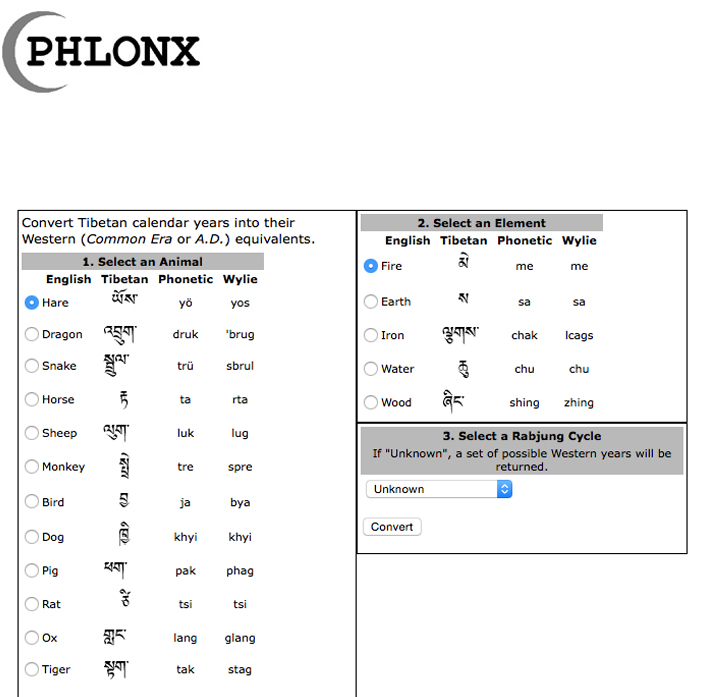
    Fred Coulson’s blog has a calculator that will convert your Tibetan year into a Western equivalent. Provide the animal, element, and rab byung and you might get something useful: http://phlonx.com/resources/tibetan calendar/

    For more on the Tibetan Calendar: http://www.nitartha.org/calendar overview.html

  • IABS 2011: Reporting from Taiwan (Gene Smith Panel)

    IABS 2011: Reporting from Taiwan (Gene Smith Panel)

    Convened by Michael Sheehy and Jeff Wallman of TBRC, “Gene Smith: His Life and Work” was the first panel I attended at IABS 2011 Congress.

    Michael Sheehy gave a formal presentation entitled “Banned Books, Sealed Printeries and Neglected Dkar chag” that described some fascinating research on the history of Takten Damchö Phuntsok Ling Monastery (where Tāranātha passed on) and its printery. He recounted three separate attempts to rescue the woodblocks of Jonang texts from the Phuntsok Ling printery by three different Tibetan lamas over several centuries following Tāranātha’s death. It is not until the efforts of Losal Tenkyong (blo gsal bstan skyong), a Zhwa lu Tulku who was close to Jamgon Kongtrul, that the printery doors were unlocked and a dkar chag of the texts found there was created.

    (more…)
  • The 16th Congress of the International Association of Buddhist Studies Begins

    The 16th Congress of the International Association of Buddhist Studies Begins

    The 16th Congress of the International Association of Buddhist Studies is under way here at Dharma Drum Buddhist College in Jinshan, New Taipei, Taiwan.

    The opening session of the Congress included a truly fascinating address by Tom Tillemans. Professor Tillemans spoke about looking to Buddhist philosophy, specifically Dharmakīrti, for developing defenses against hard-line materialists who claim that there is no such thing as mind. This was probably one of the better delivered and more interesting talks I’ve heard at the several conferences I have attended this past year and a half (of course I’m partial to philosophical discussions). If there is time I will treat it to its own blog post here.

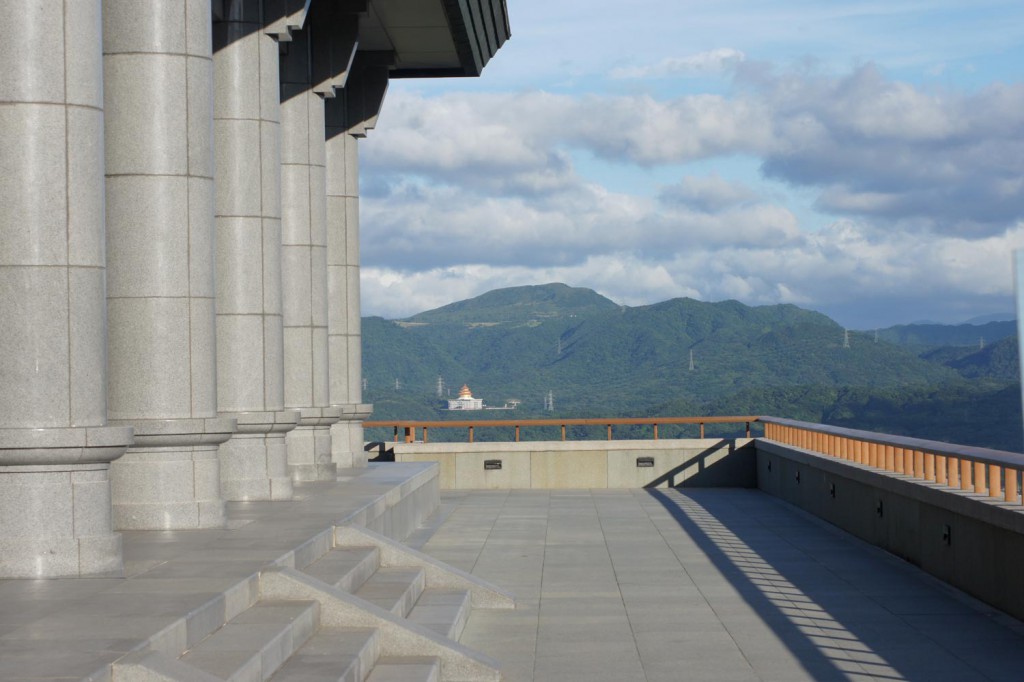
    The opening day saw the nearly 600 scholars from around the world introduced to the bewilderingly large grounds of Dharma Drum Buddhist College and its amazingly dedicated support staff. The army of Taiwanese that greeted the delegates, and have been at every corner to guide us from floor to floor and room to room each day since, are embodying what I can only imagine is an amazing sense of the importance of service cultivated here in Taiwanese Buddhist culture. At times one feels as though herded by shepherds or kindly directed by an aunt who thinks you are her slightly disabled nephew, but the sincerity overpowers the oddity. Dharma Drum Buddhist College is situated on Dharma Drum Mountain, a massive estate with beautiful modern buildings designed to impress. The scale of the place is almost inhuman, and although spending time in each separate area is enjoyable, the architects seem to have forgotten that buildings at an institution should flow together in such a way as to make traversing from one meeting place to another somewhat less than an epic journey across space and time. But I digress… The Dharma Drum Mountain is an excellent place for a congress of the International Association of Buddhist Studies as it is a manifestation of modern Buddhism and plays a role in Buddhist studies. Thanks to the kindness of Dr. Bill Magee, one of the organizers of the conference, I am able to attend this gathering of scholars and it has been an honor and a privilege just to be among such amazingly dedicated and accomplished Buddhist scholars and scholars of Buddhism. The conference is very well organized but is so full of amazing panels that it is impossible to attend even half of what I would like. In the next series of blog posts I will endeavor to recount as much as I can about my experiences and the papers presented at this historic event.

  • Glossaries for Buddhist Studies

    Glossaries for Buddhist Studies

    Update on Buddhist Studies resources on the web:

    There are some new additions to Marcus Bingenheimer’s excellent resource “Glossaries for Buddhist Studies.”

  • Tsadra Foundation’s Advanced Contemplative Scholarships

    Tsadra Foundation’s Advanced Contemplative Scholarships

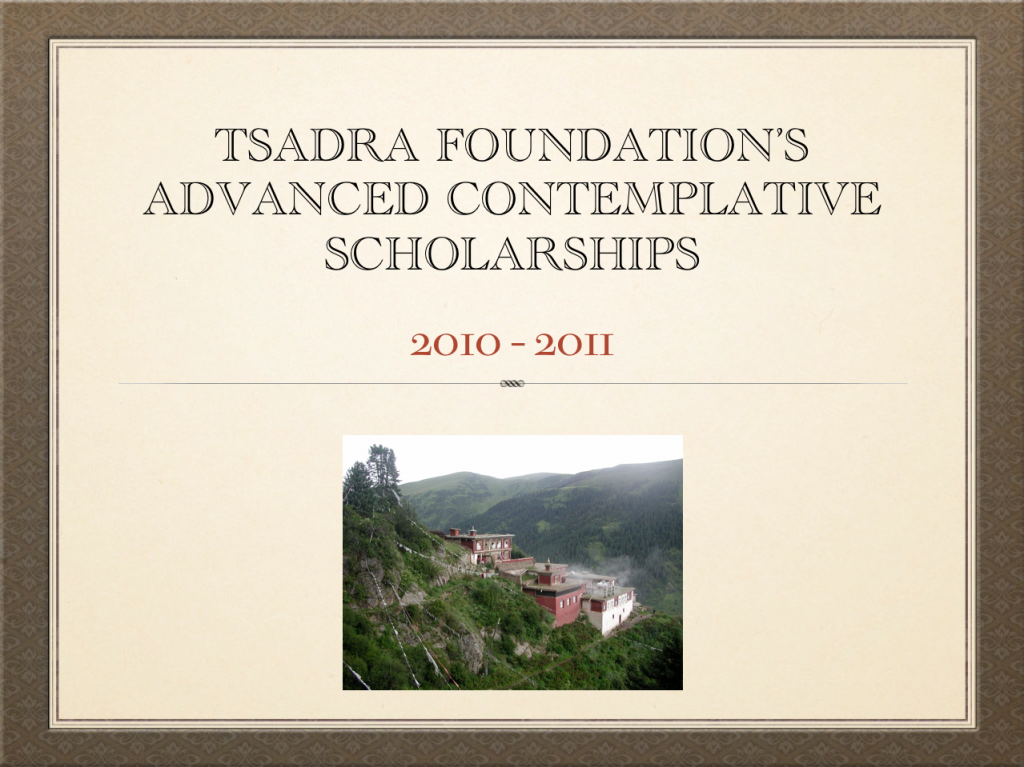
    The Advanced Contemplative Scholarship program was launched in 2009 under the direction of Anthony Chapman and the first scholarships were awarded for retreat in 2010. Now in 2011 the second cohort of recipients are in retreat and we can provide some more information about this fascinating and successful scholarship program. The Tsadra Foundation’s Contemplative Program supports the practice of Tibetan Buddhism in the form of long-term retreat, primarily through three-year retreat programs for advanced practitioners. The scholarships discussed here are not for short dharma programs. Instead they are designed to target those people who show a long-term commitment to the development of Tibetan Buddhism in Western culture through the combined study and practice of Tibetan Buddhism, the hallmark of Tsadra Foundation’s activity.

    Currently there are 39 people supported in long-term retreat through two programs: the Tsadra Foundation Contemplative Program and the Tsadra Foundation Advanced Contemplative Scholarship (TFACS) Program. The Contemplative Program is at the center of Tsadra Foundation’s mission and was initiated at the very beginning of the Foundation’s existence in the year 2000. The Contemplative Program was not open to unsolicited applications and has been only for the most advanced practitioners who have already completed at least one three-year retreat. The new TFACS program invites applications and is open to those intending to enter retreat in the United States, France, the United Kingdom, Canada, and Spain. One does not need to have completed a three-year retreat previously to apply. There continues to be a rigorous screening process involving assessment of both the individual applicant and the retreat program to which they are committing, but the application is open to those wishing to enter into three-year retreat for the first time in any Tibetan Buddhist tradition. Application information can be found online at www.tsadra.org.

    The Tsadra Foundation Contemplative Program currently supports fourteen people in three-year retreat programs and one person in individual retreat. The  TFACS program supports seven people in three-year retreat programs continuing on with their 2010 scholarships and fifteen new people in three-year retreat centers with another two people in special individual retreats. In the first year, the TFACS program had fifteen applications and ten were accepted, eight women and two men from the United States and France. In the second year, 17 applicants were selected from 21 initial applications. This year, the six women and eleven men are from the United States (5), France (1), Spain (4), and the United Kingdom (7).

    Tsadra Foundation Contemplative Program Statistics:

    Year 11 (2011): 15 retreatants

    TFACS: Tsadra Foundation Advanced Contemplative Scholarship Program

    Year 2 (2011): 24 retreatants (7 continuing from last year with 17 new recipients)

    Total people currently in retreat

    2011: 39 retreatants

    By Retreat Type

    36 in Three-year retreat : 3 in Solitary retreat

    By Gender

    18 Women : 21 Men

    By Region

    18 US : 10 FR : 4 Spain : 7 U.K.

    For more information please see the scholarship section at www.tsadra.org.

  • The Four Applications (T: rigs pa bzhi)

    The Four Applications (T: rigs pa bzhi)

    Dr. Art Engle gave a presentation on his work at the recent Tsadra Foundation Fellows and Grantees Conference entitled “Observations on Asanga’s Bodhisattvabhūmi.” During his talk he discussed the translation of rigs pa as “application” instead of “reason” in the context of “The Four Applications” (Wyl: rigs pa bzhi; Tib: རིགས་པ་བཞི་ ; Skt: catasro yuktayaḥ). Here he provides us with his notes, translations, and the associated text citations:

    The Four Applications

    [Note: The following passage is an excerpt from Ārya Asaṅga’s The Listener’s Stage (S: Śrāvakabhūmiḥ, T: Nyan thos kyi sa). It forms part of a larger discussion on what are referred to as thirteen “requisites” (S: sambhāraḥ, T: tshogs) for attaining freedom from attachment. The two activities of listening to and reflecting upon the true Dharma taken together represent the tenth of these qualities. Asaṅga’s description of the four applications (S: catasro yuktayaḥ, T: rigs pa bzhi) appears in his explanation of the second of two methods for engaging in the practice of reflection. It is here that we find Asaṅga stating that the term yukti is synonymous with yoga (T: sbyor ba) and upāya (T: thabs), any of which could be rendered in this context as an “application,” a “means,” or an “expedient.” It is for this reason that I have translated the term as “application,” rather than the more commonly seen rendering “reason.” The Sanskrit of the text that appears below is not well edited and contains a number of corruptions; nevertheless, it is helpful in the effort of attempting to render an accurate English translation. Another important primary source for the four applications is a passage that appears in Chapter Ten of the Saṃdhinirmocana Sūtra.]

    cintanā katamā | yathāpīhaikatyas tān eva yathā śrutān dharmān ekākī rahogataḥ | ṣaḍ acintyāni sthānāni tad yathā, (1) ātmacintāṁ, (2) sattvacintāṁ, (3) lokacintāṁ, (4) satvā(ttvā)nāṁ karmavipākacintāṁ, (5) dhyāyināṁ dhyāyiviṣayaṁ (6) buddhānāṁ buddhaviṣayaṁ varjayitvā (viśodhayitvā ?) svalakṣaṇataḥ | sāmānyalakṣaṇataś ca cintayati |

    SEMS PA GANG ZHE NA, ‘DI LTAR ‘DI NA LA LA GCIG PU DBEN PAR SONG STE, BSAM GYIS MI KHYAB PA’I GNAS DRUG PO ‘DI LTA STE, BDAG LA SEMS PA DANG, SEMS CAN LA SEMS PA DANG, ‘JIG RTEN PA LA SEMS PA DANG, SEMS CAN RNAMS KYI LAS KYI RNAM PAR SMIN PA LA SEMS PA DANG, BSAM GTAN PA RNAMS KYI BSAM GTAN GYI YUL DANG, SANGS RGYAS RNAMS KYI SANGS RGYAS KYI YUL RNAM PAR SBYANGS NAS, JI LTAR THOS PA’I CHOS DE DAG NYID RANG GI MTSAN NYID DANG, SPYI’I MTSAN NYID KYI SGO NAS SEMS PAR BYED PA YIN NO, ,

    What is reflection (S: cintanā, T: sems pa)?

    It is [described] as follows: Here a person goes alone to a solitary place and, after having cultivated the six inconceivable topics—that is, reflection upon the self, reflection upon beings, reflection upon the world, reflection upon the ripening of beings’ deeds, the objects of meditation that pertain to those who practice meditation, and the objects of a Buddha that are possessed by Buddhas—he [or she] reflects upon the individual and general characteristics of those teachings [that have been heard] in the same manner that he [or she] heard them.

    sā punaḥ cintā dvividhā gaṇanākārāsahagaṇanāyogena dharmeṇa | tulanākārama(rā), yuktyā guṇadoṣaparīkṣaṇākārā [ca][|] sa cet skandhapratisaṁyuktāṁ deśanāṁ cintayati | sa ced anyatamānyatamāṁ pūrvvaniviṣṭāṁ deśanāṁ cintayaty ābhyāṁ cintayati |

    SEMS PA DE YANG RNAM PA GNYIS TE, BGRANG BA’I RNAM PAS CHOS RNAMS LA BGRANG BA’I TSUL GYIS SEMS PAR BYED PA DANG, GZHAL BA’I RNAM PAS RIG PAS YON TAN DANG SKYON NYE BAR BRTAG PA’I TSUL GYIS SEMS PAR BYED PA YIN NO, ,GAL TE PHUNG PO DANG LDAN PA BSTAN PA LA SEMS PAR BYED DAM, GAL TE DE LAS GZHAN PA SNGAR BSTAN PA GANG YANG RUNG BA BSTAN PA LA SEMS PAR BYED NA YANG RNAM PA DE GNYIS KYIS SEMS PAR BYED PA YIN TE,

    Moreover, this reflection is of two types: (1) [reflection] upon teachings using a method that is a form of counting and (2) [reflection upon teaching] by means of a form of deliberation that consists of examining the good and bad qualities [of a particular topic]. If [someone] reflects upon a teaching that relates to the aggregates, or reflects upon any other teaching that was previously given, he [or she] reflects upon it using [either of] these two [methods].

    yathā punaḥ katham iti rūpam ucyate | daśa rūpīṇy āyatanānīti | yac ca dharmāyatanaparyāpannaṁ rūpaṁ sa ca rūpaskandhaḥ, tisro vedanā vedanāskandhaḥ | ṣaṭ saṁjñākāyāḥ saṁjñāskandhaḥ | ṣaṭ cetanākāyāḥ cetanāskandhaḥ | ṣaḍ vijñānakāyā vijñānaskandha ity evaṁ gaṇanāsaṁkhyākārāṁ skandha [gaṇanāṁ] cintayaty uttarottaraprabhedena yena vā punar asyāḥ saṁkhyāgaṇanākārāyāś cintāyā apramāṇaḥ praveśanayo veditavyaḥ |

    DE YANG JI LTAR ZHE NA, GZUGS ZHES BYA BA NI SKYE MCHED GZUGS CAN BCU DANG, CHOS KYI SKYE MCHED DU GTOGS PA’I GZUGS GANG YIN PA STE, DE NI GZUGS KYI PHUNG PO YIN NO, ,TSOR BA RNAM PA GSUM NI TSOR BA’I PHUNG PO YIN NO, ,’DU SHES KYI TSOGS DRUG NI ‘DU SHES KYI PHUNG PO YIN, ‘DU BYED KYI TSOGS DRUG NI ‘DU BYED KYI PHUNG PO YIN, RNAM PAR SHES PA’I TSOGS DRUG NI RNAM PAR SHES PA’I PHUNG PO YIN TE, DE LTAR NA BGRANG BA DANG, GRANGS KYI RNAM PAR PHUNG PO BSTAN PA LA SEMS PAR BYED PA DANG, GONG NAS GONG DU RAB TU DBYE BA’I TSUL GYIS GRANGS DANG, BGRANG BA’I RNAM PA SEMS PA DE LA TSAD MED PA’I SGO NAS ‘JUG PA’I TSUL DU RIG PAR BYA’O, ,

    How, then, [are these two methods carried out]?

    The term “form” refers to the ten bases that have the nature of form, as well as the form that is included in the entity basis. This is what makes up the form aggregate. The feeling aggregate is made up of three types of feeling. The conception aggregate is made up of six collections of conceptions. The formations aggregate is made up of six collections of formations. The consciousness aggregate is made up of six collections of [various forms of] consciousness. It should be understood that this is how one reflects upon a teaching about the aggregates in a manner that consists of a form of counting and enumeration. Moreover, [it should also be understood] that this method of reflection that is based on a form of enumeration and counting can be applied to an immeasurable degree by [further] distinguishing [the aggregates] using ever more detailed types of classification.

    kathaṁ yuktyupaparīkṣākārayā cintayā skandhadeśanāṁ cintayati | catasṛbhir yuktibhir upaparīkṣate | katamābhiś catasṛbhir yad utāpekṣāyuktyā, kāryakāraṇayuktyā, upapattisādhanayuktyā | dharmatāyuktyā ||

    JI LTAR NA RIGS PAS NYE BAR BRTAGS PA’I SEMS PAS PHUNG PO BSTAN PA LA SEMS PAR BYED PA YIN ZHE NA, RIGS PA BZHIS NYE BAR RTOG PAR BYED DE, BZHI GANG ZHE NA, ‘DI LTA STE, LTOS PA’I RIGS PA DANG, BYA BA BYED PA’I RIGS PA DANG, ‘THAD PA SGRUB PA’I RIGS PA DANG, CHOS NYID KYI RIGS PAS SO, ,

    How does one reflect upon a teaching about the aggregates using a form of investigation that applies various types of expedient means (S: yuktyupaparīkṣā, T: rigs pas nye bar brtags pa)?
    [Such a teaching] is investigated by means of the four applications.

    What are the four applications?

    They are (1) the application that relates to dependence (S: apekṣāyuktiḥ, T: ltos pa’i rigs pa), (2) the application that relates to performance of an action (S: kāryakāraṇayuktiḥ, T: bya ba byed pa’i rigs pa), (3) the application that relates to demonstration of a proof (S: upapattisādhana-yuktiḥ, T: ’thad pas grub pa’i rigs pa), and (4) the application that relates to the nature of things (S: dharmatāyuktiḥ, T: chos nyid kyi rigs pa).

    apekṣāyuktiḥ katamā | dvividhā apekṣā utpatyapekṣā prajñaptyapekṣā ca | tatrotpattyapekṣā yair hetupratyayaiḥ skandhānāṁ prādur bhāvo bhavati | tasyāṁ skandhotpattau te hetavas te pratyayā apekṣyante | yair nāmakāyapadakāyavyaṁjanakāyaiḥ skandhānāṁ prajñaptir bhavati | tasyāṁ skandhaprajñaptau te nāmapadakāyavyaṁjanakāyā apekṣyante | iyam ucyate skandheṣūtpattyapekṣā | prajñaptyapekṣatā (kṣā)ca | yā cotpattyapekṣā | yā ca prajñaptyapekṣā sā yuktir yoga upāyaḥ | skandhotpattaye | skandhaprajñaptaye tasmād apekṣāyuktir ity ucyate |

    DE LA LTOS PA’I RIGS PA GANG ZHE NA, LTOS PA NI RNAM PA GNYIS TE, SKYE BA’I LTOS PA DANG, GDAGS PA’I LTOS PA’O, ,DE LA SKYE BA’I LTOS PA NI RGYU GANG DAG DANG, RKYEN GANG DAG GIS PHUNG PO RNAMS SKYE BAR ‘GYUR BA’I PHUNG PO’I SKYE BA DE NI RGYU DE DAG DANG, RKYEN DANG DE DAG LAS LTOS PA YIN NO, ,MING GI CHOGS DANG, TSIG GI TSOGS DANG, YI GE’I TSOGS GANG DAG GI PHUNG PO RNAMS GDAGS PAR ‘GYUR BA’I PHUNG PO GDAGS PA DE NI MING GI TSOGS DANG, TSIG GI TSOGS DANG, YI GE’I CHOGS DE DAG LA LTOS PA YIN TE, DE NI PHUNG PO RNAMS KYI SKYE BA’I LTOS PA DANG, GDAGS PA’I LTOS PA ZHES BYA’O, ,SKYE BA’I LTOS PA GANG YIN PA DANG, GDAGS PA’I LTOS PA GANG YIN PA DE NI PHUNG PO SKYE BA DANG, PHUNG POR GDAGS PA’I RIGS PA DANG, SBYOR BA DANG THABS YIN PAS NA DE’I PHYIR LTOS PA’I RIGS PA ZHES BYA’O, ,

    What is the application that relates to dependence?

    There are two types of dependence: the dependence that relates to arising (S: utpattyapekṣā, T: skye ba’i ltos pa) and the dependence that relates to informative statements (S: prajñaptyapekṣā, T: gdags pa’i ltos pa). Regarding these, the dependence that relates to the arising [of the heaps] means that the causes and conditions by which the heaps are made to appear are the causes and conditions upon which the arising of the heaps depends. [The dependence that relates to informative statements about the heaps] means that the collections of names, assertions, and syllables by which the informative statements regarding the heaps are made are the collections of names, assertions, and syllables upon which the informative statements regarding the heaps depend. These [two types of dependence] that occur in relation to the heaps are called “the dependence that relates to the arising” and “the dependence that relates to informative statements.”
    Both the dependence that relates to the arising [of the heaps] and the dependence that relates to informative statements [about the heaps] are an application (S: yuktiḥ, T: rigs pa) or a means (S: yogaḥ, T: sbyor ba) or a method (S: upāyaḥ¸T: thabs) that is directed toward the arising of the heaps and [an application or a means or a method] that is directed toward the informative statements made in relation to the heaps. Therefore, it is called “the application that relates to dependence.”

    kāryakāraṇayuktir yā [ta]d utpannānāṁ skandhānāṁ svena hetunā svena pratyayena tasmiṁs tasmin svakāryakaraṇe viniyogas tad yathā | cakṣuṣā rūpāṇi draṣṭavyāni | śrotreṇa śabdā[ḥ] śrotavyāḥ | yāvan manasā dharmā vijñeyā iti | rūpeṇa cakṣuṣo gocare avasthātavyaṁ | śabdena śrotrasya, evaṁ yāddharmair manasa iti | yad vā punar anyad apy evaṁ bhāgīyaṁ | tatra tatra dharmāṇām anyo[a]nyaṁ kāryakāraṇe prati yuktir yoga upāya iyam ucyate | kāryakāraṇayuktiḥ |

    BYA BA BYED PA’I RIGS PA GANG ZHE NA, PHUNG PO RANG GI RGYU DANG, RANG GI RKYEN GYIS BSKYED PA GANG YIN PA RNAMS NI RANG GI BYA BA BYED PA DE DANG DE DAG LA SBYOR BAR BYED PA YIN TE, ‘DI LTA STE, DPER NA MIG GIS GZUGS RNAMS LA LTA BAR BYED PA DANG, RNA BAS SGRA RNAMS NYAN PAR BYED PA DANG, YID KYIS CHOS RNAMS SHES PAR BYED PA’I BAR LTA BU DANG, GZUGS KYIS MIG GI SPYOD YUL DU GNAS PAR BYED PA DANG, SGRAS RNA BA’I SPYOD YUL DU GNAS PAR BYED PA DANG, DE BZHIN DU CHOS RNAMS KYIS YID KYI SPYOD YUL DU GNAS PAR BYED PA’I BAR DAG LTA BU DANG, GZHAN YANG DE LTA BU DANG MTHUN PA’I CHOS RNAMS DE DANG DE DAG GCIG LA GCIG BYA BA BYED PA’I RIGS PA DANG, SBYOR BA DANG, THABS SU ‘GYUR BA GANG YIN PA DE NI BYA BA BYED PA’I RIGS PA ZHES BYA’O, ,

    What is the application that relates to performance of an action?

    It is the assigning (S: viniyogaḥ, T: sbyor bar byed pa) of the performance of this or that action to [the individual entities that make up] the heaps, each of which has arisen on the basis of its own causes and conditions. For example, the eye sees [visible] forms, the ear hears sounds, and so on, up to the mind knows entities. [Visible] form is established as the field of action for the eye, sound is established as the field of action for the ear, and so on in the same way, up to entities are established as the field of action for the mind. In addition, further descriptions of a similar kind can be made in relation to the performance of actions that occur mutually among different entities. Such an application or means or method is called “the application that relates to performing an action.”

    upapattisādhanayuktiḥ katamā[|] anityā[ḥ] skandhā iti, pratītyasamutpannā, duḥkhā[ḥ], śūnyā, anātmāna iti tribhiḥ pramāṇair upaparīkṣate yad utāptāgamena, pratyakṣeṇānumānena ca[|] ebhis tribhiḥ pramāṇair ūpapattiyuktaiḥ satāṁ hṛdayagrāhakair vyavasthāpanā sādhanā kriyate | yad uta skandhānityatāyā vā, pratītyasamutpannatāyā vā, duḥkhatāyā [ḥ], śūnyatāyā, iyam ucyate upapattisādhanayuktiḥ |

    ‘THAD PA SGRUB PA’I RIGS PA GANG ZHE NA, PHUNG PO RNAMS MI RTAG PA’AM, RTEN CING ‘BREL PAR ‘BYUNG BA’AM, SDUG BSNGAL BA’AM, STONG PA’AM, BDAG MED PA’O ZHES TSAD MA GSUM PO ‘DI LTA STE, YID CHES PA’I LUNG DANG, MNGON SUM DU RJES SU DPAG PA DAG GIS NYE BAR RTOG PAR BYED CING ‘THAD PA’I RIGS PA DAM PA RNAMS KYI SNYING ‘PHROG PAR BYED PA’I TSAD MA GSUM PO DE DAG GIS ‘DI LTA STE, PHUNG PO RNAMS MI RTAG PA NYID DAM, RTEN CING ‘BREL BAR ‘BYUNG BA NYID DAM, SDUG BSNGAL BA NYID DAM, STONG PA NYID DAM, BDAG MED PA NYID DU RNAM PAR ‘JOG PAR BYED CING, SGRUB PAR BYED PA YIN TE; DE’I ‘THAD PA SGRUB PA’I RIGS PA ZHES BYA BA’O, ,

    What is the application that relates to demonstration of a proof?

    The assertions that the heaps are impermanent, that they are dependently arisen, that they have a nature that consists of suffering, that they are empty [of a self that is distinct from them], and that they do not [in themselves] constitute a self are investigated using the three forms of authoritative knowledge (S: pramāṇam, T: tshad ma)—that is to say, trustworthy scripture, direct perception, and inference. These three forms of authoritative knowledge—which represent forms of application that relate to proofs (S: upapattiyuktiḥ, T: ’thad pa’i rigs pa) and which captivate the minds of the wise—establish and demonstrate the impermanence, dependently arisen nature, suffering nature, empty nature, and selflessness of the heaps. [Hence,] this [method of reflection] is called “the application that relates to demonstration of a proof.”

    dharmatāyuktiḥ katamā| kena kāraṇena tathā bhūtā ete skandhā[ḥ], tathā bhūto lokasanniveśaḥ kena kāraṇena kharalakṣaṇā pṛthivī, dravalakṣaṇā āpaḥ, uṣṇalakṣaṇaṁ tejaḥ [ḥ], samudīraṇalakṣaṇo vāyuḥ, (|) anityāḥ, skandhā [ḥ], kena kāraṇena śāntaṁ nirvvāṇam iti| tathā rūpaṇalakṣaṇaṁ rūpaṁ | anubhavalakṣaṇā vedanā, saṁjānanalakṣaṇā saṁjñā, abhisaṁskaraṇalakṣaṇāḥ saṁskārāḥ, vijānanālakṣaṇaṁ vijñānam iti| prakṛtir eṣāṁ dharmāṇām iyaṁ svabhāva eṣa īdṛśaḥ | dharmataiṣā caiva cāsau dharmatā | saivātra yuktir yoga upāyaḥ [|] evaṁ vā etat syāt | anyathā vā, naiva vā syāt, sarvvatraiva ca dharmataiva pratiprasaraṇadharmataiva yuktiḥ | cittanidhyāyanāya, cittasaṁjñāpanāya iyam ucyate dharmatāyuktiḥ |

    CHOS NYID KYI RIGS PA GANG ZHE NA, CI’I PHYIR PHUNG PO RNAMS DE LTA BUR GYUR BA YIN, ‘JIG RTEN GNAS PA DE LTA BUR GYUR PA YIN, CI’I PHYIR SA’I MTSAN NYID SRA BA YIN, CHU’I MTSAN NYID GSHER BA YIN, ME’I MTSAN NYID TSA BA YIN; RLUNG GI MTSAN NYID GA-YO BA YIN, CI’I PHYIR PHUNG PO RNAMS MI TIG PA YIN, CI’I PHYIR MYA NGAN LAS ‘DAS PA ZHI BA YIN, DE BZHIN DU CI’I PHYIR GZUGS KYIS MTSAN NYID GZUGS SU RUNG BA YIN, TSOR BA’I MTSAN NYID MYONG BA YIN, ‘DU SHES KYI MTSAN NYID KUN SHES PAR BYED PA YIN, ‘DU BYED RNAMS KYI MTSAN NYID MNGON PAR ‘DU BYED PA YIN, RNAM PAR SHES PA’I MTSAN NYID RNAM PAR SHES PAR BYED PA YIN ZHE NA, DE NI CHOS NYID YIN TE, CHOS DE DAG GI RANG BZHIN DE YIN ZHING, DE DAG GI NGO BO NYID DE LTA BU YIN PAS CHOS NYID DE GANG KHO NA YIN PA DE NYID ‘DIR RIGS PA DANG, SBYOR BA DANG, THABS YIN NO, ,DE BZHIN DU DE LTA BU’AM, GZHAN NAM, GZHAN DU MI ‘GYUR BA NI SEMS LA GZHAG PAR BYA BA DANG, SEMS LA GO BAR BYA BA’I PHYIR THAMS CAD DU YANG CHOS NYID KHO NA LA BRTEN PA DANG, CHOS NYID KHO NA’I RIGS PA YIN TE; DE NI CHOS NYID KYI RIGS PA ZHES BYA’O, ,

    What is the application that relates to the nature of things?

    In response to questions such as, “Why do the heaps have such a nature?” “[Why] does the arrangement of the world have that nature?” “Why does the earth [element] have the essential characteristic of hardness, the water [element] have the essential characteristic of wetness, the fire [element] have the essential characteristic of heat, and the air [element] have the essential characteristic of motility?” “[Why] are the heaps impermanent?” “Why is nirvana a state of peace?” and, similarly, [in answer to such questions as “Why] does form have the essential characteristic of displaying [the quality of] form?” “[Why do] feelings have the essential characteristic of experiencing?” “[Why do] conceptions have the essential characteristic of causing things to be recognized?” “[Why do] formations have the essential characteristic of shaping/forming things [in a particular way]?” and “[Why does] consciousness have the essential characteristic of awareness?” [the understanding that] this is the natural condition of those entities, that this is what their essential nature is like, that this is their very nature is here an application or a way or a means, and hence it is called “the application that relates to the nature of things.” Alternatively, the application that the relates to the nature of things and that relies upon the nature of things with the aim of fixing the mind upon and causing the mind to recognize that this is the way things are, that they are not some other way, that they do not cease to be this way, and that they are [this way] everywhere is called “the application that relates to the nature of things.”

    evaṁ catasṛbhir yuktabhiḥ skandhadeśanā upaparīkṣyata iti | yāvat punar anyā kācid deśanā iti yā evam ābhyāṁ dvābhyām ākārābhyāṁ gaṇanāsaṁkhyākārā ca yuktyupaparīkṣaṇākārā ca samyag upanidhyāyanā tasyās tasyā deśanāyā iyam ucyate | saddharmaśravaṇacinta[nā] ||

    DE LTAR NA RIGS PA BZHIS PHUNG PO B STAN PA DANG, GZHAN GANG YANG RUNG BA BSTAN PA LA NGES PAR RTOGS PAR BYED PA YIN TE, DE LTAR RNAM PA GNYIS PO BGRANG BA DANG, GRANGS KYI RNAM PA DANG, RIGS PAS NYE BAR RTOG PA’I RNAM PA DE DAG GIS BSTAN PA DE DANG, DE DAG LA YANG DAG PAR RTOG PAR BYED PA GANG YIN PA DE NI SEMS PA YIN TE, DE NI DAM PA’I CHOS NYAN PA DANG SEMS PA ZHES BYA’O, ,

    This is the way in which a teaching about the aggregates is investigated by means of the four applications. Moreover, the correct and attentive consideration of any other specific teaching using [either of] these two methods that represent [either] a form of counting and enumeration or a form of examination using the applications is what is referred to as reflection. This is what is referred to as “listening to and reflection upon the true Dharma.”


  • The Challenge of a Faithful Translation

    The Challenge of a Faithful Translation

    The Challenge of translation – Faithful yes, but not a slave

    BY CHRISTIAN CHARRIER

    While no one disputes that a translation must be truthful, the definition of truthfulness and the ways in which translators have striven to achieve it have varied over the centuries. Word-for-word translation has given way to translation of meaning with the translated text reading as naturally in the TL as the original did in the SL. Reconciling truthfulness and beauty is one of the most important challenges faced by translators.

    *****

    Much has been said and written about the notion of faithfulness (or fidelity) in translation, even the sexist comment that a translation is like a woman : if is faithful it is not beautiful and if it is beautiful it is not faithful, as if being both faithful and beautiful were mutually exclusive

    Obviously, like everything else, “faithfulness” depends on how you define it – a principle of loyalty or honesty or a matter of exactness and accuracy ; or  both ; or much more that that ) – and also it depends on what you relate it to – word or meaning ; the source language or the target language ; the source text or the target text ; the author or the reader.

    Faithfulness will also depend on the different choices you make and the strategies you use in different translating situations (oral or written), with different texts (literary or technical ; philosophy, poetry, logics, etc…). And accordingly, it raises different types of difficulties. Usually technical translators are envious of literary translators because they do not have technical problems to solve, and literary translators are envious of technical translators because they only have technical questions to deal with. We Dharma translators, are not envious of anybody else, because we have both : the technical problems and all the rest…

    Without getting into theoretical issues about linguistic theories in translation, I would like to relate this notion of faithfulness to my personal experience as a Dharma translator and  specially to one model of translation strategy developed by Lederer (2001) at the ESIT school of translators in Paris that I find interesting and useful.  So, as this exploration of the extent of faithfulness,  has mainly given me the opportunity to reconsider my ideas about translation and my involvement in translating Dharma I am afraid that apart from being a very self-centered talk, the rest might be very familiar to you and overrun.

    *****

    In the early eighties, when the director of a FPMT center in France asked me to translate orally, from English to French, the teachings of the resident gueshé on Shiné and Lhaktong, I thought he was pulling my leg. First, I did not know who Shiné and Lhaktong were and did not think that just knowing a foreign language suddenly qualified someone to be a translator or worse an interpreter. On top of that How can you translate something you do not understand ? The reason that apparently made me a translator was that I understood English and had a degree in linguistics from a Canadian university. But speaking a language and translating a Buddhist senior monk talk about meditation and philosophy are for me two different things : in one case, you think you know what you are talking about, while in the other you know you don’t.

    But curiosity and temptation were stronger than I thought, so I finally went up to meet Gueshé la in his room and find out more about the subject.

    After hearing all my excuses about my incompetence, Gueshé La just smiled at me and said : ” Oh don’t be so shy just say the same thing in your own language ! “

    Saying the same thing in my own language ! That was exactly what I thought I could not do, as my knowledge of the thing itself was rather a non-thing and definitely not functional.

    But as you cannot resist a wise and compassionate person, a few days later, after some more encouragement by Gueshé la, convincing me that there was not any body else around who could do it, I was sitting on the hot cushion, scared as a newborn lamb, trying to convey as faithfully as I could, that is almost word by word, whatever Gueshé la was saying. Sorry, whatever the English translator was saying, as I did not know Tibetan then. This was my first experience of translating Dharma : translating a Tibetan translator translating the words of a Tibetan scholar speaking about a subject I knew nothing about. This is how Dharma teachings were introduced in France when at this time when there were no direct Tibetan-French translators available. Taking any one who came close to accomplishing the function of a merely labeled translator. In that case ME.

    Everybody knows the famous expression (traduttore, traditore) : that interpreters are traitors.  And in that case we were two traitors. Although some might argue that two traitors are probably better than just one, as betraying the traitor could be one step closer to truth !?! Anyway, we both joined our efforts as best we could, trying to translate every word like a dictionary would. Isn’t a dictionary the best tool for translating ? This is when I proudly started to consider myself as being just a tool at the service of Dharma and others. A Dharma translating machine so to speak.

    (more…)
  • “As for the Blessing of Vajravārāhī, Marpa Lhodrakpa does not have it.” WTF?

    “As for the Blessing of Vajravārāhī, Marpa Lhodrakpa does not have it.” WTF?

    “As for the Blessing of Vajravārāhī, Marpa Lhodrakpa does not have it.” WTF?
     by Sarah Harding

    In the beginning, my work translating the Pakmo Namshe[1] by the 2nd Pawo Rinpoche Tsuklak Trengwa (dPa’ bo gtsug lag Phreng ba, 1504-1566) presented several surprises. I had always believed that this was a commentary about the secret practice of Vajravārāhı based on the sādhana by the Sixth Karmapa Tongwa Dönden (mThong ba don ldan, 1416-1453) that we had all practiced in three-year retreat. I had certainly used it as such. But as soon as I came across the actual words of the sādhana within the text, it was clearly not that. Tsuklak Trengwa gives the title of the sādhana as simply dPal rdo rje rnal ‘byor ma’i gsang ba’i grub thab, or Srı Vajrayoginı Guhya Sādhana, authored by Nāropa and translated by Marpa. Well that’s easy, I thought, because there’s a three-folia verse text in the Peking Tengyur by Nāropa, or rather Mahā Nāḍapāda, with just that Sanskrit name.[2] Great—only that was not it. Then I actually opened and looked at every single text attributed to Nāropa in the Tengyur, and could not find a match. Then for weeks there were random feverish searches on TBRC under every conceivable word, like “yoginī,” “secret,” “vajra,” “pig,” and so on. Finally one fine day brought up the Miscellaneous Works (gsung thor bu) of the First Karmapa, Dusum Khyenpa (Dus gsum mkhyen pa, 1110-1193), and there I found it among several other secret Vajrayoginī practices, 29 folios and with no author, under the title dPal rdo rje rnal ‘byor ma’i gsang bsgrub [rdo?] rje btsun mo lhan skyes.[3] That was what I call a researcher’s moment of glory. It’s been all down hill from there.

    The second big surprise was the nature of the text. I was looking forward to translating Pakmo Namshe because I understood it to be a practice commentary. Pawo Tsuklak Trengwa even says, “It is this sādhana exactly as presented by the bhagavatī herself that will be expounded here.” But after the first fifty pages I realized that it’s really a rebuttal, a giant polemic in defense of Kagyu practices. I’ve since found that many if not most Kagyu commentaries on Vajrayoginī written during this period, the 15th-16th centuries, are similarly on the defensive. At first I thought that if I could make it through the history section, just fourteen folios, then finally there would be the Dharma. But that naiveté was again shattered when a few pages into the so-called “actual instructions,” even in the section on the location in which to practice, (Mountain peaks and charnel grounds/ Lone tree trunks and empty caves/ Hermitages and isolated places,… ) the narrative bends around to start sections with that red warning flag of “mkhas pa kha chig gis,” and somehow launches into another tirade. The one most shocking for me was the quote early on that is the title of this paper, “As for the blessing of Vajravārāhı, Marpa Lhodrakpa does not have it.” I mean, what? There’s been great controversy about mahāmudrā and maybe some suspicious creative innovations by lineage masters, such as evidenced by the accusations leveled at Gampopa. But Marpa? And he doesn’t even have the blessing? As I figure it, we’re screwed. So I decided to jump right in to the fray and try to figure out what’s going on here. Truly it is a can of worms, and I barely got the lid off. In order to make some use of the considerable time and energy that I already spent on Pakmo Namshe, although my work on it has now been set aside, I will present excerpts primarily from my translation of that, and some from other researches, especially Sakya Paṇḍita, Gorampa, Padma Karpo, Tashi Namgyal, and Lowo Khenchen. I’ll also make available a polished translation of the history section. What follows is basically a travelogue of my confusions, or my ‘khrul pa’i thob yig.

    (more…)