

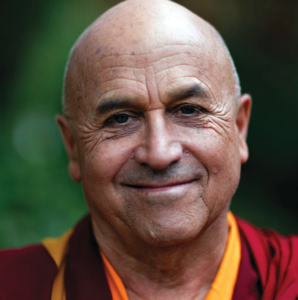
Matthieu Ricard
Born in France in 1946, son of philosopher Jean-François Revel and artist Yahne Le Toumelin, Matthieu Ricard is a Ph.D. in cell genetics turned Buddhist monk who has studied Buddhism in the Himalayas for the last 50 years under respected masters such as Kangyur Rinpoche and Dilgo Khyentse Rinpoche. He is a humanitarian, an author, a photographer, and a speaker at various international events. His books in English include The Monk and the Philosopher; The Quantum and the Lotus; Happiness: A Guide to Developing Life’s Most Important Skill; Why Meditate?; Altruism: The Power of Compassion to Change Yourself and the World, A Plea for the Animals, Enlightened Vagabond, Beyond the Self: A conversation between Neuroscience and Buddhism, In Search of Wisdom, Freedom for All and Our Animal Neighbours. Matthieu Ricard has been a friend to Tsadra Foundation since its inception and along with many publication projects in Tibetan language, has also been supported at various times to translate Buddhist texts.
Current Projects as a Tsadra Foundation Fellow
- The Nectar of Brilliant Moon, The Treasury of Essential Instructions, 800-page commentary by Dilgo Khyentse Rinpoche (1910-1991) on Longchenpa’s (1308-1364) Mengag Dzö (man ngag rin po che’i mdzod).
- Translation project into English and French simultaneously.
Videos and Events
- Matthieu Ricard: Conversation on Buddha-Nature with Lopen Dr. Karma Phuntsho, 2020.
- Matthieu Ricard: How to let altruism be your guide.
- Matthieu Ricard: TED Talk: The Habits of Happiness.
Translators
Active
Past
Institutions
Active
Past
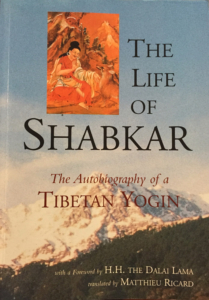
The Life of Shabkar has long been recognized by Tibetans as one of the masterworks of their religious heritage. Shabkar Tsogdruk Rangdrol devoted himself to many years of meditation in solitary retreat after his inspired youth and early training in the province of Amdo under the guidance of several extraordinary Buddhist masters. With determination and courage, he mastered the highest and most esoteric practices of the Tibetan tradition of the Great Perfection. He then wandered far and wide over the Himalayan region expressing his realization. Shabkar’s autobiography vividly reflects the values and visionary imagery of Tibetan Buddhism, as well as the social and cultural life of early nineteenth-century Tibet.
— (Source: Shambhala Publications)