


David Higgins
David Higgins received his doctorate from the University of Lausanne, Switzerland in 2012. He subsequently held a position as a Post-doc Research Fellow in the Department of South Asian, Tibetan and Buddhist Studies at the University of Vienna where he explored the relationship between Mahāmudrā and Madhyamaka philosophies in Bka’ brgyud scholasticism during the post-classical period (15th to 16th centuries). His research interests include Indo-Tibetan Buddhist philosophy and epistemology with a particular focus on Bka’ brgyud Mahāmudrā and Rnying ma Rdzogs chen doctrines and practices. His PhD thesis was published under the title Philosophical Foundations of Classical Rdzogs chen in Tibet: Investigating the Distinction Between Dualistic Mind (sems) and Primordial Knowing (ye shes) (Vienna, WSTB no. 78, 2013). His recent publications include Mahāmudrā and the Middle Way: Post-classical Kagyü Discourses on Mind, Emptiness and Buddha Nature (Vienna, WSTB no. 90, 2016, 2 vols.) and Buddha Nature Reconsidered: The Eighth Karma pa’s Middle Path (Vienna, WSTB, 2019, 2 vols.), both of which were co-authored with Martina Drazczyk. David began a translation project with a grant from Tsadra Foundation in 2021.
Current Project as a Tsadra Foundation Fellow
- The Eighth Karmapa Mi bskyod rdo rje’s commentary on Chandrakirti’s Madhyamakavatara entitled, Chariot of the Siddhas of the Dakpo Lineage, with reference to three printings and a critical edition of the Sanskrit root text.
Previously Published Work (Selected)
- Philosophical Foundations of Classical Rdzogs chen in Tibet: Investigating the Distinction Between Dualistic Mind (sems) and Primordial Knowing (ye shes) (Vienna, WSTB no. 78, 2013).
- Mahāmudrā and the Middle Way: Post-classical Kagyü Discourses on Mind, Emptiness and Buddha Nature (Vienna, WSTB no. 90, 2016, 2 vols.) with Martina Drazczyk.
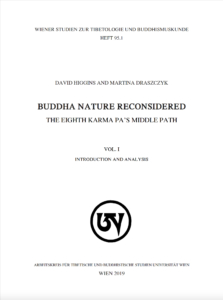
- Buddha Nature Reconsidered: The Eighth Karma pa’s Middle Path (Vienna, WSTB, forthcoming, 2 vols.) with Martina Drazczyk.
Translators
Active
Past
Institutions
Active
Past
The prodigious writings on buddha nature by the Eighth Karma pa Mi bskyod rdo rje (1507–1554) reveal a persistent concern to reconcile two divergent lines of interpretation of buddha nature that had long divided Buddhist thinkers in India and Tibet. One view, advanced in the earliest extant tathāgatagarbha texts, takes buddha nature to be an innate unchanging constituent of a human being that exists throughout the flux of sentient existence and persists after death. The Karma pa frequently criticizes a variant of this view promulgated in Tibet by the Jo nang founder Dol po pa Shes rab rgyal mtshan (1243–1313) and his disciples, who stressed the permanent and transcendent status of buddha nature and ultimate reality.
This book is an outgrowth of our previous study on the complex philosophy of Mahāmudrā that evolved in Tibetan Dwags po Bka’ brgyud traditions between the 15th and 16th centuries.3 In that work, we looked at how traditional Buddhist theories concerning buddha nature, the nature of mind, the nature of reality, and emptiness shaped, and were in turn shaped by, key developments in Bka’ brgyud Mahāmudrā doctrine during this period.4 Our research revealed the extent to which tathāgatagarbha theories in Tibet served to crystallize the central aims and presuppositions of their respective Buddhist schools. By the time Buddhism began to spread to Tibet from India (ca. 7th c.) the core premise of buddha nature theory—that beings have within them the potential to attain buddhahood—had already, in some Buddhist traditions, assumed the status of a keystone concept, one that unified and locked into place a set of representative views and practices. Because buddha nature views developed in this way as basic interpretive paradigms for both establishing and validating the doctrinal and sectarian identities of the major Tibetan Buddhist schools, their comparative analysis allows us to bring into focus some of the key discussions and debates that shaped Tibet’s intellectual history.
— (Source: Preface of Buddha Nature Reconsidered)