I will be attending the AAR meeting in Montreal this week. Please take a look at this list and let me know which sessions you would most like to hear about. I’ll try my best to get to as many as I can.
Enjoy!
~Marcus


[rev_slider alias=”tsadra-blog”]
I will be attending the AAR meeting in Montreal this week. Please take a look at this list and let me know which sessions you would most like to hear about. I’ll try my best to get to as many as I can.
Enjoy!
~Marcus

Back on day two of the ISYT conference, Elijah Ary (Ph.D., Harvard University) presented us with his study of the biographies of Tsong Kha pa blo bzang grags pa, entitled “From Disciple to Divinity: a shift in the figuration of Tsong kha pa blo bzang grags pa (1357-1419).”
Dr. Ary described two distinct tendencies in dge lugs descriptions of Tsong kha pa. First, Tsong kha pa is described as a disciple of Mañjuśri who received teachings directly via visions or through a medium (his teacher dbu ma pa). Second, a later development, presents Tsong kha pa as a sprul pa of Mañjuśri. In this case, all his actions are to be described within the rubric of enlightened activity. As Mañjuśri, all the stories of Tsong kha pa’s meetings with Mañjuśri need to be explained, since Mañjuśri doesn’t need to appear to himself. Furthermore, some stories relate how Tsong kha pa could not understand Mañjuśri’s speech and needed a medium to translate for him. Ary found that there is some evidence for discomfort with viewing Tsong kha pa as an emanation of Mañjuśri even within the dge lugs tradition itself. Outside of the tradition, it has even been suggested that Tsong kha pa met with a demon pretending to be Mañjuśri (Gorampa’s claim). Ary explored the multiplicity of meaning in Tibetan Buddhism and the various traditional hermeneutical tools used to explain (away) various inconsistencies. The three main methods he mentioned are 1) to describe Tsong kha pa’s biographical information through how he appears to the viewer, either in terms of common or exclusive (thun mongs dang thun mongs ma yin pa) view; 2) through reference to relative and ultimate reality (kun rdzob bden pa dang don dam bden pa); and 3) through reference to the inability of normal beings to understand the intention of the acts of enlightened beings.
(more…)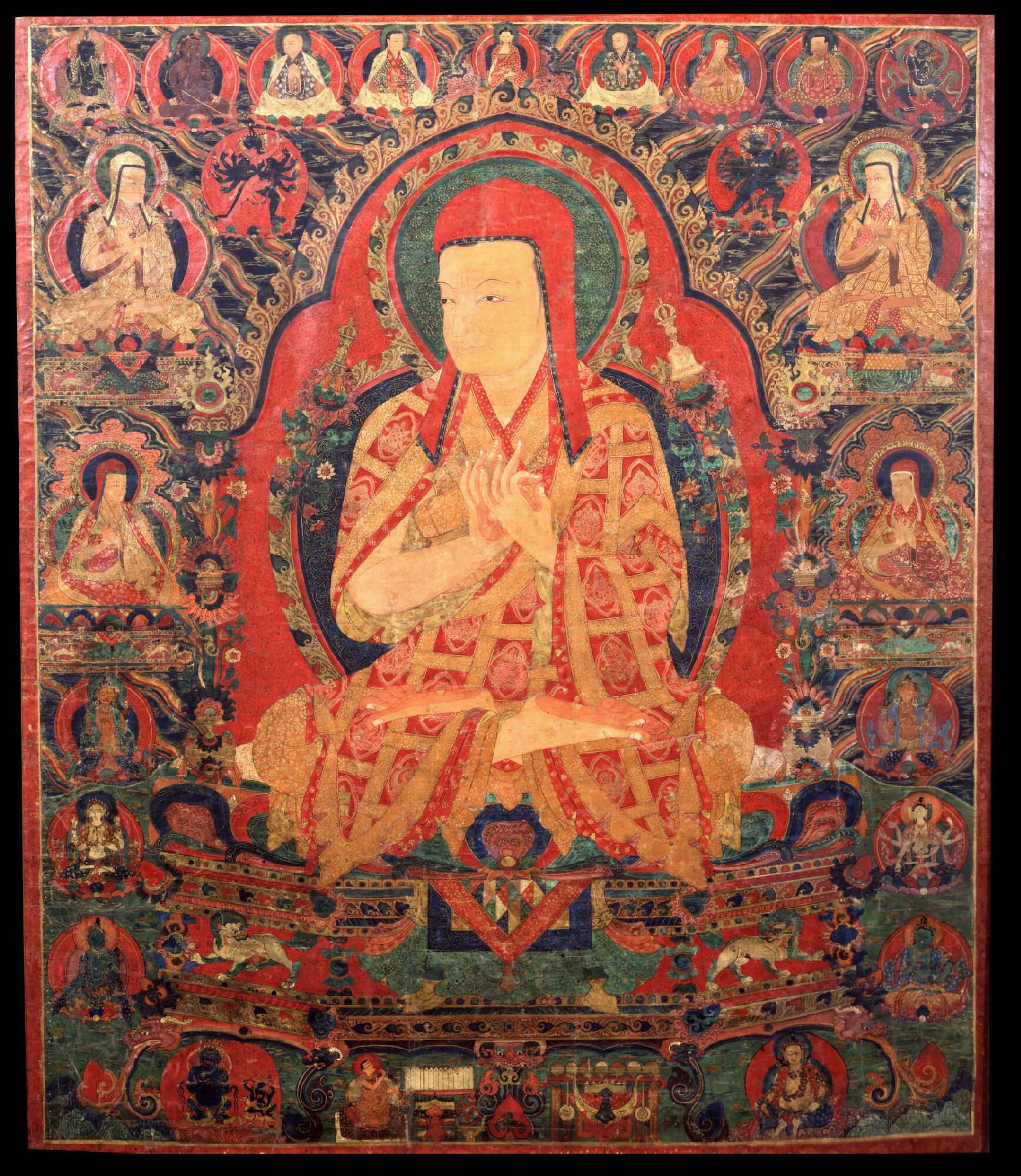
The fourth day of presentations was an interesting mix of discussions on Tibetan history, women’s studies, and anthropology.
One of the most interesting was a presentation entitled “Sources for Researching the life of Ngor chen kun dga’ bzang po” by Jörg Heimbel of the University of Hamburg. This important branch of the Sa skya school is based at Ngor E waM chos ldan, founded in 1429 in a valley southwest of gzhi ka rtse (now only a 1-hour jeep ride). The Ngor school enjoyed the patronage of the Kings of Mustang and later the Kings of Derge. According to Jörg’s research there are only three different biographies available for Ngor chen, some of which have multiple editions available. Several biographies seem to be missing as Appey Rinpoche’s text on the Saskya literature notes 13 total biographies (whether or not this was an accurate count was questioned). The three extent editions are: 1) Mus chen sems dpa’ chen po dkon mchog rgyal mtshan’s biography (he was the 2nd Ngor abbot and much of it was written during Ngor chen’s life); 2) Gu ge paNDi ta grags pa rgyal mtshan (1415-1456/87?), also a personal disciple of Ngor chen- apparently van der Kuijp has an edition but Jörg was unable to obtain it. 3) Sangs rgyas phun tshogs (1649-1705) wrote the famous Ngor chos ‘byung and the gdan rabs (abbatial history) of Ngor monastery. Jörg focused on his fascination with Sangs rgyas phun tshogs work as an editor and compiler who cited his sources extensively and provided his readers with as many sources as possible on the subjects he discussed.
(more…)
Things have been very busy here at the conference and I have not had time to blog about each of the presentations at ISYT. However, I have taken extensive notes and will be posting these as time warrants. I also have a collection of photographs, although very few of the presenters as they specifically asked that pictures not be taken. For now, I will try to update a piece of each day as it passes and will add more posts on every individual presentation I attended at a later date.
(more…)
Seiji Kumagai (Kyoto University, Japan)
Marc-Henri Deroche (École Pratique des Hautes Études, Paris, France And Kyoto University, Japan)
The second morning of the conference began with two friends and colleagues presenting issues related to one of the most important problems of Buddhism, the two truths. Seiji Kumagai of Kyoto circumscribed the history of the development of the two truths theory in Indian Buddhist, Bön, and Tibetan Buddhist philosophy. His handout and presentation was a wealth of information succinctly presented in outline-style. I had never learned anything about the Bön tradition’s conception of the two truths, which appears to be suspiciously (or not so) close to Buddhist presentations.
(more…)
Mr. Gurung’s discussion of some finer points of Bön po history opened the conference, after a great welcome from conference convener Elijah Ary and superb speeches by the eloquent and genuinely funny Charles Ramble (President of IATS) and Brandon Dotson (President of ISYT). Dr. Ramble certainly stole the show on this first day with his well timed scholastic jokes and clear speaking voice. Notable moments of the commencement speeches include: Elijah noting the importance of the local for this second ISYT conference. The city of light has never held a IATS or ISYT conference and the venues (Ecole Normale Superieure, Bibliotheque Sainte-Barbe, INALCO and musee du quai Branly) are legendary. Charles compared his receipt of an invitation to give the opening speech to a description of the stages of shock a patient goes through when learning they have contracted an incurable disease, and Brandon noted the importance of a venue where a collegial attitude was the focus and young scholars could feel safe to “stick our neck out” with new ideas without fear of rebuke. The feeling was collegial, but perhaps a little subdued by humility as the honor of standing in the Ecole Normale Superieure began to sink in.
Mr. Gurung’s presentation was renamed at the last moment to “Where do they come from? Expansion of ancestors and other members of gshen rab mi bo’s family.” His presentation was divided into four short discussions of 1) gshen rab’s father’s name, 2) gshen rab’s mother’s name, 3) his eight brothers and one sister, and 4) his key disciples. My jet-lag kicked in and the first two sections are a bit of a blur, but suffice to say that Gurung referred to Dunhang texts PT1134 and PT1235 and discussed the possible origin of the various versions of names given in a hagiography of gshen rab mi bo, which he argued were cobbled together by the author from texts from the mid-11th century and perhaps earlier. The names originated in a large corpus of early documents and their lack of clarity is what is most notable. The most interesting point, it seemed to me, came in the discussion of the third part. While in some accounts gshen rab is an only child, in Gurung’s study, a list of eight brothers and one sister is given. gshen rab appears to be the youngest son in this list. Further, the eight brother’s names accord with the first eight of the “9 vehicles” of Bon teachings. gshen rab then accords with the final stage, rdzogs chen, the ninth vehicle. The direct connection is not mentioned in the text, as the reference to the siblings comes early on in the text and the description of the “9 vehicles” comes in the 17th chapter of the hagiography. Gurung noted that the first five brother’s names match the first five vehicle names exactly, with the others becoming clear references when the descriptions of the brothers are given. Without any other reference for this presentation, Gurung was left with many questions and his fourth point caused more questions from the audience, as the creation of a common Tibetan theme of a trinity of teacher and two heart sons (thugs sras) was identified. It appears that, much like the Buddha (Shariputra and Maudgalyayana) gshen rab also had two heart sons. Gurung’s discussion was cut short, but his thesis should prove to be of great interest to those studying the Bön tradition as pieces of the hagiography of gshen rab mi bo appear to be unique and he makes reference to many Dunhuang texts.
More to come soon… and pictures!

I have arrived in Paris! Sans baggage, but in high spirits. I will be blogging about the presentations made at the Second International Seminar of Young Tibetologists (ISYT), which will be convening tomorrow, Monday September 7th through September 11th. A great group of dedicated young scholars has worked hard since the London meeting in 2007 to prepare what looks to be an excellent conference in Paris. Elijah Ary, Marc-Henri Deroche, Alice Travers and Nicola Schneider are the organizing committee and they have extended a wonderful welcome to me and I am very glad to be able to come and observe as a representative of Tsadra Foundation.
I am also pleased to note that Trace Foundation and the Fonds de Solidarité et de Développement des Initiatives Etudiantes supported ten young scholars of Tibetan origin who will be able to present at the conference because of their generosity. I will be sure to attend some of their presentations, although because so many are presenting each day, I will be unable to attend every session. However, I shall do my best to report as much of the comings and goings of the conference.

Just before leaving India, several weeks after the conference at Bir, John and I met Eric, Elizabeth and Marcus in Delhi. We exchanged views about the conference and I mentioned a memorandum I had written about a year before the conference took place, when I was a member of the planning advisory committee. The memo is of no great relevance now, in the aftermath of the conference, but it may still be of interest in that it expresses a point of view contrary to the one so strongly promoted by the conference organisers. If you have the patience to read it (I apologise for its rambling length), I’d be glad to have your reactions and to share ideas on the subject.
In his very engaging opening talk, Dzongsar Khyentse Rinpoche touched on some of the concerns I mentioned. But as things got under way—ably compered by Ivy, a high-powered professional organiser—it was clear that the conference had only one agenda: Translating the Words of the Buddha, which meant Translating the Buddhist Literary Heritage, which meant Translating the Kangyur. That was the starting point. If you haven’t already discovered it, you may want to look at David Kittelstrom’s report on the Wisdom Publications’ Blog (go to archives for April and click on “older posts” at the bottom of the page).
For me the most frustrating thing, especially at the beginning, was that no opportunity was allowed for anyone to challenge the conference’s basic premise. We were asked to discuss first the “What?” then the “How?”. No space was given for the “Why?”. The conference began with the practically unquestioned assumption that the translation of the Kangyur was self-evidently necessary and desirable (and possible). We then forged ahead, spending the first two of the conference’s (only) five days discussing how best to formulate the five-year, twenty-year, hundred-year goals… There was a certain amount of murmuring of course, but this was ignored.
My other disappointment stemmed from the fact that I had hoped for some sense of continuity with the conference at Boulder and the interesting conversations about the problems of translation that had been begun there. But Bir was a very different affair.
However, let me not appear to be entirely negative. The conference was both interesting and enjoyable. Of course, it was great to meet the other participants, some of whom had been at Boulder (Jules and Jessie, Betsy Napper, Anne Klein…). There were also many new faces, including some very interesting scholars, Tibetologists and Sanskritists, from the American academy. And there was an undeniable and increasing feeling of enthusiasm for the project of translating the Kangyur, however crazy and unrealistic that sounds. Perhaps it was the blessing of the Three Jewels and the lineage masters. Perhaps that extraordinary image of Manjushri had something to do with it. And anyway, there was surely more than just poetic justice in the fact that the event had been summoned and was presided over by the incarnation of Trisong Detsen. So by the end of the conference, I was, despite myself, tentatively won over, though I remain to be convinced on a whole host of practical issues. In any case, as Tulku Pema Wangyal commented later, the conference at Bir was mainly about Aspiration: the indispensable first step. So we’ll have to wait and see, and in the meantime decide to give support to whatever turns out to be wholesome and positive.
I greatly regretted the absence of the Tsadra fellows. I think your presence as translators who have already devoted so many years to such a massive, and massively useful, work as the shes bya mdzod and other projects would have tipped the balance of the conference and guided the discussions in more profound and useful directions. Your presence would have raised the tone—and demonstrated that, whatever the conference organisers may have thought they were doing, they were very far from starting something new.
***********************************
Memorandum on Translating the Kangyur and other items for the agenda.
attn: Tyler Dewar, Larry Marmelstein, Derek Kolleeny, Steve Goodman.
Dear Tyler, Dear Colleagues,
I have tried several times to set down in writing my thoughts on “Translating the Words of the Buddha”, but it has been difficult not to get bogged down in its many ramifications. Like Larry, I found Derek’s feedback very helpful and I concur with most of what he has said.
This leaves me free to talk about the subject that bothers me most.
I wonder if I am the only one to have misgivings about the “Kangyur Project”? I feel that in the run up to Christmas last year (2007) we were having an interesting exchange of ideas about the problems and challenges of translation—from the translator’s point of view—but that the discussion has been somewhat high-jacked by all this talk about translating the Kangyur. Everyone seems to have been galvanised by this idea. No sooner is it mentioned than we are coming up with ten-year, twenty-year, hundred-year schemes. There is a lot of hype and a bit too much enthusiasm and this is making me nervous. A lot of time can be wasted in this kind of excited talk—especially, I have often observed, on the part of people who are doing the planning, but who will not actually be involved in the work: the labour, and I mean labour, of translation itself. I have often noticed too that, on the subject of translation, non-translators, especially, I may say, Tibetan lamas, show considerable naivety. They are quite unaware of what is involved.
Don’t get me wrong. I am not saying that I think it is a bad idea to translate the Buddhist scriptures. To be sure, it is a wonderful aspiration. And as we plan for the years ahead, it is pleasant to envisage a golden future of generous sponsors, colleges of dedicated translators, and the serried ranks of beautifully bound volumes that must surely result. So I certainly don’t want to spoil the fun, but I would like to make a couple of points.
To begin with, let us consider the Kangyur itself. Objectively, it is an amazing achievement: surely one of the greatest monuments of world civilisation. But as people (both lamas and disciples) think about the possibility of translating it into western languages, it seems to me that our imaginations are dominated, perhaps unconsciously, by the archetypal image of how the Dharma was transmitted to Tibet. We think of the Dharma-kings, of Guru Rinpoche and Shantarakshita, and of the glorious company of translators. We recall that in the task of assimilating the Dharma, the Tibetans were singularly successful, and that it was through translation that they managed to save the traditions of Indian Buddhism from annihilation. And we think that, in order to bring Buddhism to the West, we ought to be doing the same kind of thing. How great it would be, we think, if we had someone like Tri Ralpachen: a central coordinating authority instead of the present chaos. How wonderful if everyone were to agree, or perhaps were made to agree, on what terms to use. How fantastic if we could find translators as dedicated and hardworking, and sponsors as generous and patient as the Tibetans had in the eighth century and later.
But then irritating individuals like me come along and say:
“Wait. This is the twenty-first century. We are modern westerners, not medieval Tibetans. Our situation, and perhaps our needs, are different. Perhaps in the transmission of Buddhism to the West, the translation of the Kangyur is not as crucial as people think. And what if we do manage to translate the entire Kangyur, Who is going to read all this stuff? And why?
In answer to this outrageous question, it might be reasonable to look at the Tibetans themselves. How do they make use of the Kangyur? The fact is that, except in extremely rare (I suspect non-existent) cases, the vast majority of the volumes of the Kangyur are neither studied nor even read. For most Tibetans, the Kangyur is not, in practice, a source of doctrinal teaching to be systematically absorbed in the way that a pious Christian might read the Bible. It is instead a vehicle of spiritual power. To receive the lung transmission of the Kangyur—an undertaking that takes weeks if not months of patient, full-time sitting—is an extremely positive act. The Kangyur is regarded, not as a vast library of indispensable texts, but as an instrument for generating merit. People pay for the Kangyur to be recited in order to remove obstacles and to improve their karmic situation. This means that the volumes of the Kangyur are distributed to a group of monks, who read them simultaneously aloud at top speed. I have even come across the website of a monastery in India where, for a smaller fee, the sacred volumes are simply unwrapped, opened, and then closed—for even this is regarded as a meritorious deed. In saying this, I do not wish to impugn these practices, and I am not dismissing them as mere superstition. I have no problem at all about people making prostrations in front of the Kangyur. I have done it myself on several occasions. Cangioli drew a comparison between the Kangyur and the Pali Canon, but I am not at all convinced that the two collections occupy the same position in their respective traditions. The Theravadins recite their scripture as part of their liturgy and one certainly has the impression that when they do so, they are reflecting on what they are saying.
So I repeat my question in another form. What are we hoping to achieve by translating the Kangyur? Evidently, it is not to produce another merit-generating device. That would make no sense, for we have one already and it is in Tibetan. People will no doubt answer that we want to translate the Kangyur because we want to open up the treasures of Indian Buddhism for the West. Well and good. That’s fine. It would indeed be wonderful to have the great Mahayana sutras in western languages. But we should be aware that in making such a translation—that is, in producing versions of the these texts that people are expected to read and study, we are going down a path that actually diverges from Tibetan Buddhist practice as it now stands.
“So what?” people will say. “What’s wrong with that? We are, after all, modern westerners. We have our universities and our higher curricula. We have sophisticated academic tools. And above all, we want to study. There is no reason why we should imitate, or feel hidebound by, the medieval pieties of the Tibetans.” This is of course a perfectly respectable point of view. It is the attitude of academic scholarship. It does, however, raise far-reaching questions about Tradition, about the transmission of the teachings, and about the nature of the Dharma itself. To move in that direction, it seems to me, will inevitably lead to a distancing from the living Tradition. And for those who are interested in the actual practice of Buddhism, and therefore in the effective transmission of the Dharma to the West (as distinct from the flourishing of Buddhist studies there), this is a significant step. I am not saying that it is a step that should not be taken, but I am saying that it should not be taken unconsciously. And it seems to me obvious that this is a point on which the “scholar translators” and the “practice translators” are liable to part company.
But then, who knows? Something quite different might happen. Just suppose that the Kangyur does get translated, as people seem to want it to be. And just suppose that Tibetan Buddhism is successfully transmitted to Westerners who continue to practice in the same spirit and manner as their teachers. Why should the end result in English be any different from the end result in Tibetan: an English “Kangyur” that will be revered and worshipped, but not read?
There is no denying that to make an English translation of the Kangyur would be a massive achievement, even if it does take 100 years. But at the conference in Bir, I thought—I was hoping—that we would be concerned with something else: something a little more modest and near at hand, something of more immediate and practical concern to the translators, the people who are actually doing the work.
It has been said on several occasions that Dzongsar Khyentse Rinpoche summoned this conference because he is concerned about the transmission of the Dharma to the West. But what is it that will transmit this Dharma? Is it the texts of the sutras and tantras? To answer in the affirmative betrays, I suspect, an assumption more appropriate to the Christian tradition where the Bible is regarded (by Protestants at any rate) as the primary source of revelation: the “lively oracles of God”. But the situation is different in the Buddhadharma. The Buddha’s liberating message is not a matter of texts. At any rate, it is not a matter of texts alone, and the transmission of the Dharma to the West will not be effected through an act of literary scholarship. The scriptures are themselves dependent on transmission. The Buddha’s message consists in, and its truth is demonstrated and vindicated—not by the printed word of a critically edited, translated cannon—but by the enlightened realisation of great practitioners.
That, at least, is my belief though there may be many who do not share it. You may of course say that there is the Dharma of the scriptures and the Dharma of realization, and that we need both. That is true. But it is clear from the way that the Tibetans have themselves acted down the centuries—especially in relation to the Kangyur—that the Dharma can be condensed into something comparatively brief. This has been the compassionate activity of generations of teachers. The lamrim literature of all four schools is just that. In order to gain enlightenment, it is not necessary to know every doctrine. It is not necessary to read every word that the Buddha uttered and is contained in the Kangyur. And this is fortunate! Three hundred years, Dr Yarnall tells us, would be needed for one full time translator to translate the Tengyur. One wonders how long it would take for one person to translate the Kangyur and then, once that is done, how long it would take for one person to read and assimilate it. The Tibetan teachers made their summaries and essentializations for pragmatic reasons. Time is short. The precious opportunity will soon be over. I believe that for the transmission of the Dharma to the West, it is the compilations of the great master and their essential instructions that are the most important texts to translate. They are the texts most urgently needed, for it is here that the living message of the Buddha truly lies. It is these texts that will make a difference to people’s lives.
So perhaps this comes down to saying that the way the Tibetans treat the Kangyur nowadays is not an accident. Perhaps this is exactly as it should be! But if this is so, perhaps the translation of the Kangyur en bloc is not such an urgent matter.
Of course, if one is interested, not so much in Buddhist practice, but in the intellectual feast afforded by the Kangyur, then of course the sky is the limit. Here we have the raw material for thousands of doctoral theses. But here is a hard truth. Despite its scholastic appearance, the Tibetan tradition is soteriological or it is nothing. To ignore this fact, to conduct one’s studies in the spirit of western scholarship divorced from transmission and practice, is to depart from that tradition. For many people, this may not be problematic. Indeed, there is nothing wrong with it, if that is what you want. The results will certainly be impressive, but I do not believe that it will effect the transmission of Buddhism to the West.
I am not saying that scholarly work has no place. Very far from it. On the other hand, I believe that the interests of the academic scholar and the traditional practitioner diverge at a fundamental level, even if there is a considerable area of overlap. The two spheres do interpenetrate, but only up to a point. They do not coincide.
It stands to reason, in any case, that the circumstances in which the Kangyur might be translated into modern English will be wholly different from those that obtained when the Sanskrit scriptures were rendered into Tibetan. It seems that, in the eighth century, the Tibetans were peculiarly receptive, culturally and linguistically, to the arrival of Buddhist teachings from India. And at that time, Indian Buddhism was still at the zenith of its glory and influence. There seems to have been a rich supply of panditas able and ready to guide the Tibetans in the translation of often highly recondite texts. The scenario is very different now.
In contrast with the wealth of medieval Indian Buddhism, the modern Tibetan tradition survives only as a fragile remnant. Then, in contrast with the tabula rasa (comparatively speaking) of eighth century Tibetan, we have in the English language an idiom that is already old. English has its own enormous literature stretching back a thousand years. It is a language that has been formed and conditioned, root and branch, by the Christian tradition. And it has within itself a rich and ancient translation tradition of its own. Our language is itself an immense and precious patrimony. It must be used with care, and with responsibility, for what we do as translators will affect those who come after us. It must be fully understood and appreciated if its great potential is to be used to advantage.
Let us not be simplistic about the difficulties involved in translating Tibetan texts into English. Moreover, the language of the sutras and the tantras is archaic and it is difficult even by Tibetan standards; and to my certain knowledge there are passages that remain impenetrably obscure even to extremely learned scholars. To assemble the conditions for the translation of the Kangyur, to enlist the support of sponsors willing to spend fortunes; to find committed and competent translators; and to persuade Tibetan scholars to work with them like the Indian panditas of old—all that is the easy part. The real difficulties will begin with the work itself.
When speaking with Tibetan lamas about translation, one sometimes has the impression that they think it is a simple matter, a virtually mechanical process of decoding and re-encoding. Actually, people who have no experience of translation often think like that. But suppose the Tibetans were to translate some of the English classics into Tibetan, or suppose, more to the point, that they were to set themselves the task of retranslating the Kangyur into modern Tibetan. Perhaps they would then have a greater appreciation of the enormity of the task. (But at least modern Tibetan youth would then be able to drink directly from the sources, instead of having to seek the precarious assistance of English translations (see Garfield’s article)) [This is a reference to an article by Jay Garfield circulated among the advisory committee members.].
So yes, by all means. Let us have some discussion about the translation of the Kangyur, and let us by all means profit from the learning of Peter Skilling (that would be wonderful), but let us recognize too that there are also other important subjects for discussion.
2. It was precisely in the interests of transmission—bringing the Dharma to the West—and in the belief that translations should inspire and communicate effectively to their readers that I suggested that translation theory should figure on the agenda. “Does anybody know what translation theory is?” was the discouraging reaction of one of the conference organisers during a meeting with DKR. To which I might have replied: “Does anyone in this meeting know what translation is?” Quite simply, translation theory has to do with the difficulties of conveying meaning from one language to another. These difficulties are considerable and I think it would be in everyone’s interest to reflect on them at the conference.
3. With regard to transmission, I think it would be good to ask the lamas (perhaps also the heads of schools who are being asked to short-list important texts) about their attitudes to lung transmission. What do they think it is? How important is it? Can it be conveyed by a modern English translation (of a tantra for instance)? If so, how does this work? If not, why not? Presumably, the Tibetan Kangyur embodies this transmission via the Sanskrit literature and tradition. How could this be re-transmitted to the English translation of the Kangyur, taking into account the kind of people who will be performing the task?
Finally, and on the same topic, I think it would be interesting to ask the lamas, not only what texts they want to be translated, but also what texts they don’t want to be translated. And why. That itself raises interesting questions about western attitudes to reading and publication.
Wulstan
In case you want to see any of these again, videos of Alak Zenkar Rinpoche, Jeffrey Hopkins and others are available for viewing on the Light of Berotsana site: http://berotsana.org/conference/videos.html